Köhler Kalk invests in a new kiln


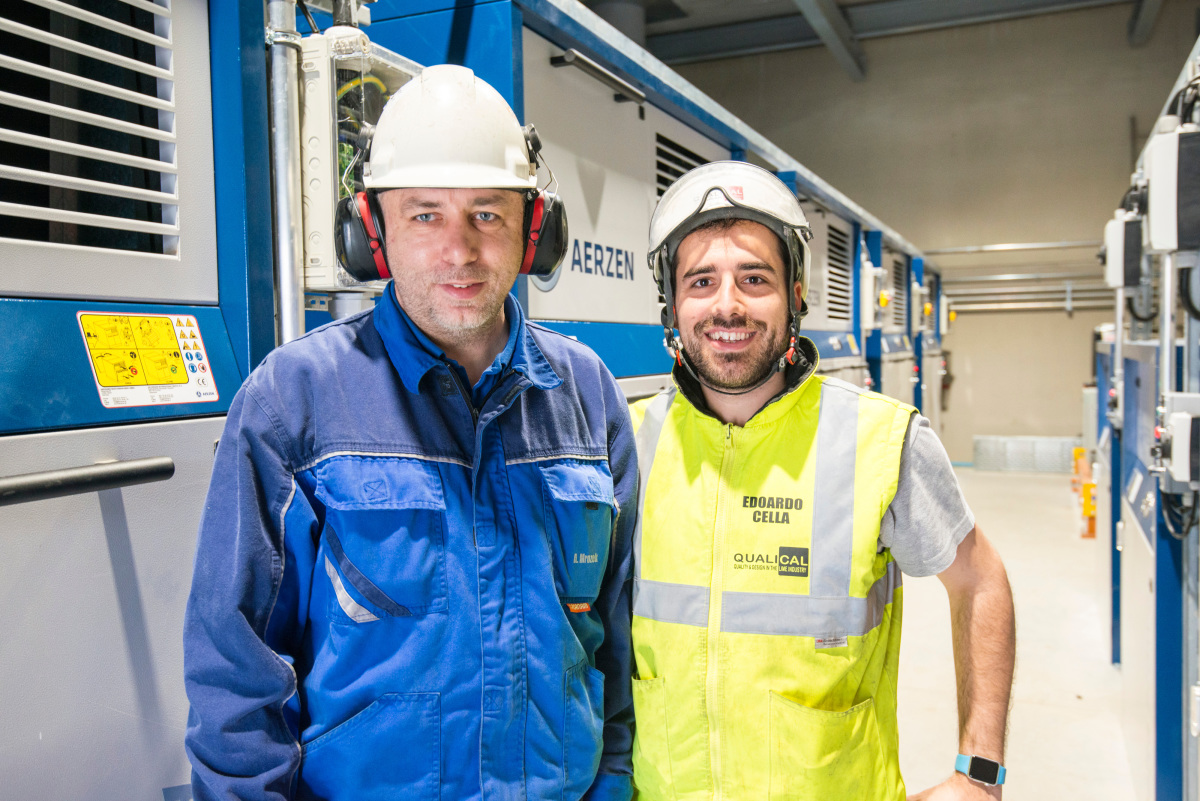


Köhler Kalk in Northern Hesse commissioned a new kiln. Thanks to the rotary lobe compressors made by Aerzen, the plant manufactured by QualiCal counts among the most efficient solutions in its field.
1 Using the best available technology for burning lime
In 2017, with a view to securing the future of the company’s location in the Werra-Meissner district, the family-owned business decided to invest in a new kiln.
The QualiCal specialists from Italy received the order. Designed as a parallel flow regenerative (PFR) kiln, this type is among the most energy-efficient lime burners according to BAT (best available technology, component of the installation authorization law according to EU Directive 2010/75/EU concerning industrial emissions).
While in the past, the consumption of coke had been...
1 Using the best available technology for burning lime
In 2017, with a view to securing the future of the company’s location in the Werra-Meissner district, the family-owned business decided to invest in a new kiln.
The QualiCal specialists from Italy received the order. Designed as a parallel flow regenerative (PFR) kiln, this type is among the most energy-efficient lime burners according to BAT (best available technology, component of the installation authorization law according to EU Directive 2010/75/EU concerning industrial emissions).
While in the past, the consumption of coke had been the biggest single operating cost factor at Köhler Kalk, this has now shifted to their pulverized lignite and electrical energy costs. “Up to now, electricity was never an issue,” reflects Christian Köhler. “The old kiln was a largely mechanical affair.” Once the new plant has been run-in, the fuel will no longer be brought into the kiln together with the dolomite rock in layers and set on fire, but instead blown directly into the calcination zones with distributed burner lances. For that, blowers for transport and cooling air are just as necessary as they are for generating process air in PFR kilns.
2 Hybrid blower solution reduces energy
consumption
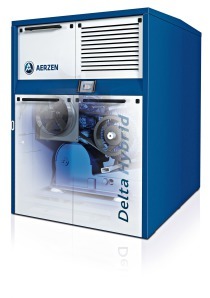
The targeted blow-in of lignite through a total of 24 burner lances - equally distributed between the two shafts - improves the thermal efficiency, as the carbon releases its energy directly onto the rocks. The calcination is accompanied by a sophisticated form of airflow - the parallel flow regeneration (PFR) feature. At Köhler Kalk, rotary lobe compressors of the Aerzen Delta Hybrid series assume this function. Hybrid blowers combine two procedures for conveying air in one machine: the Roots principle as isochoric compression for low pressures and the screw compressor principle with internal compression for higher pressures. As far as the concept is concerned, the Delta Hybrid is based on the well-known and successful Aerzen series Delta Blower and Delta Screw. Aerzen has calculated that the rotary lobe compressor requires 15% less current than existing blowers for absolutely oil-free air conveyance.
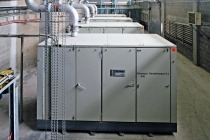
At Köhler Kalk, the economical use of electrical energy has a significant effect on the efficiency of overall production – with accordingly rapid ROIs. The importance of the blower technology in modern PFR kilns becomes clear when taking a look into the machine room of the new kiln. For the combustion air, three Delta Hybrids D 75 L (max. 132 kW, 4,000 m³/h, 1,000 mbar) are in operation. Another two assemblies with the same capacity convey cold outside air, blown from below into the calcined lime, to cool it down to a considerably lower temperature before discharging it. For cooling the burner lances in the two furnace towers and for pneumatic conveyance of the pulverized lignite, Köhler Kalk will in future rely on the Aerzen Delta Blower series. As the (in all) three type-GM 25 S assemblies (55 kW, max. 1450 m³/h) provide considerably less capacity than the five Delta Hybrid blowers, Köhler Kalk decided not to do an upgrade here. “Our goal was to achieve maximum efficiency gains while keeping any increase in the plant’s costs as low as possible,” says Köhler.
3 The future belongs to Hybrid blowers
“In kilns, positive displacement blowers are traditionally used without exception. They work very reliably, but they also consume quite a lot of energy,” explains Francesco Cella, CTO at QualiCal. With the change to rotary lobe compressors, the plant manufacturer succeeded in making the necessary air volumes available as energy efficiently as possible in synergy with pinpoint speed control of the blowers. Thanks to its special rotor profiles, the Delta Hybrid is able to save energy by means of internal compression alone. So significant savings with no loss in quality or any reduction in the reliability of the positive displacement blowers were achieved.
In a very close co-operation between QualiCal and Aerzen, the process data were analyzed and simulated and, finally, the results reflected in the blower technology at a very early stage. “This success is the result of a very reliable and extensive exchange of information. We are very good at burning lime, and Aerzen is very good at generating process air – so we complement each other very well,” adds Carlo Cella, CEO at QualiCal, who is clearly pleased with the collaboration.
4 Conclusion
The new assembly at Köhler Kalk clearly shows how economic benefits, sustainability and increasing product quality can be harmonized. Even though hybrid technology is initially more expensive than conventional blower technology in terms of hardware costs, the substantially lower operating costs justify investing in Delta Hybrid rotary lobe compressors. From the point of view of the operator, Christian Köhler is convinced that the future belongs to hybrid blowers in kiln construction for lime treatment. “Our kiln is the first in Germany to calcine dolomite according to the PFR procedure. So, as pioneers, we are eager to see how high the efficiency gain will be after the running-in period,” he says.
//www.aerzen.com" target="_blank" >www.aerzen.com:www.aerzen.com | //www.qualical.com" target="_blank" >www.qualical.com:www.qualical.com

Überschrift Bezahlschranke (EN)
tab ZKG KOMBI EN
This is a trial offer for programming testing only. It does not entitle you to a valid subscription and is intended purely for testing purposes. Please do not follow this process.
This is a trial offer for programming testing only. It does not entitle you to a valid subscription and is intended purely for testing purposes. Please do not follow this process.
tab ZKG KOMBI Study test
This is a trial offer for programming testing only. It does not entitle you to a valid subscription and is intended purely for testing purposes. Please do not follow this process.
This is a trial offer for programming testing only. It does not entitle you to a valid subscription and is intended purely for testing purposes. Please do not follow this process.