Extended ultrasonic investigation of gypsum setting
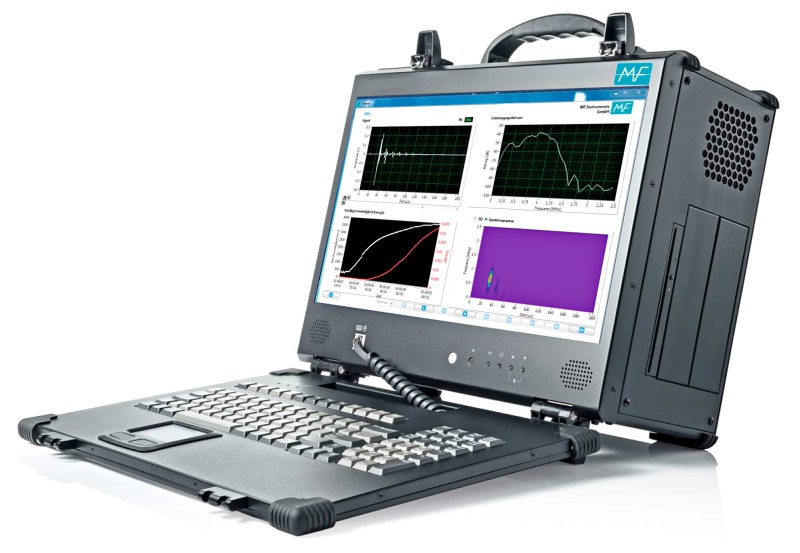
Gypsum was studied from the time of mixing for more than forty-five days using the MFC ultrasonic analyser measuring system for characterisation of inorganic binder systems. The complete curing process was subdivided into eight time sectors.
1 Introduction
A measuring system for the characterisation of inorganic binder systems that uses the transmission method to measure the acoustic velocity of longitudinal waves in a specimen and the transmitted/received energy is described in [1]. The measuring cell consists of two brackets bearing the transmitter and receiver, and a specimen holder. In addition to the transmitter/receiver and the specimen, the acoustic path includes the contact chambers, which are filled with the couplant, and are separated from the specimen by a dividing film or layer. The transmitter is connected to the...
1 Introduction
A measuring system for the characterisation of inorganic binder systems that uses the transmission method to measure the acoustic velocity of longitudinal waves in a specimen and the transmitted/received energy is described in [1]. The measuring cell consists of two brackets bearing the transmitter and receiver, and a specimen holder. In addition to the transmitter/receiver and the specimen, the acoustic path includes the contact chambers, which are filled with the couplant, and are separated from the specimen by a dividing film or layer. The transmitter is connected to the pulser and the receiver to the signal analyser.
How information on structural changes during hydration can be obtained via the energy distribution by frequencies (ultrasonic spectra) – dissipation and scattering coefficients was shown in [1].
Not only the spectra, however, but also the integral energy/energy curve or trend is of informational value. The energy curve correlates in general to the inception of strength gain with the rheometric results, Vicat tests and isothermal calorimetry [2]. Analysis of the energy curve, including acoustic velocity, demonstrated that volume shrinkage occurs in the early stages of gypsum dehydration [1]. This was also confirmed in [3] using conventional means. The tests performed in [1] lasted up to 60 hours, with energy rising ever further. The question thus arose of how energy and acoustic velocity behave over a longer period.
This work discusses the results of an ultrasonic investigation of gypsum curing which started at zero and extended over more than 1000 hours.
2 Method
The specimen material was commercially available plaster of Paris for both building and hobby modelling purposes, marketed by Pufas Werk KG (Article Number: 000-0033-2013), a product which meets all the requirements stated in [4], and distilled water for mixing.
The specimens were prepared as follows: Two parts of gypsum by volume were strewn in accordance with [5] into one part by volume of water for 30 s (w/g = 0.583). Manual mixing then took place for 60 s (30 figure-of-eight motions), followed by low speed mechanical mixing for 60 s. The ultrasonic measuring cells were then filled and the specimen holders’ apertures – the open specimen surfaces – were sealed closed using adhesive tape. After a defined time, the adhesive tape was removed and the specimen surface thus exposed. The laboratory environment conformed to the relevant standard [6].
3 Results
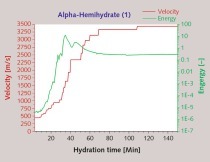
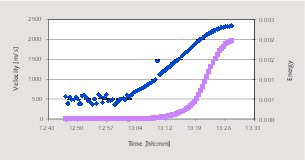
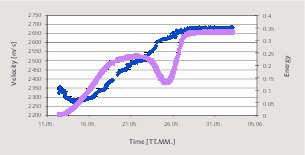
Figure 1 illustrates by way of example the inception of strength gain. Energy is shown as a dimensionless quantity. The energy emitted by the transmitter applies as the reference value for it; the Y values represent the portion transmitted by the gypsum. Here, and in all other figures with the exception of Figure 5 the absolute time is plotted on the X axis, with the point ‘17.04.2015 12:47:29’ representing zero time. The figures show the raw (unprocessed) data.
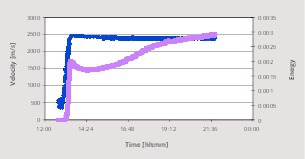
After the initial rise/maximum, energy drops a little and reaches its first minimum (Figure 2). This minimum is followed by the formation of a relatively short plateau, which is itself followed by a slow rise. This continues until the adhesive tape is pulled off and the specimen surface exposed, which occurred in the test described here after approx. 600 h (Figure 3). This time corresponds approximately to the maximum standardised age of test objects in strength testing of cements.
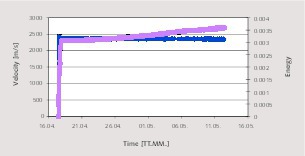
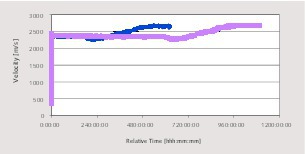
Intensive drying of the specimen commences, inter alia, from this time onward, and energy reaches its second maximum. The second minimum and a further rise then occur in succession, and energy and velocity appear to reach their constants (Figure 4). This part of the plot is shown separately to improve clarity. The continuing duration of the test then equates to the x value read off from Figure 4 plus 597 hours 25 minutes.
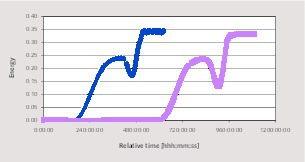
As can be seen from Figure 5, all specimens in all measuring cells exhibit, within the scope of mensurational tolerance, the same behaviour, irrespective of when the specimen surface was exposed. The test described is shown in red. A further test, in which the adhesive tape was removed after 166 hours (the highest age for test objects in strength testing of gypsum) is shown in black. The shape of the curve does not change, only a simple parallel shift along the X axis occurs.
4 Conclusion
The ultrasonic energy absorbed/transmitted during gypsum curing changes by five orders of magnitude and proves to be of great informational value. It is possible to differentiate five rising and two falling sectors, each with two minima and maxima, in the plot against time until energy reaches its constant. The next step in this work would be to determine the significance of the results obtained from a building-chemistry viewpoint. It scarcely needs to be mentioned that gypsum grades other than those used in this work need not necessarily exhibit the same behaviour.
//www.mf-instruments.de" target="_blank" >www.mf-instruments.de:www.mf-instruments.de

Überschrift Bezahlschranke (EN)
tab ZKG KOMBI EN
This is a trial offer for programming testing only. It does not entitle you to a valid subscription and is intended purely for testing purposes. Please do not follow this process.
This is a trial offer for programming testing only. It does not entitle you to a valid subscription and is intended purely for testing purposes. Please do not follow this process.
tab ZKG KOMBI Study test
This is a trial offer for programming testing only. It does not entitle you to a valid subscription and is intended purely for testing purposes. Please do not follow this process.
This is a trial offer for programming testing only. It does not entitle you to a valid subscription and is intended purely for testing purposes. Please do not follow this process.