The influence of binder modification by means of the superplasticizer and mechanical activation on the mechanical properties of the high-density concrete
The influence of mechanical and chemical activation on the mechanical properties of high-density concrete and cement mortar has been studied. Portland cement optimum content necessary for apparent increase in the mechanical properties of cement composites has been determined. The size-content study of the mechanically and chemically activated cement has been undertaken. The heat emission development of the mortar based on activated binder has been studied by means of calorimetric measurements. It has been demonstrated that increase in concrete hardening after the activation originates from formation of the cement fine-crystalline structure. According to the elemental analysis data, hydrated calcium silicates (CSH) are developed in spherical globules.
1 Introduction
The mechanical properties of cement composites are dependent on the application efficiency of the binder`s properties [1-3]. A higher level of the efficiency can be achieved by various means of binder activation [4]. The hydration process quickens and the activity of the binder increases due to fine powdering of cement. Qian J. et al. [5] note that strength properties of fine-ground cements with milling fineness more than 5000 cm²/g do not differ at any age of the hardening period to some significant extent (the 2nd day hardening compressive strength increases by 5 – 10 %, but...
1 Introduction
The mechanical properties of cement composites are dependent on the application efficiency of the binder`s properties [1-3]. A higher level of the efficiency can be achieved by various means of binder activation [4]. The hydration process quickens and the activity of the binder increases due to fine powdering of cement. Qian J. et al. [5] note that strength properties of fine-ground cements with milling fineness more than 5000 cm²/g do not differ at any age of the hardening period to some significant extent (the 2nd day hardening compressive strength increases by 5 – 10 %, but the 28th day compressive strength is similar despite the increase in milling fineness). In view of economic and technological feasibility the optimum milling fineness is believed to be of 4000 – 5000 cm²/g.
Nowadays a variety of technologies of cement binding materials dispersion and activation in a liquid medium are being developed. With the appearance of rotary-pulsing apparatus (RPA) we have gained the ability to activate the cement-water suspension directly in RPA [4]. But the technology providing cement-water suspension activation has not become a frequent practice due to under-investigated issues of mechanical activation influence on rheology and structure formation of cement-based systems.
Sajedi [6] notices that mechanical activation of the cement suspension at initial stage of hydration and structure formation leads to an increase in volume of the chemically active coagulation medium and its consolidation which results in 30 % strength increase. In [7], it has been noted that by mechanical activation of the cement suspension by means of RPA, the strength of cement rock at 1 day increases by 70 %. It has also been noted that the activation should be conducted during concrete preparation, since the cement grains with sizes of 40 – 60 µm and bigger remain unhydrated. This worsens due to difficulties in even water distribution between separate particles of binding material. The aggregation of the separate particles in floccules caused by the adsorption and molecular cohesive force takes place and prevents homogenous wetting.
Currently there is a lack of data relating to the optimum content of activated cement and to the influence of mechanical and chemical activation MCA and mechanical activation (MA) parameters on the cement composites strength. Also there are ambiguous data about the influence of MCA of cement suspension on cement mortar heat emission development and the grain size composition of the activated cement. The impact of highly active superplasticizers on the properties mentioned above has not been studied sufficiently.
2 Experimental procedure and results
In relation to these facts, the author have undertaken a study to estimate the MCA basic parameters for cement suspension to obtain high-strength cement mortars and high quality concrete by means of RPA 0.8-55A-2.2УЗ manufactured according to ТУ 5132-001-70447062.
The experiment was conducted in the following manner: in preparation estimated amounts of cement and water were mixed and then loaded into an RPA hopper for activation.
The influence of the partial replacement of activated Portland cement on the mechanical properties of cement mortar with content 1:3 has been defined. Portland cement CEM III/A32.5 N satisfying the requirements of GOST 31108-2003 (EN 197-1), enriched sand with fineness modulus 2.7, naphthalene formaldehyde superplasticizer “Реламикс Т-2”, manufactured according to ТУ 5870-002-14153664-04 at a rate of 1 % were used for the experiment. Water-to-cement ratio for each composition is equal to 0.355. The composition with the additive being investigated without mechanical activation was taken as a control sample. The bending strength test has been undertaken according to GOST 30744-2001 “Methods of testing using polyfraction standard sand”. The experiment results are shown in Table 1.
As seen from Table 1 with increase in the activated cement content, strength properties rise at an early stage of hardening and at 28 days as well. The highest growth in bending strength is observed in composites where all cement was exposed to activation. The strength growth accounts for 98 % at 1 day, 24 % at 3 days and at 28 days it does not differ significantly from the control sample. The highest growth in compressive strength has been observed in compositions where 100 % of Portland cement was exposed to activation and it accounts for 82 % at the 1st day of hardening, 24 % at the 3rd day and it shows no significant difference at the 28th day in comparison with composition with non-activated cement. Despite this it has been accepted to activate 50 % of cement in further investigation due to the fact of the increased equipment wear rate and decreased cement activation efficiency. The efficiency of cement dispersion by means of rotary-pulsing apparatus rises significantly in the presence of surfactants: the concrete density grows and strength rises sharply, especially at the 1st day of moist curing.
In order to prove the achieved results, the influence of MCA of cement suspension in the presence of additive “Реламикс Т-2” on the mechanical properties of high-density concrete has been studied.
The experiment was conducted in the following manner: in preparation 50 % of the cement was mixed with water containing the superplasticizer “Реламикс Т-2” on amount of 1 % by cement weight and then the cement suspension was exposed to MA by means of RPA during two minutes. Then coarse and fine aggregates and the rest of the cement were added to the obtained suspension and mixed by means of a concrete-mixer during 5 minutes. The following concrete composition was taken for the study: cement 490 kg, sand 555 kg, aggregates 1315 kg. Water content was being corrected to achieve a similar consistency for the concrete mixtures (with slump of concrete cone 7 – 9 cm) in all compositions. Cubical shaped samples with a side length of 10 cm were exposed to tests according to GOST “Concretes. Methods for strength determination using reference specimens”. The flow-test spread has been estimated according to GOST 310.4-81 “Cements. Methods of bending and compression strength determination”. The experiment results are shown in Table 2.
As seen from the results in Table 2, the insertion “Реламикс Т-2” (composition 2) leads to increase in concrete strength by 85 % at the 1st day of hardening (from 8.1 MPa to 15 MPa), by 69 % at the 3rd day (from 23.2 MPa to 39.2 MPa), and by 40 % at the 28th day (from 42.8 MPa to 59.8 MPa) in comparison with the control sample. The strength increase accompanies concrete density growth (by 2 %) in each period of hardening.
The more considerable increase in compressive strength of concrete is reached by means of MCA of cement suspension in the presence of “Реламикс Т-2” (composition 3). In this case the increase in concrete strength accounts for 249 % at the 1st day of hardening (from 8.1 MPa to 28.4 MPa), 156 % at the 3rd day (from 23.2 MPa to 59.4 MPa), and 66 % at the 28th day (from 42.8 MPa to 71.2 MPa). The strength increase accompanies concrete density growth (by 3 %) in comparison with the control sample.
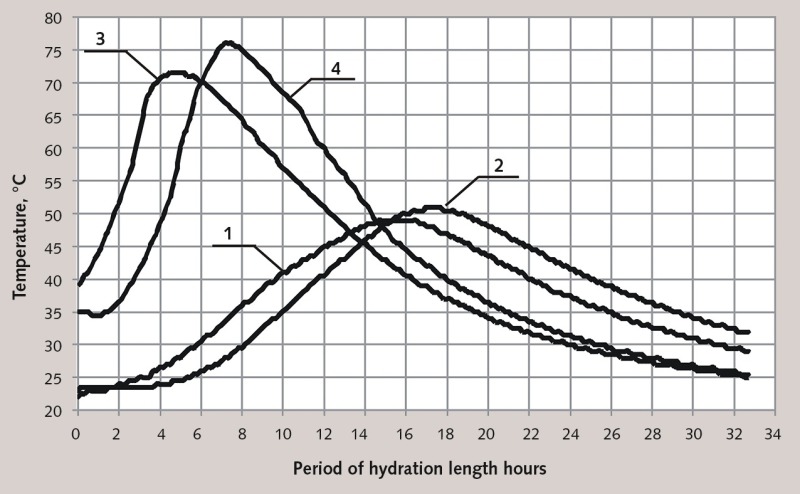
Thus, efficiency of cement dispersion by means of rotary-pulsing apparatus in the presence of superplasticizer increases considerably: the concrete density grows and strength rises sharply, especially at the 1st day of moist curing which is probably connected with the specific character of cement microstructure formation. The cement mortar heat emission development has been studied by means of calorimetric methods. Water-to-cement ratio of each composition accounts for 0.42. The experiment results are given in Figure1.
It is seen from Figure 1 that MA of cement suspension leads to an increase in hydration temperature by 20-25 C⁰ while a sharp left-side motion of the temperature peak occurs which indicates intensification of cement mortar hydration.
In the presence of “Реламикс Т-2” without mechanical activation some hydration retardation occurs at early periods of hardening, but in the composition exposed to MA sharp growth in hydration and increase of temperature peak by 25 C⁰ also takes place.
The particle size distribution in cement was estimated on samples obtained after hydration without MCA of cement mortar and after MCA. The estimation was undertaken by means of particle size laser analyzer “Horriba La-950V2”.
Removal of water from cement minerals and cement, which is active in a liquid medium, and was done by means of a Buchner filter jointed with a water jet pump. Immediately after separation of liquid phase, samples on the filter were filled with pure alcohol and then were preserved in acetone given that the amount of acetone was at least in 5 times bigger in comparison to the weight of the cement sample. After that material was dried in a cabinet dryer at a temperature of 105 C⁰. The cement specific surface area was estimated on preparatory dehydrated and dried cement samples according to the method described above by means of the Cozini-Karman method (ПСХ-9 device). The experimental results are given in Table 3.
Particle size distribution in samples: 1- pure Portland cement; 2- composition with no additive exposed to MCA; 3- composition with no additive, 4- composition with “Реламикс Т-2” exposed to MA; 5- composition with “Реламикс Т-2”.
As seen from the data provided above the specific surface area of cement exposed to MA increases by 10 % in comparison to the control sample. With insertion of “Реламикс Т-2” in the cement suspension exposed to MA the cement specific surface area grows by 29 % in comparison to the composition modified with “Реламикс Т-2” without MA.
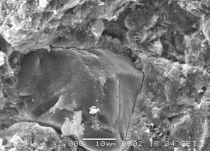
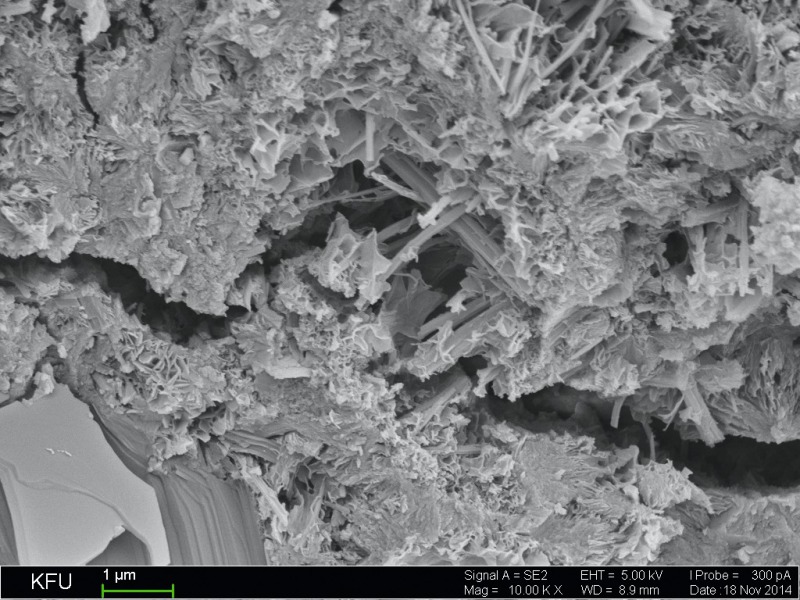
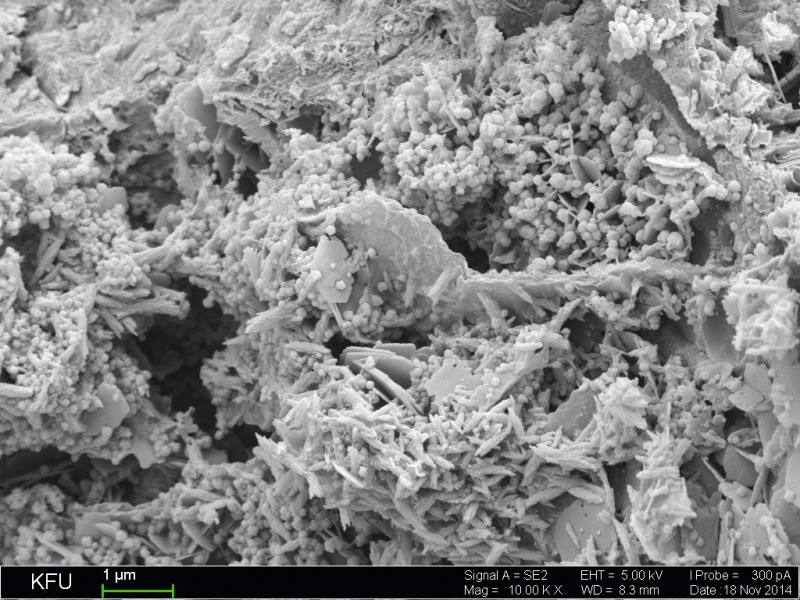
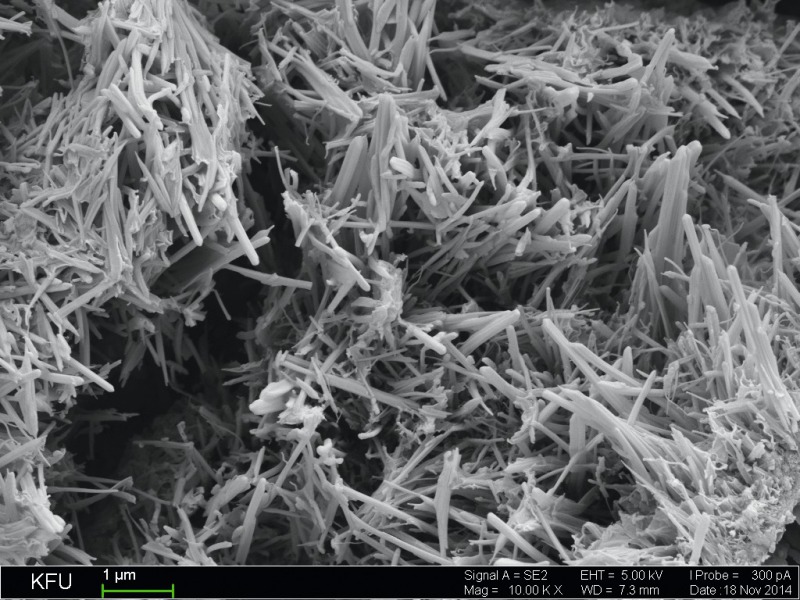
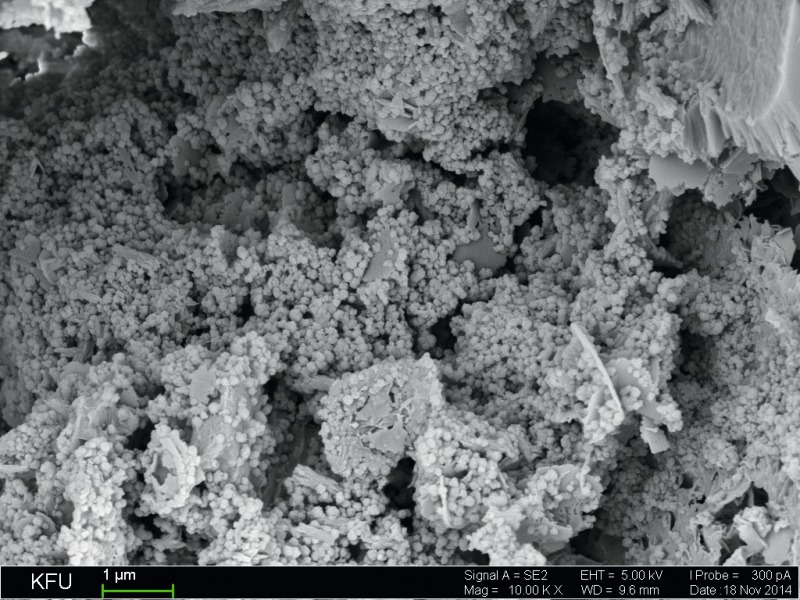
The structure of cement rock has been studied by means of an electron microscope equipped with an energy dispersic spectrometer AZtec X-MAX. Spectrometer resolution is equal to 127 eV. Surface morphology photography was taken at accelerating voltage of 5 keV. Elemental analysis was done at accelerating voltage of 20 keV with focal length of 9 mm, penetration depth less than 1 mm. The cement rock split sample was taken and covered by means of high-vacuum unit Quorum T150 ES with Au/Pd alloy coating provided on the sample in ratio 80/20. The electron microscopy photography is given in Figure2.
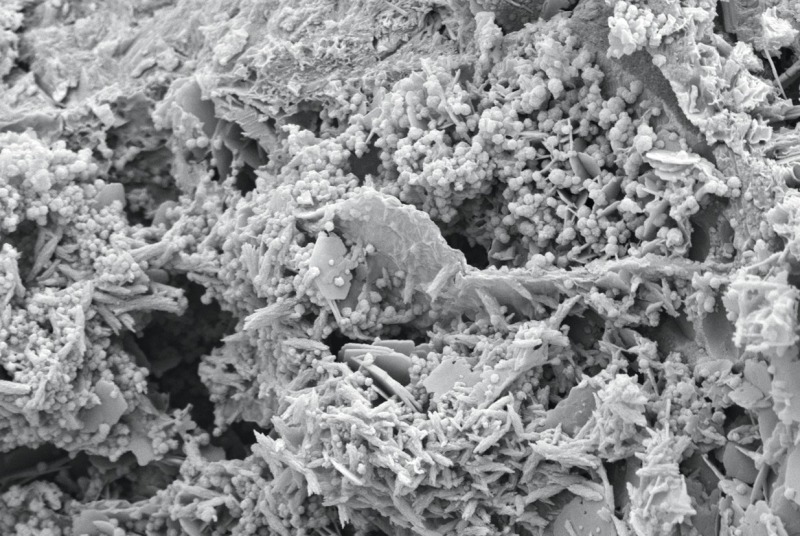
As seen from Figure 2 the control sample is represented with a microfissured coarse crystalline structure. With MA of cement suspension, formation of microcrystalline structure is observed. According to elemental analysis data, hydrated calcium silicates (CSH) are formed in spherical globules. Insertion of platicizing additive leads to formation of hydrated calcium aluminate sulfate in cement rock pores which accelerates concrete strength development at an early stage of hardening (composition C). MCA of modified cement suspension (composition with “Реламикс Т-2” exposed to MCA) leads to the formation of a highly microcrystalline structure of cement rock and spherical globules of hydrated calcium silicates in bigger amount and smaller in size in comparison to the composition B which causes higher mechanical properties of cement composites.
3 Conclusions
Positive influence of MCA of cement suspension in the presence of superplasticizer on the mechanical properties of the high-density concrete has been proven. The increase in concrete strength accounts for 249 % at the 1st day of hardening and 66 % at the 28th day in comparison with the control sample
Under condition of MCA of cement suspension with insertion of superplasticizer and without it, sharp acceleration of heat emission development occurs and growth of temperature by 20-25 C0 takes places in comparison to the control sample
Particle size distribution of cement samples hardened in standard conditions and after MCA exposure has been estimated. The specific surface area of cement suspension exposed to MCA increases by 10-29 % in comparison to the control sample
MCA of modified cement suspension leads to formation of highly microcrystalline structure of cement rock and spherical globules of hydrated calcium silicates in bigger amount and smaller in size in comparison to the control sample exposed to MCA with no “Реламикс Т-2”. This causes higher mechanical properties of cement composites
MCA of cement suspension leads to sharp growth of strength of cement mortars and concretes, especially at an early stage of hardening which is relevant to cast-in-place construction and also enables the achievement of higher final strength of concrete. Formation of microcrystalline structure of cement rock makes conditions for increase in the durability of obtained composites

Überschrift Bezahlschranke (EN)
tab ZKG KOMBI EN
This is a trial offer for programming testing only. It does not entitle you to a valid subscription and is intended purely for testing purposes. Please do not follow this process.
This is a trial offer for programming testing only. It does not entitle you to a valid subscription and is intended purely for testing purposes. Please do not follow this process.
tab ZKG KOMBI Study test
This is a trial offer for programming testing only. It does not entitle you to a valid subscription and is intended purely for testing purposes. Please do not follow this process.
This is a trial offer for programming testing only. It does not entitle you to a valid subscription and is intended purely for testing purposes. Please do not follow this process.