NOx separation

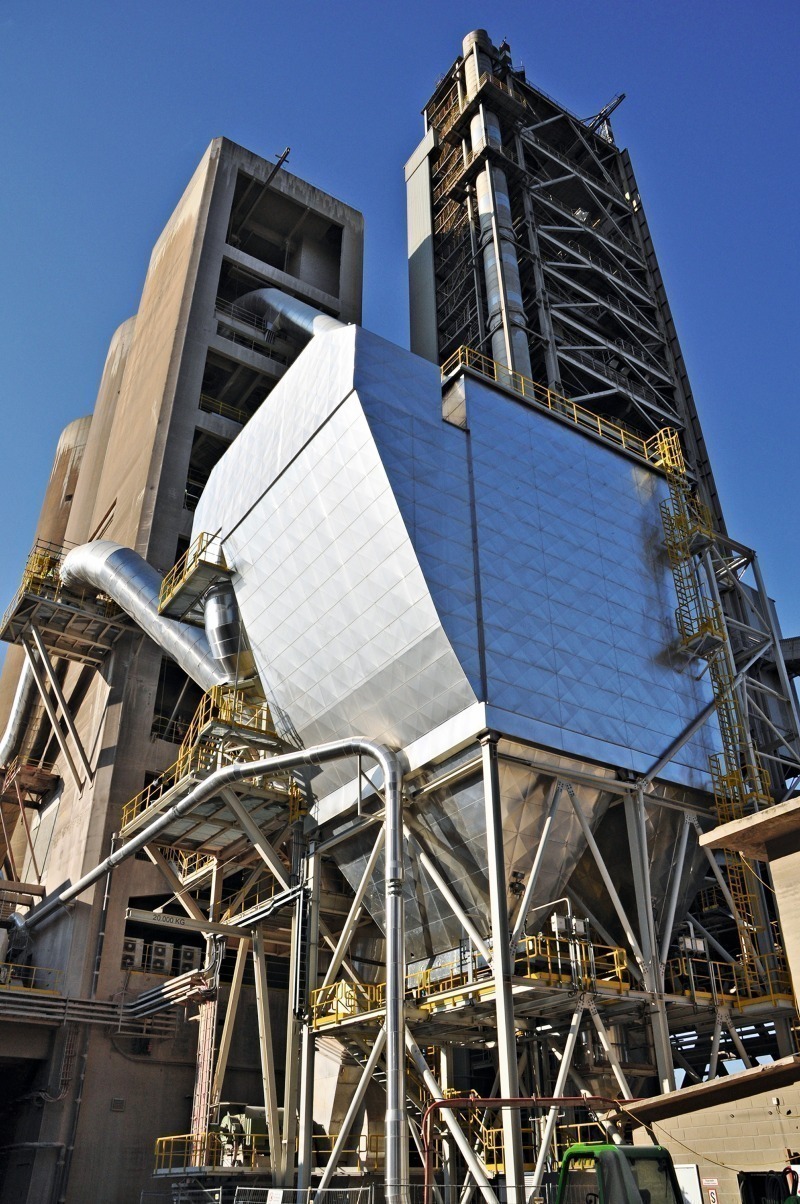
The new SCR process – “semi-dust raw gas circuit” – for NOx separation was successfully implemented by Scheuch for Lafarge Perlmooser GmbH in Mannersdorf/Austria.

For the past 40 years the company Scheuch GmbH of Aurolzmünster/Austria has been successfully com­mitted to the development and production of dedusting plants and devices for the cement industry. The range of applications extends from the basic pulse filter programme, with its many different varieties ranging from classic dedusting to process gas and hot gas filtration. With EMC filter technology in particular, the past decade has been highlighted by new standards for oven, clinker cooler, mill and chlorine bypass dedusting with respect to bag length, pressure loss, cleaning pressure and bag...
For the past 40 years the company Scheuch GmbH of Aurolzmünster/Austria has been successfully com­mitted to the development and production of dedusting plants and devices for the cement industry. The range of applications extends from the basic pulse filter programme, with its many different varieties ranging from classic dedusting to process gas and hot gas filtration. With EMC filter technology in particular, the past decade has been highlighted by new standards for oven, clinker cooler, mill and chlorine bypass dedusting with respect to bag length, pressure loss, cleaning pressure and bag service life.

With extensive experience spanning several decades and this comprehensive knowledge of dust separation in the cement process, Scheuch addressed the separation of harmful substances at an early stage. Different plant concepts are used for the specific respective requirements, from simple to high-end solutions, designed according the amount of emissions, which, in turn, varies with the kind of raw material or with the properties of the fuel being used.


Reduction of NOx emissions

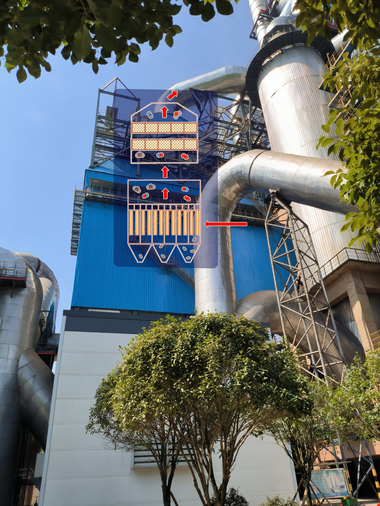
Today there are various process-adapted SCR technologies available for the reduction of NOx emissions. High-dust switching, semi-dust switching with a dry electrostatic precipitator as a pre-separator and optionally integrated gas conditioning tower in the catalytic system as well as low-dust switching. Scheuch had already begun with the development and optimisation of the technology and design of SCR systems years ago by testing under practical conditions in pilot systems. In the process, the goal was to be able to utilise appropriate lead times for new, stable technologies. However, an additional goal was to gather long-term experience in regard to the service life of catalytic elements, degree of separation, etc. for further optimisation possibilities (Fig. 1).


“Semi-dust switching” technology

The “semi-dust” version was derived on the basis of the experience and findings from the “high-dust switching” and “low-dust switching” versions, which were operated in parallel pilot systems. In this process variant the catalytic converter – installed immediately after the heat exchanger, like with the normal flue gas circuit – is preceded by a pre-separator in the form of a dry electrostatic precipitator for temperatures up to 400 °C. A gas conditioning tower integrated in the optionally catalytic system then ensures the maximum filter inlet temperature for the available EMC bag filter.

The world’s first semi-dust industrial plant

for NOX separation

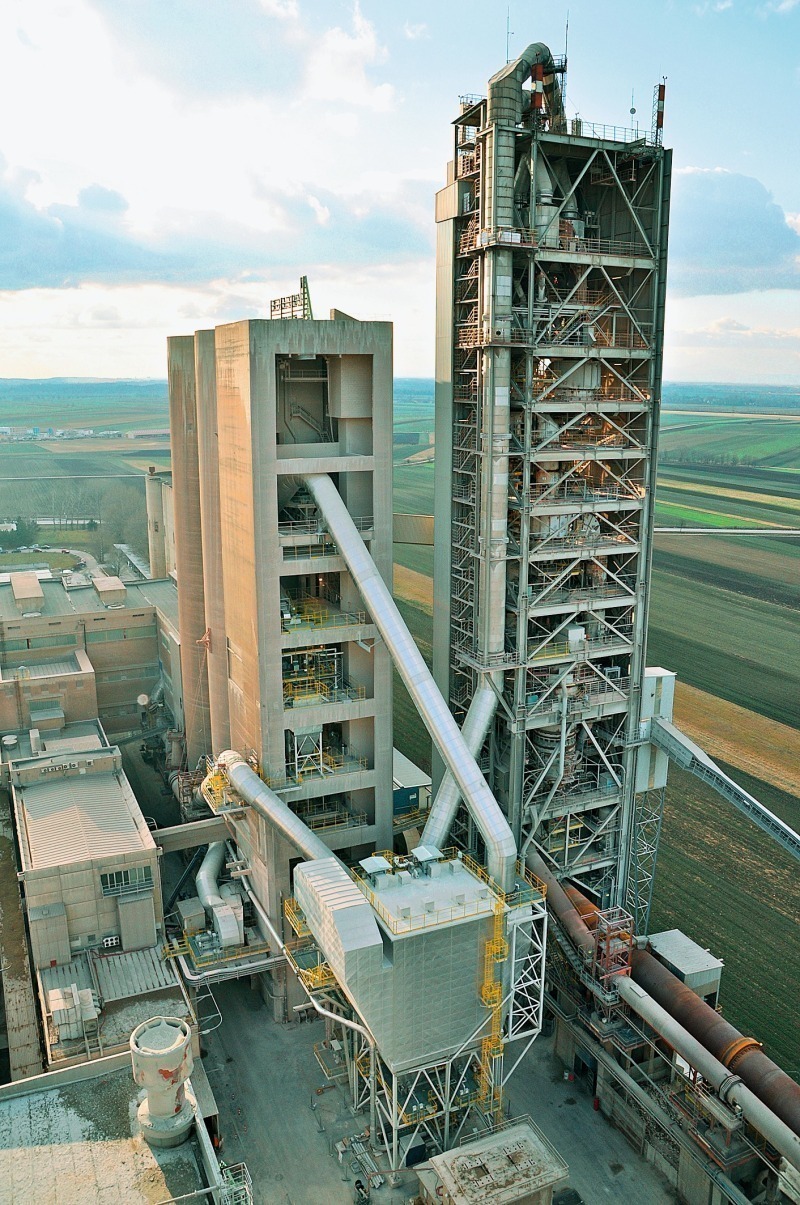
The new SCR process – “semi-dust raw gas circuit” – for NOx separation was implemented this year by Scheuch for Lafarge Perlmooser GmbH in Mannersdorf/Austria. It is the world’s first industrial application of its type for the cement industry. This plant is designed for an NOx limit value of 200 mg/Nm3.

With production in excess of one million tons, ­Lafarge Perlmooser GmbH is the largest cement plant in Austria. Thanks to the close collaboration between ­Lafarge and Scheuch, the on-schedule turnkey hand­over of the overall plant for NOx separation, including the necessary modification for the integration of the SCR semi-dust systems in an existing heat exchanger tower, was made possible.

The kiln line of the cement plant was constructed during the energy crisis of the 1970s and designed with energy-optimisation according to the state-of-the-art technology of the time. This means low kiln exhaust temperatures in the range of 290 °C to 340 °C. A unique feature of this oven is a dust content of 180 g/Nm³, which is why after careful analysis the decision was ultimately made to install the world’s first industrial SCR semi-dust system for NOx separation.

Plant concept

The kiln exhaust gas is first dedusted in a high-­temperature dry electrostatic precipitator and then passes through the two-layer catalytic converter. With the integration of a gas conditioning tower below the catalytic converter for the exhaust gas cooling, the filter inlet temperature required in direct operation is ensured. The dust separated in the dry electrostatic precipitator is conveyed back to the exhaust gas flow by means of a pneumatic dust conveyor pump.

During the commissioning – performed on-schedule in March after a construction phase of several months – a great emphasis was placed on plant safety and fault-free kiln operation. The plant then went into continuous operation.

The catalytic converter was observed in regular intervals in order to check the effectiveness of the cleaning system and to ensure the functionality of the start-up and shut-down procedure.

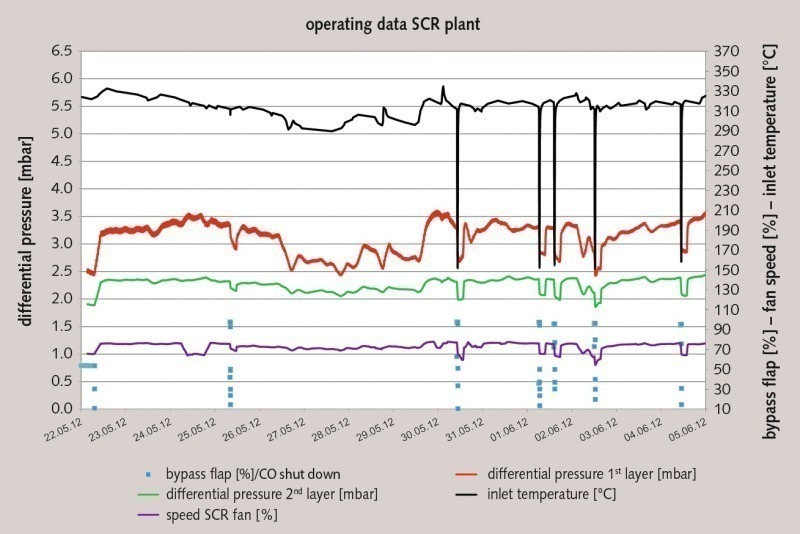
After the positive results in this phase, the planned performance test could be performed over a period of two weeks. In the process, the adherence to the contractually specified parameters was to be checked. The specified value of 200 mg/Nm³ for the NOx separation was permanently met, and from an operational costs perspective, the values with respect to energy and harmful substance consumption were even undercut (Fig. 2).

Plant and process-specific parameters bring about difficult dust properties (e.g. very high dust resistance) and diminish the performance of the pre-separation through the electrostatic precipitator. As a consequence, the dust load for the catalytic elements increases and the effectiveness of the cleaning is reduced. The availability of the plant is currently still not at a satisfactory level, therefore additional steps are required for optimisation and the initial approaches to a solution are being worked out.

Due to the good degree of separation of the SCR plant (fine denitrification) – the requisite clean gas value is achieved with this plant alone – the existing SNCR plant for the preliminary denitrification is no longer necessary. The result is additional, considerable ­savings in operational costs.

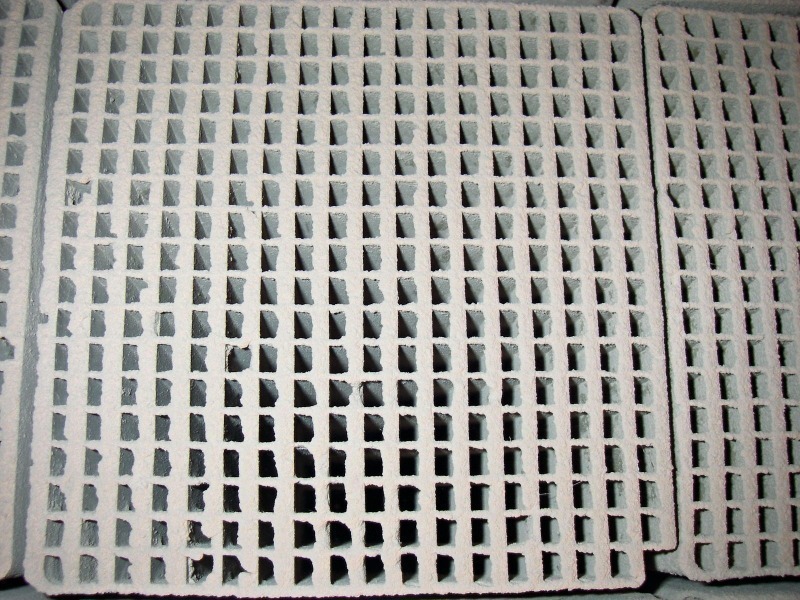
Initial catalytic converter analyses indicate a relatively low activity loss, however more specific statements can only be made after extended periods of operation. A positive side-effect of this semi-dust circuit: Any existing organic compounds are simultaneously broken down (Fig. 3).


NEW: Combined denitrification and VOC separation

The DeCONOx process from Scheuch

Scheuch has worked very intensively with the subject of denitrification and subjected the advantages and disadvantages of so-called low-dust and high-dust systems to critical testing. In the process, a special emphasis was placed on the simultaneous reduction of nitrogen oxides and organic carbon compounds.
With the new ­DeCONOx process from Scheuch, a system that meets these requirements with regard to high operational safety and minimised energy expenditure has now been provided.


Simultaneously reducing nitrogen oxides and

carbon compounds

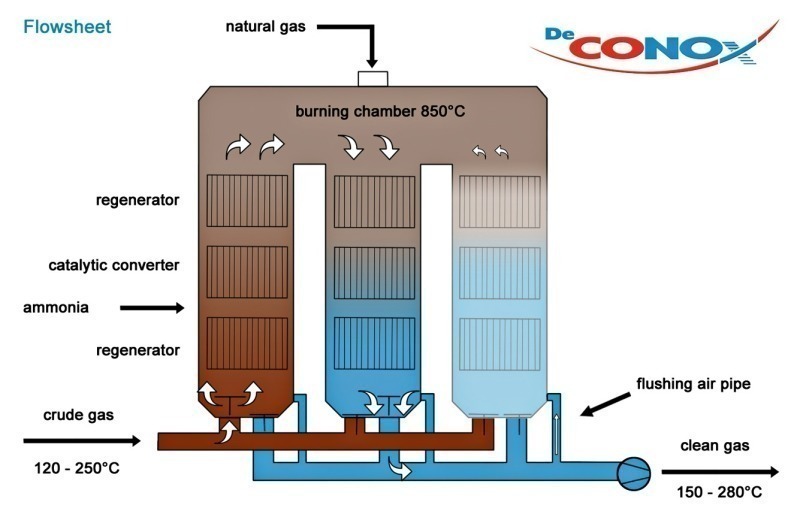
The DeCONOx process is the combination of a regenerative thermal oxidation (RTO) with a low-dust SCR (selective catalytic reduction). It combines these two tested technologies in one system. Nitrogen oxides and carbon compounds can be simultaneously reduced with the DeCONOx process. The breakdown of NOx takes place through catalytic reduction using ammonia and the breakdown of carbon compounds takes place through combustion (thermal oxidation in the combustion chamber). The heat arising in the afterburning process covers at least part of the thermal energy requirement for the denitrification, which is necessary for the reheating of the flue gas to the required operating temperature of the catalytic converter. As a result, the energy expenditure of the DeCONOx pro­cess is reduced considerably in comparison to a low-dust SCR.


Functional principle

The two-tower version is the simplest form of this system. The flue gas flows alternately in each of the ­towers. The switching takes place in one-minute cycles, whereby the gas absorbs the heat in the upward flow and releases the heat again in the downward flow. In the bottom regenerator, the flue gas is brought to the necessary catalytic converter inlet temperature of at least 240 °C (depending on the SO2 content). After the ammonia injection, the gas flows through the catalytic converter. The upper regenerator brings the gas up to the burner temperature. In order to guarantee a complete oxidation, the combustion chamber is regulated to a temperature of 850 °C.


Laboratory plant at the technical centre

Thus far the DeCONOx process is subject to a total developmental time expenditure of three years. In single-year testing on a laboratory plant in Scheuch’s technical centre, the basic principle of denitirifcation with ammonia injection and the regenerative afterburning was explored and optimised and the functional capacity was verified.

Test plant: Two-tower version

At the end of 2010 a two-tower version was set up for testing under real conditions with Kirchdorfer Zementwerk in Kirchdorf/Austria, in close cooperation with Prok. Dipl.-Ing. Anton Secklehner (Technical Director), and was continuously optimised and improved over a two-year test operation.

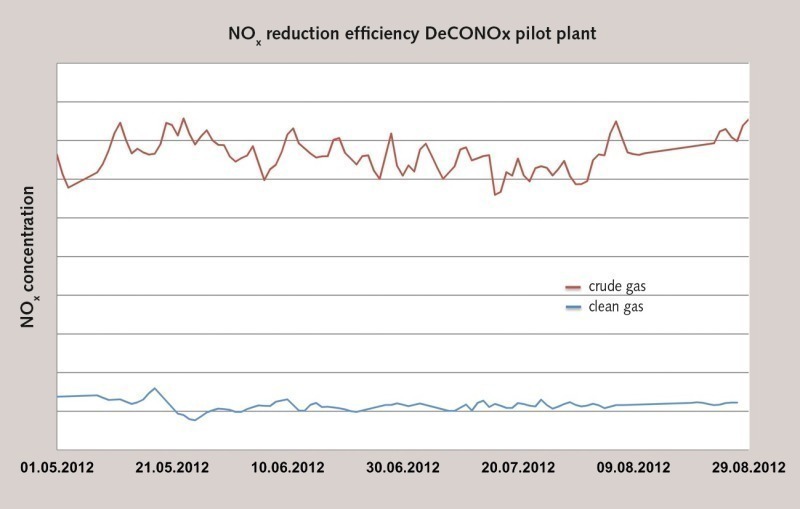
A crucial finding was made with respect to the catalytic converters used by Scheuch. They can boast the claim of withstanding constant temperature changes without any noticeable mechanical stability loss. The separation of VOC corresponds to that of a regenerative, thermal afterburning, and the NOx separation performance is identical to that of a low-dust SCR. This was verified in tests conducted over a two-year period (Fig. 4).


Outlook: Multiple-tower version

For use in large industrial plants, DeCONOx versions with three, five or seven towers are planned in the future – depending on the volumetric flow. This is especially due to the fact that short-term peaks of harmful substances arise during the switching in a two-tower version and thus the optimal performance cannot be fully achieved.

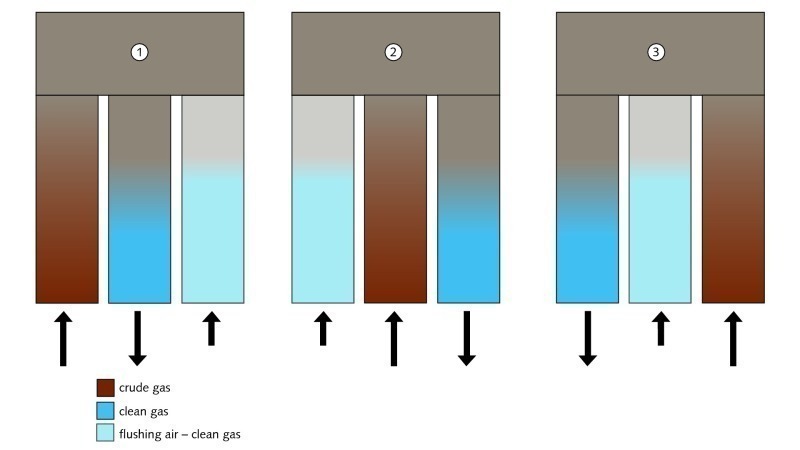
For the elimination of the peaks of harmful substances, the additional third tower of a three-tower version for example is flushed with clean gas. The exhaust gas present and not cleaned in the flushing tower is forced into the combustion chamber through the flushing process and the remaining organic compounds are oxidised there. This flushing tower assumes the function of a clean gas tower after the next switch-over, the crude gas tower becomes the flushing tower and the former clean gas tower assumes the function of a crude gas tower (Fig. 5 and 6).

This DeCONOx three-tower version will be available as a pilot plant from January 2013 on and will provide additional findings and operational experience for large industrial applications.

Überschrift Bezahlschranke (EN)

tab ZKG KOMBI EN

4,99 € / Woche* (Test EN)

This is a trial offer for programming testing only. It does not entitle you to a valid subscription and is intended purely for testing purposes. Please do not follow this process.

This is a trial offer for programming testing only. It does not entitle you to a valid subscription and is intended purely for testing purposes. Please do not follow this process.

Bestellbutton in Angebotsbox (EN)

tab ZKG KOMBI Study test

2,49 € / Woche* (Test EN)

This is a trial offer for programming testing only. It does not entitle you to a valid subscription and is intended purely for testing purposes. Please do not follow this process.

This is a trial offer for programming testing only. It does not entitle you to a valid subscription and is intended purely for testing purposes. Please do not follow this process.

Bestellbutton in Angebotsbox (EN)

Related articles:

Issue 6/2022 SCHEUCH GMBH

The cement industry puts its trust in Scheuch technologies for exhaust gas cleaning

At Scheuch, almost six decades’ worth of experience in the environmental technology sector goes into all its systems and projects. The company has become well known worldwide for its groundbreaking...

more
Issue 3/2023 TIANJIN CEMENT INDUSTRY DESIGN & RESEARCH INSTITUTE CO. LTD.  TIANJIN SINOMA ENGINEERING RESEARCH CENTER CO. LTD.

Application of a high-temperature & low-dust SCR in a cement plant

The ultra-low emission of nitrogen oxides is a major problem faced by Chinese cement plants in recent years. Almost all Chinese provinces require the emission concentration of nitrogen oxides to be...

more
Issue 12/2016 MAG. ERICH FROMMWALD, CEO, AND DIPL.-ING. ANTON SECKLEHNER, PLANT DIRECTOR, KIRCHDORFER ZEMENTWERK HOFMANN GMBH

First DeCONOx system up & running nicely at Kirchdorfer Zement

ZKG: The new DeCONOx system installed at Kirchdorfer Zementwerk counts as the world’s first industrial-scale plant of its kind, making you a pioneer in the use of this technology. What made you...

more
Issue 4/2020 MAERZ OFENBAU AG

A high-dust SCR plant at Conch Cement

In various Chinese provinces the limit values regarding nitrogen oxide and ammonia emissions are going to be reduced or have already been reduced in the recent past. The target value for the CemCat...

more
Issue 5/2022 TIANJIN CEMENT INDUSTRY DESIGN AND RESEARCH INSTITUTE CO. LTD.

Research progress of nitrogen oxides (NOx) control technology for industrial flue gas

1 Introduction With the development of the economy and the progress of technology, energy consumption is growing fast. Along with the increasing of energy consumption, atmospheric pollutants are...

more