Mathematical separator performance evaluation
Separators in the cement industry have the task of separating coarse from fine material, and it is worthwhile to fully understand the function of separators in raw and cement mills. Consequent troubleshooting, the elimination of technical barriers and optimum ­processing will result in an increase in the final product of the mill.

1 Introduction

The Teheran cement company was founded in 1954. At first, the plant production was started with a kiln capacity of 300 t/d clinker. Nowadays, the factory complex has eight cement production lines with a clinker output of around 12 100 t/d. Two smaller lines are already shut down, while a 9th line is under construction. The production at the complex consists of Portland cement types 1, 2, 3 and 5, oil well cement classes A, B, D, E and G, Portland pozzolan cement (types 1 and 2) and masonry cement (225).

For the stable operation of a cement mill it is essential to know its...

1 Introduction

The Teheran cement company was founded in 1954. At first, the plant production was started with a kiln capacity of 300 t/d clinker. Nowadays, the factory complex has eight cement production lines with a clinker output of around 12 100 t/d. Two smaller lines are already shut down, while a 9th line is under construction. The production at the complex consists of Portland cement types 1, 2, 3 and 5, oil well cement classes A, B, D, E and G, Portland pozzolan cement (types 1 and 2) and masonry cement (225).

For the stable operation of a cement mill it is essential to know its performance. For this purpose first a number of parameters is selected, then the information obtained is evaluated by calculating each parameter. These parameters include: circulating load, throughput of coarse and fine material per hour, separating efficiency, softness parameters and uniformity coefficients as well as the position of the cut point and the bypass point.

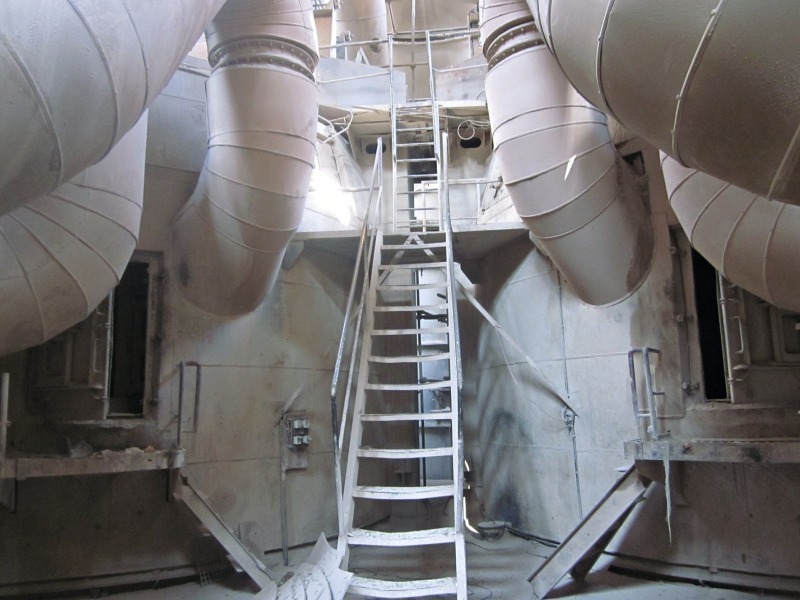
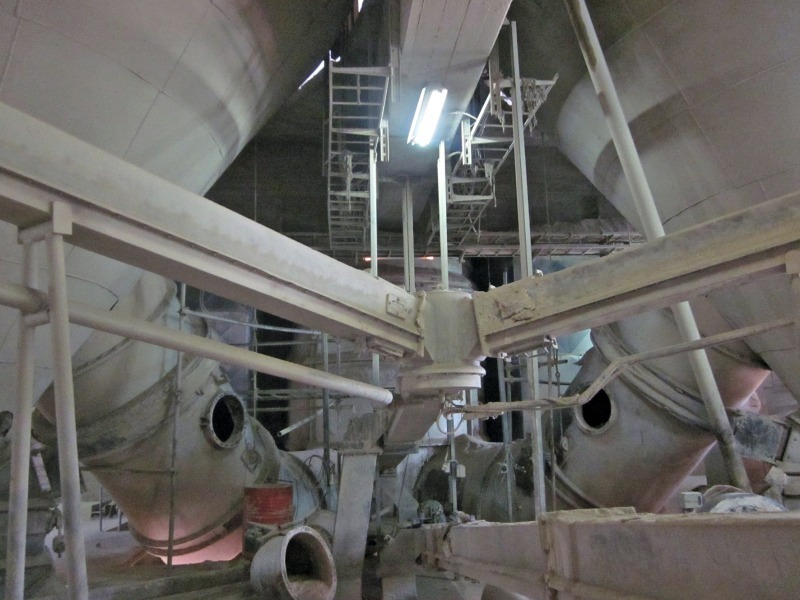
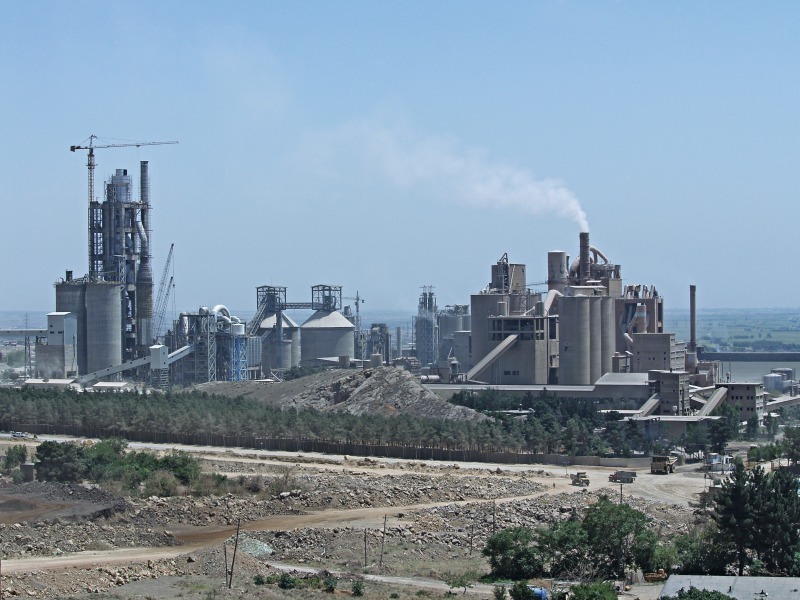
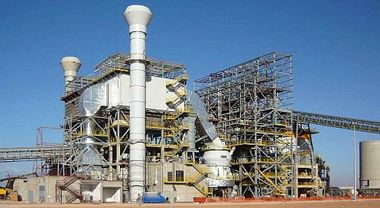
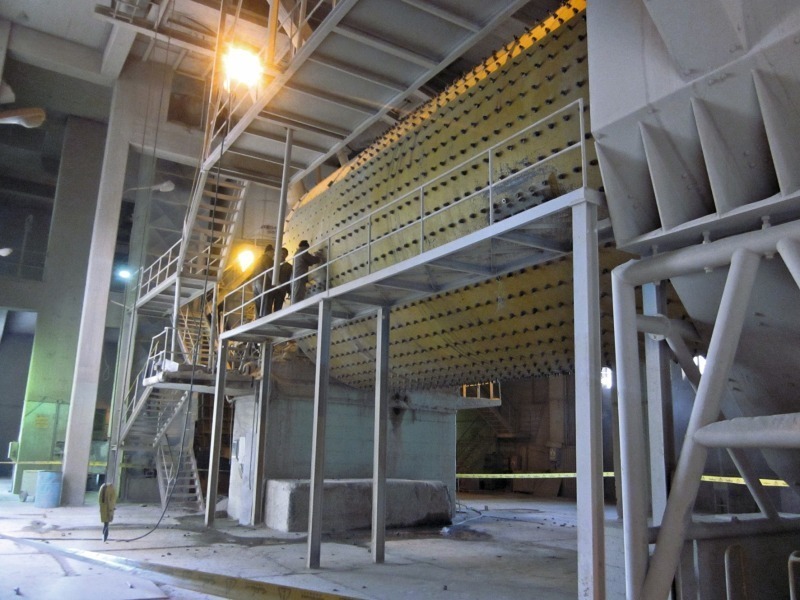
The plant raw material includes limestone, clay, bauxite, iron ore, pozzolan, gypsum and other addi-tives. Most of these materials are supplied from open pit mines, which lie close to the factory. Bauxite, iron ore and gypsum are purchased. Today, the sales of cement have risen to an overall amount of 13 000 t/d. The total number of staff including the head office is 1651 persons. Detailed views of some of the raw mill no. 6 are shown in Figures 1–3.

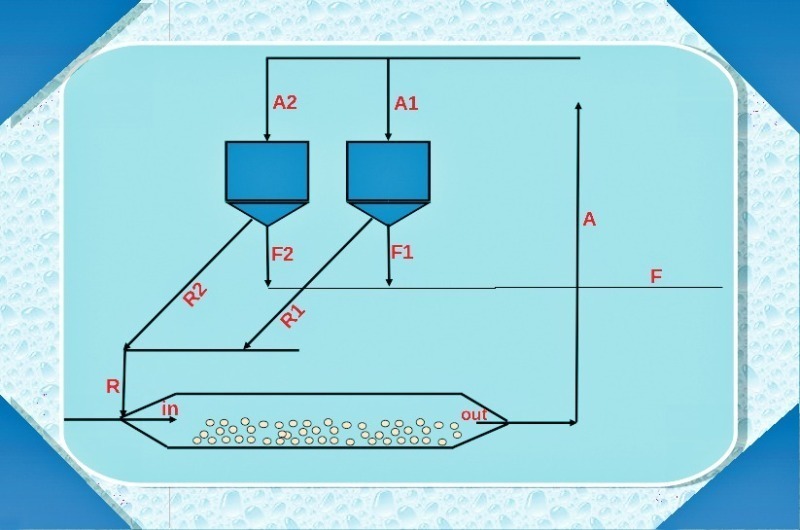
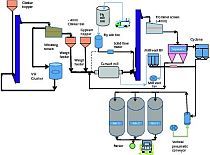
Line 6 of the Teheran cement factory presents the most important unit of the plant. At a nominal capacity of 4000 t/d clinker, it is equipped with a single chamber ball mill. The capacity of this mill is 385 t/h. The output of the mill crusher and the output of the ball mill enter two elevators, each forwarding the material to two separators. Figure 4 shows schematically the route of the input and output through the mill and the separators.

2 Separator settings

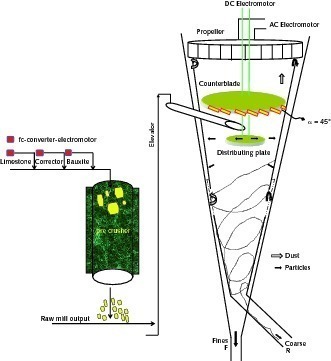
After weighing the output of the three ore silos, the next station is the pre-crusher. From there, the crushed ore and all other raw materials enter another elevator to reach the separator. The output of the separator is regulated by the suction mill fan and the speed of the distributing plate. The rock silos are automatically controlled by request from the ore tonnage. It should be noted that the separators of the raw mill of unit 6 are of an older generation with lower efficiency than modern ones. Tonnage output of the ternary silos is done by set points. For example a tonnage of 305 t is requested as follows:

Set point limestone = 270 t/h

Set point corrector = 25 t/h

Set point bauxite = 10 t/h

The tonnage varies according to the change in density or height of the bed rock. It can be fixed by adjusting the rpm of the conveyor. The speed of the conveyor is changed by setting the frequency of the motor, which is equipped with a control panel.

In connection with the separator, the following ­cases are considered:

The propeller is driven by an AC electric motor with invariable rotation.

The angle of the blades in the counter is invariable and equivalent to 45 degrees. The blades are em­bedded to break up large particles and deliver them to the inner wall of the separator.

The distributing plate is driven by a DC electric motor with variable speed.

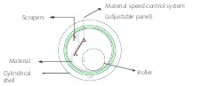
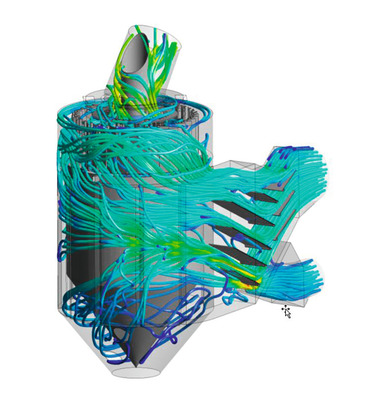
The suction fan separator is changed by a DC electromotor with variable rotation. So there are two regulators where the operator can adjust the fineness of the product (different parts of the separator are shown in Figure 5.).

3 Particle size distribution curve

Table 1 [1] shows the percentage of material passing through the various sieves (sieve analysis) for the different samples. Sample a will be taken from the inlet separator, samples r1 and r2 are taken from the coarse separators, and samples f1 and f2 are taken from the fine separators.

Based on Table 1, the percentage of the feed passing through the sieve of 9 μm is equivalent to 19.45 %. Obviously, the percentage of coarse material passing through this sieve is lower and the percentage of fine material passing through it is higher. As shown in Table 1, the passing percentage of fine samples from separator 1 on sieve No. 615 μm is 100 %. The sieve referred for the separator 2 is 515 μm.

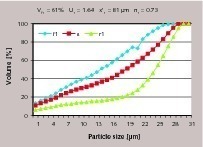
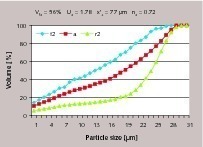
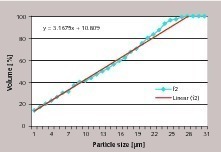
As shown, the passing percentage of coarse samples from the separators 1 and 2 on sieve No. 735 μm is 100 %, but passing percentage of feed sample on sieve within No. 515 and 735 μm is 100 % (sieve 615 μm). Figures 6 and 7 show the particle size distribution for samples of the separators 1 and 2.

4 Circulating load

The circulating load U is defined as follows [2]:
U1= A1   
       F1
U2= A2   
       F2
(A = tonnage at the entrance to the separator; F = tonnage fines or product)
The circulating load U can be calculated with the following formula [2]:
U1= ƒ1–r1
       a1–r1
U2= ƒ2–r2
       a2–r2
Columns 7 and 8 in Table1 are obtained with the above formula. Of course the feed input to the separator is the same, so we will have a1 = a2 = a. Now using the general formula, the tonnage of fines and the feed input to the separator can be calculated as follows:
US1= S ƒ1– Sr1 = 1756.47 – 909.22 = 1.64
         S a1– Sr1   1424.84 – 909.22
US2= S ƒ2– Sr2 = 1806.15 – 933.39 = 1.78
         S a2– Sr2   1424.84 – 933.39
In the above relations: US1, US2 = total circulating load in the separators1 and 2. According to the above formula  S = sum rows until 100 %.
US = (S ƒ1+ S ƒ2) – (S r1+ S r2) =
         (S a1+ Sa2) – (S r1+ Sr2)
(1756.47 + 1806.15) – (909.22 + 933.39) = 1.71
(1424.84 + 1424.84) – (909.22 + 933.39)
As the mill capacity at the time of sampling was 305 t/h, so will:
US = A/F = 1.71 A = 1.71 × 305 = 522 t/h
A = A1 + A2; A1 = A2 A1 = A2 = 261 t/h
U1 = A1/F1 = 1.64 F1 = 159 t/h
U2 = A2/F2 = 1.78 F2 = 146 t/h
A1 = R1 + F1 R1 = 261 – 159 = 102 t/h
A2 = R2 + F2 R2 = 261 – 146 = 115 t/h
According to the recent calculation, the energy balance of the mill is completed.

5 Separator efficiency [2]

The efficiency of the separators1 and 2 as well as the overall efficiency of the separators are achieved with the following relations:
h1= ƒ1 3 100
        a 3 u1
h2= ƒ2 3 100
        a 3 u2
h = h1 3 h2
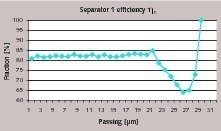
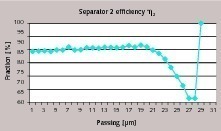
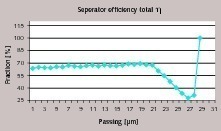
So, using the above relations, columns 9, 10 and 11 in Table 1 are completed. Moreover, according to the calculations of Figures 8, 9 and 10 are drawn.

Regarding figures 8, 9 and 10, the following results can be concluded:

Highest efficiency of the separator 1 for a diameter of 150 μm is achieved.

Highest efficiency of the separator 2 for diameters 75 and 105 μm is achieved.

Highest efficiency of both separators with diameters 75 and 105 μm is achieved.

6 Percent of the fine and coarse separator [2]

Percent of the fine separator is calculated by the following relation:
Vƒ = S a – Sr 3 100
         S ƒ – Sr
VR = 100 – VF
So, for separator 1 and 2 the performance will be calculated as follows:
VF1 = 1424.84 – 909.22 3 100 = 61 %
         1756.47 – 909.22
VR1 = 100 – 61 = 39 %
VF2 = 1424.84 – 933.39 3 100 = 56 %

   1806.15 – 933.39

VR2 = 100 – 56 = 44 %
Recent calculations show that the performance of separator 1 was better than separator 2. The fine and the coarse tonnage can be calculated as follows:
VF1 =  F1 3 100 = 159 3 100 = 61 % → VR1= 39 %
         A1                261
VF2 =  F2 3 100 = 146 3 100 = 56 % → VR2= 44 %
         A2                261

7 Tromp curve

Information obtained from the efficiency curve does not specify details sufficiently. Therefore, to clarify the details, the tromp curves for both the fine and the coarse separator are plotted. The curve for the fine particles shows that for the known particle size some of it is converted to a product. Also, the tromp curve for the coarse particles shows that some of this material goes back into the mill. To calculate tr and tf the following relations are used [2]:
tr = r 3 100  [1– 1 ]
           a              u
tƒ = 100 – tr
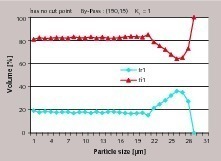
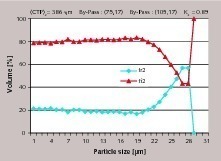
After using the above relations, columns 12 to 15 in ­Table 1 are completed. Then the tromp curves (Figures 11, 12) are drawn.

8 Cut point, bypass and separation of sharpness

The cut point defined as follows, the probability of a particle with a certain dimension or diameter being placed in the fine or coarse section is equal, so the particle with the greater dimension than dt is placed in the coarse section and the particle with lesser dimension than dt is placed in fine section [2]. Regarding Figure 11 it is clarified that the separator 1 has no cut point but the cutting point of the separator 2 is 386 μm. Also, in curve tr, minimum point is called the bypass and shown by (dt, tr) in other words in the bypass, the separator has the highest efficiency. Therefore, according to Figure 11, (150, 15) is the bypass point. As, according to Figure 12, (75, 17) and (105, 17) are the bypass points. In curve tr, the separation of sharpness is defined as follows [2]:
k = d75
       d25
d75 means what percentage of particles of 75 μm size have entered into the coarse section, and in this way d25 means what percentage of particles of 25 μm size have entered into the fine section.

For the effective and accurate separation and distribution d25 and d75 should have close values. Low value of k means that distribution is appropriate. The ideal value of k is 1 (k­ideal = 1), so the separation of sharpness for the separators1 and 2 is obtained as follows:

k1= 17 = 1
       17
k2= 17 = 0.89
       19
The result is that the particle size distribution at separator 1 was ideal and that separator 2 was effective and accurate.

9 Softness parameters and uniformity coefficient

The softness parameter (x) indicates that 63.2 % of sample passes through the sieve. The uniformity coefficient represents the slope of the curve. The optimal range of parameters expressed, is as follows [2]:
x = 40 µm
n > 65 %
For example, a sample with the softness parameter equal to 30 μm and the uniformity coefficient equal  to 59 %, is considered to be a good sample.

So, softness parameter and uniformity coefficient for the separators1 and 2 are as follows:

x1 = 81 µm
n1 = 73 %
x2 = 77 µm
n2 = 72 %
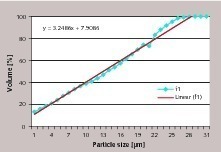
To calculate x1 and x2 of the interpolation, sieves 75 and 90 μm in Table1 are used. Also n1, n2 according to the curves f1, f2 and its trend line are obtained (Figures 13, 14).

10 Analysis

To evaluate the performance of the mill based on calculations, the particle size distribution results must be assured. To control the data listed in Table1, the following cases are considered:

The percentage of fine material passing through the sieves should be greater than the percentage of the separator feed. Also, the percentage of feed passing should be greater than the coarse material.

Numbers smaller than 1 for the circulating load are not acceptable.

Numbers greater than 100 for the separator efficiency and the tromp curves are not acceptable.

The cut point for the separators can exist or not.

The separator can have more than one bypass.

The separation of sharpness (k) can be smaller or larger or equal to 1.

In the data listed in Table1, even if in one case the result is out of range, the accuracy of size distribution testing must be doubted and the test should be repeated. Fortunately, the size distribution testing of raw mill No. 6 in any case was not out of the range in the Teheran cement factory. Therefore the results confirm that the calculations and evaluations are right and reliable.

The circulating load of the mill is equal to 1.7. The concept is, that grinding of the charge distribution is appropriate, and the mill feed material size is not larger than standard.

The separator efficiency is desirable. This means that the fine and the coarse material are well separated.

Furthermore, because the output of the mill reduces as a result of the small circulating load in the mill, thus the elevator’s amps reduce and power consumption is optimized.

Also the elevators will require less time for inspection and mechanical repairs. The decrease in the wear rate of equipment and separator’s amps should also be considered.

As the highest efficiency of separator 1 and separator 2 occurred with particles of various sizes, so we can say, the results are due to changes in the percentage of the opening of the guide vanes and due to changes in the rotor’s rpm.

According to the tromp curves (Figures 11, 12), it is clear that the separator1 does not have a cut point, in other words, the probability of the particle being placed in fine and coarse section at the same time is negligible.

The percentage of fines in the separator1 is more than separator 2, so that the conclusion is that the efficiency of separator1 is greater than separator 2.

It should be noted that, apart from softness parameter, main modules, mineral and chemical analysis, geometry minerals forms and other variables influences on the cooking, that is out of the scope of this article. Of course due to the uniformity coefficient, it is clear that uniformity of the final product and the mill performance is desirable. Therefore higher uniformity in fines of separator 1, again confirms the better performance of separator 1.

Generally, the mill performance was good, on the other hand, in all cases, the performance of separator 1 is better than the separator 2, so with inspection of the separator department and the evaluation of the operational parameters, the performance of the separator 2 will be upgraded.

Überschrift Bezahlschranke (EN)

tab ZKG KOMBI EN

4,99 € / Woche* (Test EN)

This is a trial offer for programming testing only. It does not entitle you to a valid subscription and is intended purely for testing purposes. Please do not follow this process.

This is a trial offer for programming testing only. It does not entitle you to a valid subscription and is intended purely for testing purposes. Please do not follow this process.

Bestellbutton in Angebotsbox (EN)

tab ZKG KOMBI Study test

2,49 € / Woche* (Test EN)

This is a trial offer for programming testing only. It does not entitle you to a valid subscription and is intended purely for testing purposes. Please do not follow this process.

This is a trial offer for programming testing only. It does not entitle you to a valid subscription and is intended purely for testing purposes. Please do not follow this process.

Bestellbutton in Angebotsbox (EN)

Related articles:

Issue 12/2011

Positive operating experience after separator replacement

In July 2010, Phoenix Zement in Beckum optimized a grinding plant by changing the separator (see report in ZKG INTERNATIONAL 09/2010, pp. 20-23). The background to this investment by Phoenix was the...

more
Issue 06/2014 ULTRATECH

Substantial gain in cement mill output with minor investment – a case study

1 Introduction The manufacturing process of cement is a highly electrical energy intensive process. Size reduction in a plant consumes 55-65 % of the total electrical energy consumption accounting...

more
Issue 3/2016 MU?LA SITKI KOÇMAN UNIVERSITY

Grinding and classification performance evaluation and modelling of an industrial-scale horizontal roller mill process

1 Introduction Cement is conventionally produced in multi-compartment type ball mills which is a energy intensive process [3]. Typical energy consumption of the grinding stage of cement production is...

more
Issue 4/2023 MASCHINENFABRIK KÖPPERN GMBH & CO. KG

Koesep® separator with innovative quality and performance

High Pressure Grinding Rolls (HPGR) have been used in the cement industry since 1986. The first few years as pregrinder but the energy benefits came with its use as a semi-finish grinder. For GGBS and...

more
Issue 03/2014

Increase of V-separator efficiency

The V-separator has been widely adopted for processing of comminuted material, mainly for closed circuit systems with roller press. It is a really static and energy-saving apparatus that has high...

more