Western Europe’s cement industry facing changes?
1 Introduction
The market prospects for Western Europe’s construction industry are actually not so bad. Even though Euroconstruct’s market researchers expect that growth in construction investment volume will lag behind economic growth until 2020, and will in any event be below 2 %, this is still an improvement after negative growth of
-0.4 % in the Eurozone in 2011. It is considered possible that the annual growth rate of the wealthier nations may be around 1.5 % due to modernization projects and an upswing in housing construction. However, for the Southern European countries the short and...
1 Introduction
The market prospects for Western Europe’s construction industry are actually not so bad. Even though Euroconstruct’s market researchers expect that growth in construction investment volume will lag behind economic growth until 2020, and will in any event be below 2 %, this is still an improvement after negative growth of
-0.4 % in the Eurozone in 2011. It is considered possible that the annual growth rate of the wealthier nations may be around 1.5 % due to modernization projects and an upswing in housing construction. However, for the Southern European countries the short and medium term prospects are bleak, owing to their national debts and tight financial resources. The underlying population growth rate of 0.5 % will play no significant role in developments. The rate of urbanization, forecast to rise by 5 % by 2020, is far more important as it means that there will be 23 million additional residents in towns and cities by then.
Fig. 1 shows the cement consumption growth rates of the most important Western European countries in 2010 and for selected countries also that for the first half of 2011 (1H 2011) in comparison to 1H 2010. The distinct north-south divide is clearly perceptible in the 2010 data. The Scandinavian countries Finland and Sweden show the biggest gains, while Ireland and the southern countries of Greece and Spain suffered the biggest slumps. Germany and France experienced small decreases in 2010 but are the biggest winners in 1H 2011 with double-digit positive growth rates. Italy has a small plus, while Spain still has a double-digit negative growth.
2 Information regarding the most important countries
The five most important cement consuming countries in Western Europe are Germany, England, France, Italy and Spain. Fig. 2 shows the cement consumption of these countries from 2005 to 2010. It is clear that cement consumption has declined significantly in all these countries since 2007. The biggest slumps have occurred in Spain and Italy. In Spain, the cement consumption rate fell from almost 56 Mta in 2007 to 24.5 Mta in 2010 (-56 %). Spain thereby lost first place in the ranking to Italy, whose consumption only dropped to 33.9 Mta. Germany has even managed to take over 2nd place in the ranking, having achieved a cement consumption rate of 24.6 Mta in 2010. The decreases in France and England are also not so dramatic. England was the only country in the TOP5 that managed a slight increase in cement consumption in 2010.
Fig. 3 represents the annual percentage increases and decreases of the five countries. Initially, the five curves take a similar course. In 2006, all the countries were still experiencing increases. In 2007, most countries were already experiencing negative growth and this decline continued through 2008 to culminate in 2009. In 2010, there was a significant upturn. Spain’s curve shows the most negative trend, with negative growth rates of -23.8 and -32.3 % in the two worst crisis years. In these two years England also experienced a severe slump with -13.8 and -23.9 %. Over the whole period Germany escaped relative lightly, with its worst negative growth occurring in the years 2005, 2007 and 2009. In comparison with 2010, Euroconstruct forecasts an average cement consumption for these five countries of +12 % for France, +2.0 % for Italy, +1.9 % for England, +1.8 % for Germany and -13.7 % for Spain in the years 2011-2013.
France
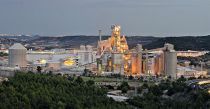
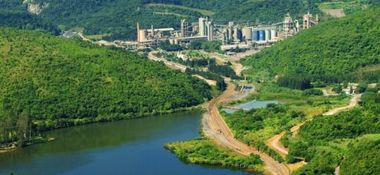
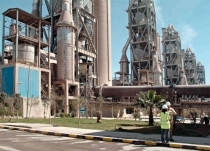
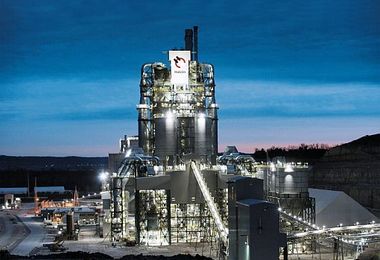
In 2010, 17.998 Mta of cement were produced in France. The consumption figure of 19.785 Mta results in a per capita cement consumption of 327 kg. 1.046 Mta of cement were exported and 3.001 Mta were imported. There are 42 integrated cement plants and grinding plants in the country. The market leader is Lafarge Ciments with a capacity of 9.5 Mta at 10 integrated plants (Fig. 4) and four grinding plants. Second place in the ranking is taken by Ciments Calcia (Italcementi) with a capacity of 6.6 Mta at 9 integrated plants (Fig. 5) and one grinding plant, followed by Holcim France with a capacity of 5.7 Mta at 5 integrated plants and three grinding plants. Vicat owns seven plants (Fig. 6) and has a capacity of 4.6 Mta. Kerneos, a manufacturer of calcium aluminate cement owns three cement plants.
Germany
Germany’s cement production rate was 30.270 Mta in 2010. 6.183 Mta were exported, while 1.194 Mta were imported. The cement consumption figure of 24.6 Mta means that the per capita cement consumption was 301 kg. At present, the market is still very fragmented, with 22 cement producing companies and the high figure of 54 plants. HeidelbergCement has a production capacity of 12.7 Mta at eight integrated plants (Fig. 7) and 2 grinding plants. Dyckerhoff (Buzzi Unicem) is in 2nd place with a capacity of 7.7 Mta at five integrated plants (Fig. 8) and two grinding plants. Schwenk Zement has a capacity of 6.9 Mta at four plants. Cemex has 4.9 Mta capacity at 2 integrated plants (Fig. 9) and three grinding plants, Holcim has 4.4 Mta (3 integrated plants, 1 grinding plant) and Lafarge has 3.4 Mta at 3 integrated plants.
Italy
Italy produced exactly 34.408 Mta of cement in 2010, with exports accounting for 2.102 Mta. Imports amounted to 1.438 Mta. The country’s cement consumption figure was 33.926 Mta, corresponding to a per capita cement consumption of 565 kg. There are 28 cement producers and 87 plants, making the market even more fragmented than in Germany. Nine of the cement producers only own pure grinding plants. The market leader is Italcementi with a capacity of 14.8 Mta at 17 integrated cement plants (Fig. 10) and 4 grinding plants, followed by Buzzi Unicem, with 10.8 Mta capacity at 11 integrated cement plants (Fig. 11) and 3 grinding plants. Colacem ranks in third place with a production capacity of 7.9 Mta, before Holcim (Fig. 12) with 5.1 Mta and Cementir with a capacity of 4.3 Mta.
Spain
In 2010, grey cement production in Spain reached a figure of 25.424 Mta, while 0.595 Mta of white cement was produced. Grey cement exports reached a level of 2.755 Mta, while 0.602 Mta was imported. The cement consumption figure of 24.507 Mta equals a per capita consumption of 532 kg, which is still an outstanding figure for a large country. At present, 13 companies principally manufacture cement in Spain and there are 47 cement factories and a number of pure grinding plants. The market leader is Cementos Portland Valderivas (CPV) with a production capacity of 15.1 Mta at 10 integrated plants (Fig. 13). The stated capacity figure of CPV includes the subsidiary firms Lemona (Fig. 14) and Uniland. Place two in the ranking is occupied by Cemex with a capacity of 11.0 Mta at eight integrated plants and three grinding plants. The other foremost companies are Lafarge with 6.8 Mta, Holcim (Fig. 15) with 5.0 Mta and FYM (Italcementi) with 3.7 Mta.
England
In 2010, 7.883 Mta of cement were produced in England (GB). 1.214 Mta were imported and there were no exports. With the cement consumption figure of 9.810 Mta, the per capita cement consumption was only 159 kg, which is one of the lowest in Europe. In England there are only four cement producers. HeidelbergCement is the market leader with 6.0 Mta at three integrated plants (Fig. 16) and three grinding plants for blast furnace slag cement. Lafarge is in second place with a capacity of 5.1 Mta at five plants (Fig. 17). Third place is taken by Rugby Cement (Cemex, Fig. 18) with a capacity of 2.8 Mta before Buxton Lime (0.8 Mta), a member of the Tarmac Group.
3 The TOP10 in Western Europe
Western Europe’s TOP10 cement manufacturers have a total cement production capacity of 205.4 Mta (Fig. 19). They thus account for 76.4 % of the entire production capacity of 269 Mta in Western Europe. The market leader, Lafarge, has a capacity of 36.6 Mta, which represents a market share of 13.6 %. Second-placed HeidelbergCement has a capacity of 32.4 Mta or 12 % and is followed by Italcementi with 28.0 Mta or 10.4 %. The subsequent places are taken by Holcim with a 10.1 % market share by capacity, Buzzi Unicem with 7.2 % and Cemex with 7.0 %. The first five companies account for 143.5 Mta or 53.3 % of the capacity. CPV/Uniland, Cimpor, CRH/Secil and Colacem have market shares of between 2.9 and 5.6 %. Companies like Schwenk, Cementir, Titan and Vicat are all well down in the ranking.
Fig. 20 shows the number of integrated cement plants and pure grinding plants in the TOP10. In Western Europe, these companies own a total of 161 integrated plants and 43 pure grinding plants. This represents 66.9 % of Western Europe’s total of 305 production facilities. Italcementi owns the largest number, with 32 integrated plants and 5 pure grinding plants, followed by Lafarge (26 + 6) and Holcim 19 + 8). Holcim thus owns the largest number of grinding plants. The TOP10 companies owning the smallest number of plants are Colacem with eight, CRH/Secil with nine and CPV/Uniland with 10. Fig. 21 shows how the capacities of the TOP10 companies are distributed by country. It will be noted that the main concentration of these leading companies is located in Spain, Italy, Germany, France, GB/Ireland and the Benelux States.
4 CO2 emission trading of the TOP10
In recent years, many voices in the cement industry expressed the fear that CO2 certificate allocations and possibly necessary certificate purchases would make cement manufacturing in Western Europe so expensive that it would no longer be competitive. However, the opposite has actually occurred. Firstly, manufacturers have succeeded in progressively reducing the clinker content, which has not only cut their CO2 emissions [1] but also lowered their production costs. Secondly, the use of alternative fuels has had the same effect, so that some companies have managed to reduce their specific CO2 emissions by around 20 % between 1990 and 2010.
On the other hand, the installed production technology in Europe cannot necessarily be called modern. Compared, for example, with many emerging countries in Asia, European plants are relatively old. Numerous companies still operate wet-process kiln lines and a lot of plants are still not equipped with modern calcining systems. Moreover, compared to Japan and China, systems for recuperating heat from the kiln and cooler exhaust gases are seldom to be found [2]. Within the framework of the EU climate protection targets and the allocation of CO2 emission rights, a benchmark of 766 kg CO2 per t of clinker was stipulated. According to a study by Cembureau, the European cement association, this has been achieved by less than 10 % of all cement plants (Fig. 22). In Western Europe the average emission rate is 858 kg of CO2 per t of clinker, while 5 % of all cement plants still emit more than 1000 kg of CO2 per t of clinker.
To determine the permitted number of free emission certificates, the above benchmark is taken as the basis and multiplied by the mean value of the production quantity between 2005 and 2008. For white cement and/or higher production quantities in the period 2009 to 2010, the cement industry is granted improved conditions. Fig. 23 shows the result of these free CO2 allocation quantities for the TOP10 in 2009 and 2010. In 2009 the companies involved received CO2 emission allocations amounting to 132.7 Mta and in 2010 a total of 130.6 Mta, corresponding to a reduction of 1.6 %. In the coming years, the allocations will be further reduced. Up to the year 2020, the aim is to cut the CO2 emissions of the cement industry by 21 % related to the emission figure of 2005. The emission rights will accordingly be allocated free-of-charge to the cement industry up to 2020, but for an emission figure reduced by 21 % compared to 2005.
In 2009, the TOP10 companies actually only used an average of 69.7 % and in 2010 71.2 % of the allocated quantities (Fig. 24). CRH/Secil only used 58.6 and 62.1 % of the allocation while Lafarge only used 61.8 and 62.4 %. As the unneeded allocations can be traded and are in great demand, e.g. on the part of the power generating industry, cement producers were able to achieve some large profits through the sale of unneeded free certificates. Fig. 25 shows these earnings for the years 2009 and 2010. In 2009, the TOP10 achieved an income of 537.1 million € from certificate trading. In 2010, the income was even 33.3 % higher, reaching 715.8 million €. The biggest incomes in 2010 were achieved by Lafarge (159 million €), HeidelbergCement (147.1 million €), Cemex (85 million €) and Holcim (78.6 million €). Italcementi, Buzzi Unicem and Cimpor did not live up to expectations, as is shown by their capacity figures and CO2 allocations.
5 Prospects
In 2010, West European cement plants only attained a capacity utilization of approximately 57.2 %. To fully come to the limits of the CO2 reduction targets by 2020, the clinker production rate would have to return to the level of around 2008, which is only possible if the two previously largest cement producing countries Spain and Italy significantly increase their production rates again. This, however, appears utopian from today’s point of view. For one thing, per capita cement consumption in the two countries is still distinctly higher than the West European average and also a further decrease in clinker factor can be expected in this decade, making it more probable that the clinker production rate will decrease by about 5–7 %. Moreover, as a consequence of overcapacities and the age and poor competitiveness of numerous plants, it can be expected that further plants will be closed down or that clinker production will be stopped. This alone will probably have an effect of about 5 %.
With regard to CO2 reduction objectives up to 2020, the major cement producers are therefore in a rather comfortable situation. However, some smaller and outdated factories will probably have to be closed down or will be taken over by one of their large competitors. Fundamentally, an increase in strategic realignment of the major cement producers can be expected. This has been demonstrated, for instance, by Italcementi on the Italian market with a realignment to a smaller number of factories and a reduction of fixed costs [3]. One possible measure is to construct larger and more efficient clinker production lines at strategic locations. The existing cement factories can sometimes stay in operation as pure grinding plants. Another popular measure is to construct new grinding plants. These not only use slag from the steel industry but in some cases also grind imported clinker.

Überschrift Bezahlschranke (EN)
tab ZKG KOMBI EN
This is a trial offer for programming testing only. It does not entitle you to a valid subscription and is intended purely for testing purposes. Please do not follow this process.
This is a trial offer for programming testing only. It does not entitle you to a valid subscription and is intended purely for testing purposes. Please do not follow this process.
tab ZKG KOMBI Study test
This is a trial offer for programming testing only. It does not entitle you to a valid subscription and is intended purely for testing purposes. Please do not follow this process.
This is a trial offer for programming testing only. It does not entitle you to a valid subscription and is intended purely for testing purposes. Please do not follow this process.