Quantification of structure formation in setting stuccoes influenced by additives
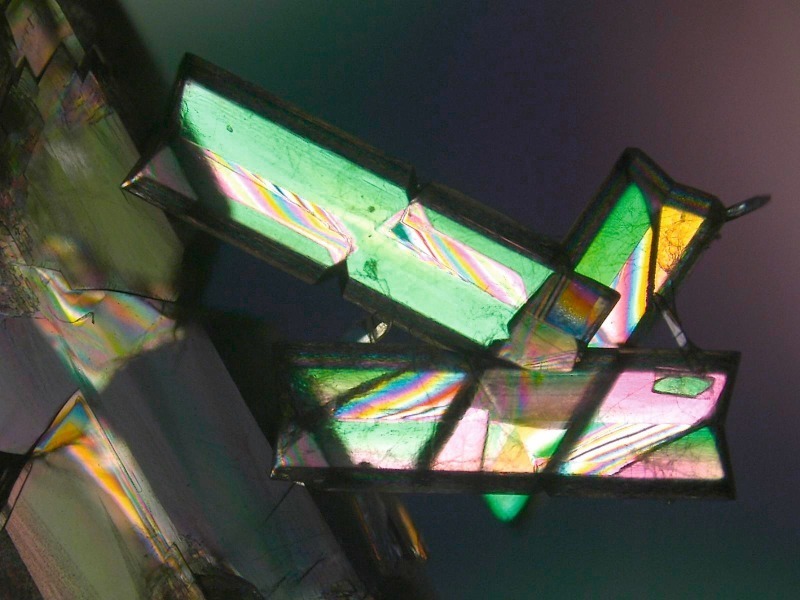
Summary: The additives used to control the hydration of calcium sulfate hemihydrate generally influence the morphology of the developing dihydrate crystals. These morphological modifications have a direct effect on the microstructure of the solidified product, resulting in definitive determination of its macroscopic properties. The following presents an analytical method which permits simultaneous and thus prompt quantification of the developing microstructure. The results obtained using this procedure have been confirmed by comparison with conventional test methods.
The setting of stucco is controlled by means of the addition of additives. These generally cause acceleration or retardation of the rehydration of the hemihydrate to dihydrate. In many cases, such intervention in the setting process results in morphological modification of the nascent dihydrate crystals [1]. Crystal morphology, for its part, influences the macroscopic properties of the finished product. Up to now, the integral effects of the structural changes associated with the crystal morphology of stucco have been determined solely via determination of the mechanical...
The setting of stucco is controlled by means of the addition of additives. These generally cause acceleration or retardation of the rehydration of the hemihydrate to dihydrate. In many cases, such intervention in the setting process results in morphological modification of the nascent dihydrate crystals [1]. Crystal morphology, for its part, influences the macroscopic properties of the finished product. Up to now, the integral effects of the structural changes associated with the crystal morphology of stucco have been determined solely via determination of the mechanical characteristics data of the finished product. There is, at present, no established high-speed test which is capable of quantifying the degree of cross-linking of the developing microstructure as a function of crystal morphology.
The method examined below makes it possible to investigate the effect of a modified crystal morphology on the structural strength of the crystal structure. Modification of crystal morphology was accomplished using the amino acid glycine.
An industrially produced stucco was used for these investigations. This is a natural gypsum from the Zechstein, and was calcined in the rotary kiln. The phase composition of the calcined material is shown in Table 1 and was determined by wet-gravimetric means, corresponding to the internal test and inspection procedure used at Knauf [2].
The amino acid glycine (Merck, p. a., purity ≥ 99 %) was used as the additive. It is known that various functional groups, such as phosphate, hydroxyl, amino and carboxyl functions, are capable of interacting with the surface of the gypsum [1, 3]. Tartaric and citric acid are the best known examples of the carboxylic acids used. They inhibit, by adsorption, the growth of certain crystal surfaces, thus modifying the morphology of the gypsum. It can therefore be supposed that glycine, due to its amino and carboxyl group, will have an analogous modifying effect on the crystals. A concentration of 2 %, referred to quantity of stucco, was selected for these experiments.
The process of structural formation in the setting stucco was tracked using oscillation rheometry in the context of dynamic mechanical analysis. The rheological properties of the substance observed result in this context as a material response to a harmonic oscillation.
The two basic rheological behaviour patterns of linear elasticity and linear viscosity are used for evaluation of this experiment. The resistance of an ideally elastic solid is proportional to the deformation generated. Such a material would, therefore, resonate in phase upon excitation by a harmonic sinusoidal oscillation. The resistance of an ideally viscous liquid is directly proportional to the rate of deformation generated. For this reason, the oscillation of such a material upon sinusoidal excitation is phase-shifted by 90 °. The time-lag between the input and the material response is a measured value of this analytical method and is designated Phase Shift Angle d. On the basis of the above deliberations, every real material will exhibit a phase shift angle of between 0 and 90 °.
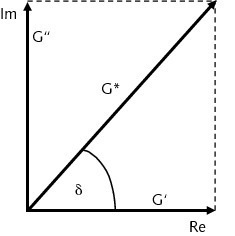
In oscillation rheometry, the following measured values can be used, in addition to time, in the form of frequency: where the angle of deflection (deformation) is given, the necessary torque (stiffness equivalent) and the appurtenant phase shift angle (viscoelasticity equivalent) are determined or, where the torque is given, the angle of deflection and the phase shift angle, correspondingly. The indirect rheological measured variable of Complex Shear Modulus |G*| and the direct measured variable Phase Shift Angle d are evaluated. The complex shear modulus is composed of a dissipative energy component and an energy component stored in the system. The quantitative composition of the two energy components depends on phase shift angle and is shown in Figure 1. Here, Complex Shear Modulus |G*|, together with Phase Shift Angle d, spans a vector diagram in the complex number plane. The projection on to the abscissa represents the energy component stored in the system and is designated Storage Modulus G‘. The projection of the vector on to the ordinates embodies the dissipated energy component and is designated Loss Modulus G‘‘. More elastic energy is stored in the system if phase shift angles of less than 45° are determined, and the substance under observation is then a viscoelastic solid. Where, on the other hand, phase shift angles of greater than 45 ° are determined, the subject material is a viscoelastic liquid, a material without yield point [4].
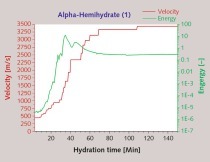
In the ultrasonic measuring procedure, a group of ultrasonic pulses is transmitted through the solidifying gypsum matrix. The velocity of the group of pulses is a function of the degree of cross-linking of the crystallites. The sonic velocity of the group of pulses rises as dihydrate formation, and the associated intergrowth of the crystallites, increases. Plotting of sonic velocity against time permits comparison of the setting behaviour of hemihydrate mixtures exposed to various influences [5].
The b-hemihydrate was mixed at a water-to-gypsum ratio of 0.75. The stucco was added within 15 s and then homogeneously agitated for 45 s. The gypsum paste was then transferred immediately to the measuring cell of the rheometer and of the ultrasonic measuring instrument.
The remainder of the material was used for additional determination of setting times in accordance with DIN EN 13279, Part 2 [6]. Visual assessment of structure formation was accomplished by means of scanning electron microscope (SEM) images.
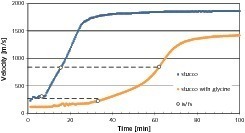
The times determined in accordance with DIN EN 13279, Part 2 for initial setting (is) and final setting (fs) are shown in Table 2. Figure 2 shows the ultrasonically determined plot of setting of the stucco mixtures used and the appurtenant setting times. The addition of glycine retards hydration of the hemihydrate. The pulse-group velocities determined by ultrasonic means supply approximately identical values for the setting times. Terminal velocity differs significantly from that of the unmodified sample when glycine is added, on the other hand. This significantly lower value is indicative of poorer cross-linking of the crystals in the structure formed. Correlation of terminal velocities to the microstructure on the basis of physical factors is difficult, since this analytical method registers only the pulse-group velocities, and neither phase shift nor amplitude attenuation.
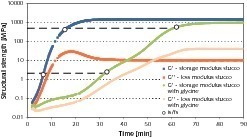
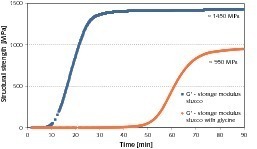
Figure 3 shows the development of the solid structure during the stucco setting process with and without the addition of glycine. These data were obtained by means of oscillation rheometry at constant amplitude and frequency. The time-resolved increases in structure parameters G‘ and G‘‘ are evaluated. The plot for Storage Modulus G‘ is proportional to the development of structural strength, while the plot of Loss Modulus G‘‘ is interpreted as the flexibility of the structure. By the nature of this method, the first measured values can be generated in this experiment 1.5 minutes after the addition of water, at the earliest.
The two moduli of the unmodified stucco initially develop approximately in parallel (black squares), the storage modulus quantitatively exceeding the loss modulus. This can be attributed to thixotropic effects resulting from interparticle interactions, such as often occur in highly filled systems. After around 4 to 6 minutes, the incipient formation of hydrate phase causes an increasing divergence in the development of the two moduli. The storage modulus increases continuously, tending toward an ultimate value after 30 minutes. The rise in this curve provides points of reference for rate of structure formation. The greatest increase is registered toward initial setting (is), and the rate of structure formation declines significantly following final setting (fs).
Loss Modulus G‘‘ initially rises, until it passes through a temporary maximum after around 18 minutes. The reading for the loss modulus then falls again, approaching after some 30 minutes its ultimate value, which is only around one third of its maximum. The plot for the loss modulus can be explained by the intermeshing or “intergrowth” of the nascent dihydrate crystals. The crystals grow and interlock more or less without hindrance up to the temporary maximum. The intergrowth of the individual crystals concomitant with the development of the structure means that they are less and less able to oscillate, resulting in the dissipation of less energy. The decline in the loss modulus is, consequently, attributable to the increasing restraint of the dihydrate crystals generated and to the formation of a three-dimensional network in the structure of the hydrating stucco.
The development of the structural moduli during hydration of the stucco under the influence of the glycine additive exhibits totally different characteristics. The plot of the curve permits subdivision of the structure formation of this sample into three sectors. The first sector, up to a time of approx. 22 minutes, is also attributable to the formation of a solid-like structure as a result of interparticle interactions. Coagulation of the particles results in the formation of a “soft” network. A significantly lower rate of structure formation than in the case of the unmodified stucco is observable in this case, however. Following the first phase, the structural parameters rise, Storage Modulus G‘ developing to a more pronounced degree than Loss Modulus G‘‘. The rate of structure formation of the glycine-modified stucco falls again immediately after initial setting (is). This second structure-formation phase is not discernable in the case of the unmodified stucco. The third structure-formation phase begins after around 50 minutes. The development of the storage modulus again accelerates, to terminate, ultimately, in a “plateau value” after the point of final setting. The ultimate value achieved for structural strength is only approx. 65 % of the value for the unmodified sample. Figure 4 shows a linear representation of the structural strengths determined, in order to emphasize the differences more clearly.
Also conspicuous is the fact that the development of Loss Modulus G‘‘ does not pass through any temporary maximum. It can be deducted qualitatively from this, in accordance with the above discussion, that the dihydrate crystals formed are intermeshed into one another only moderately, or not at all.
Finally, significant differences are apparent in the ratio of the ultimate structural values achieved in the hydrated samples of stucco. The ratio between the loss modulus and the storage modulus, i. e., between stored and dissipated deformation energy, determines the basic rheological behaviour of the material under examination and is defined by the phase shift angle. In the case under observation here, the ratio values permit derivation of information on the degree of cross-linking of the structure generated. The ratio of Storage Modulus G‘ to Loss Modulus G‘‘ in the “pure” sample is 140:1. This ratio falls by a factor of 6, to 25:1, under the influence of glycine. The results of the short-period measuring procedures, obtained using ultrasound and rheology, are summarized in Table 3.
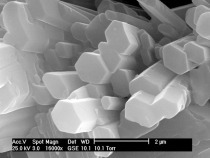
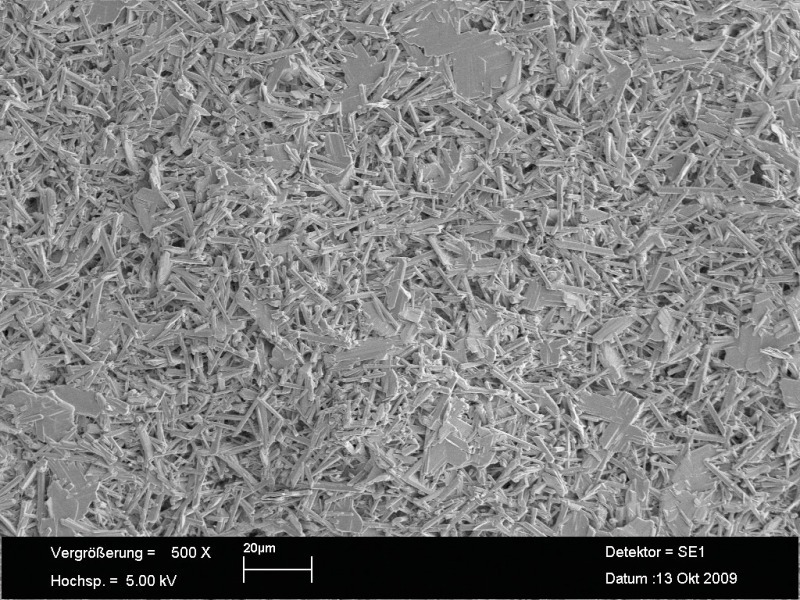
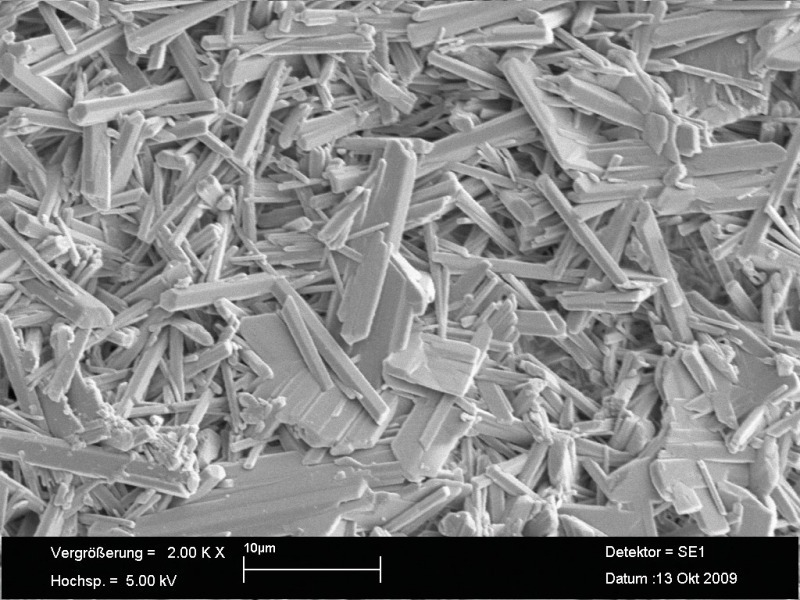
The phenomena described can be illustrated with the assistance of the scanning electron microscope. Figure 5 shows the crystal structure of the stucco sample which set without modification. The acicular habit typical of gypsum is apparent in a major part of the dihydrate crystals. Isolated flatter crystals occur in parallel. The long needle-like crystals are well able to intermesh with one another, and their slender geometry results in a large number of contact surfaces between the individual crystals. A stable structure can therefore be anticipated, and is, indeed, also reflected in the measured data.
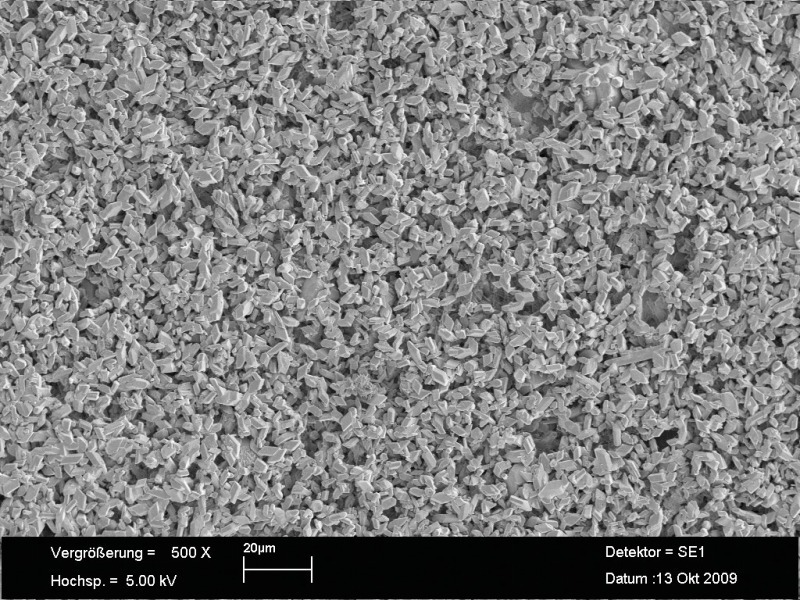
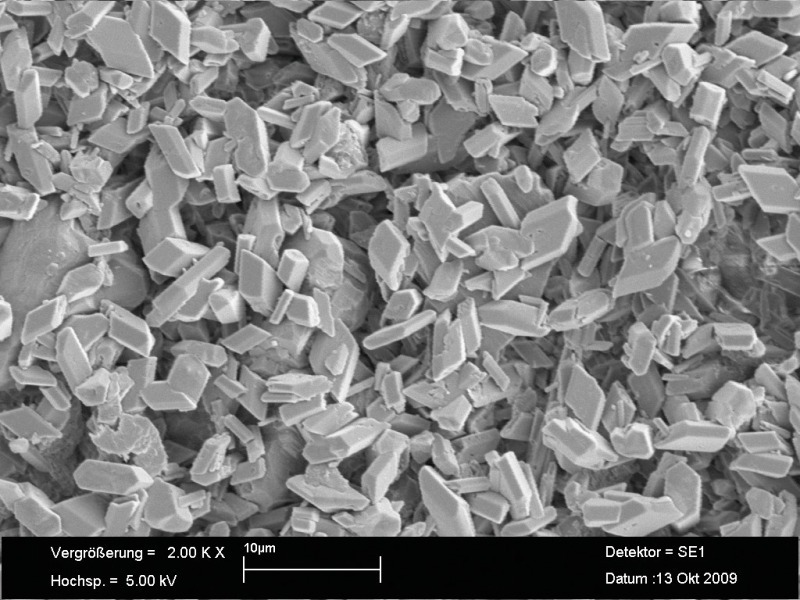
The images of the sample to which glycine was added produce a totally different picture (Fig. 6). The amino acid causes a greatly modified crystal habit in the dihydrate formed. Only short, thick, cuboid crystals result. Their intermeshing with one another is, therefore, now scarcely possible, with a significant reduction in the number of cross-linking points as a consequence. A decrease in structural strength and an increase in the flexibility of the crystal structure can therefore be anticipated. These observations, again, are also reflected in the measured data.
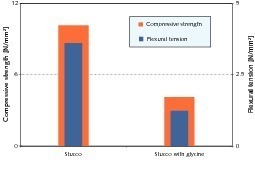
The structural modifications of the crystal structure caused by glycine also result in modifications of the macroscopic properties of the solidified gypsum body. The flexural and compressive strengths of the unmodified stucco sample and of the sample to which 2 percent glycine was added are shown in Figure 7. Determination of mechanical characteristics data was performed in accordance with DIN EN 13279, Part 2. The lower structural integrity of the glycine-modified sample is expressed in a decline in flexural and compressive strength values by more than 50 percent. Similar results are obtained for determination of modulus of elasticity (Young‘s modulus), the value of which is virtually halved under the influence of glycine.
Determination of the particle densities of the two samples indicates that these are identical, within the tolerances of measuring accuracy. Since comparable bulk densities were also established, it can be assumed that the total porosity of the two samples also concurs. This was investigated in more detail by means of mercury porosimetry. Similar capillary porosities in the 0.1 to 100 µm range, are observed here, in accordance with
Romberg [7]. This underlines the conclusion that the lower measured data obtained from the stucco samples containing glycine can be attributed to a modification of the crystal habit and to an associated poorer structural integrity. Table 4 summarizes the results obtained from the various long-period measuring procedures.
The influence of glycine on the hydration of stucco and the resultant microscopic and macroscopic modifications were investigated. At high concentrations, glycine acts as a retardant, and modifies crystal morphology from acicular to cubic. The retarding effect and lower stability in the developing microstructure were quantified by means of oscillation rheometry. The results were confirmed by ultrasonic measurements and by determination of setting times. The microscopic stability behaviour of the structure is reflected in the macroscopic characteristics of flexural and compressive strength, as well as in modulus of elasticity.
These studies were performed in the Research & Development department of Knauf, Iphofen; the authors wish here to expressed their gratitude.

Überschrift Bezahlschranke (EN)
tab ZKG KOMBI EN
This is a trial offer for programming testing only. It does not entitle you to a valid subscription and is intended purely for testing purposes. Please do not follow this process.
This is a trial offer for programming testing only. It does not entitle you to a valid subscription and is intended purely for testing purposes. Please do not follow this process.
tab ZKG KOMBI Study test
This is a trial offer for programming testing only. It does not entitle you to a valid subscription and is intended purely for testing purposes. Please do not follow this process.
This is a trial offer for programming testing only. It does not entitle you to a valid subscription and is intended purely for testing purposes. Please do not follow this process.