The cement industry in Turkey
 TurkishCement.net
 TUIK
TUIK
 TUIK
TUIK
 TUIK, TCMB
 OneStone Research
 TCMB
TCMB
 TCMB
TCMB
 Akcanca
 HeidelbergCement
 Oyak Group
 Limak Cimento
 Vicat
Vicat
 Nuh Cimento
 OneStone Research
 OneStone Research
 TCMB, OneStone Research
TCMB, OneStone Research
TCMB, OneStone Research

The cement industry in Turkey is very competitive. Large new capacity has been installed, driven by a robust domestic cement demand growth and large exports. The question is how will the demand growth continue and when will a peak be reached in the per capita cement consumption?
1 Turkey’s latest development
2023 will be the 100th anniversary of the establishment of the Republic of Turkey. By then, Turkey could already be a member of the European Union, but today the country seems to be even further away from the EU than in 1999, when the country became a membership candidate. How-ever, Turkey needs Europe and Europe needs Turkey, not only for economic reasons. In 2016, Turkey had a population of 79.0 million (73 % urbanization) and a gross domestic product (GDP) of US$ 857 billion or a GDP per capita of US$ 10 807, making it an upper-middle income country. Compared...
1 Turkey’s latest development
2023 will be the 100th anniversary of the establishment of the Republic of Turkey. By then, Turkey could already be a member of the European Union, but today the country seems to be even further away from the EU than in 1999, when the country became a membership candidate. How-ever, Turkey needs Europe and Europe needs Turkey, not only for economic reasons. In 2016, Turkey had a population of 79.0 million (73 % urbanization) and a gross domestic product (GDP) of US$ 857 billion or a GDP per capita of US$ 10 807, making it an upper-middle income country. Compared to 2015, the per capita income declined by US$ 207, due to the Turkish Lira’s dramatic depreciation against the US dollar.
According to the Turkish Statistical Office (TUIK), the economy grew 2.9 % last year, taking account of local currency and inflationary adjustments, after 6.1 % in 2015 and 5.2 % in 2014. In the first quarter of 2017 (Q1 2017), the growth rate of the economy was stated to be 5.0 %, which puts Turkey among the fastest growing countries, despite its high inflation, weak investment, unemployment of about 11 %, increasing current account deficit, negative assessments by credit rating agencies and deteriorating geopolitical environment. It is important to note that in December 2016 TUIK announced a major revision of its national account system and the methodology it uses to calculate GDP figures. This was done in order to bring the methodology into compliance with the European System of Accounts (ESA 2010).
This revision surprised analysts due to an almost 20 % (19.7 %) upward adjustment of the nominal GDP for 2015. Virtually overnight, the GDP increased from US$ 720 billion to US$ 861 billion and the GDP per capita increased from US$ 9257 to US$ 11015. The 2015 GDP growth rate was raised from 4.0 % to 6.1 %. According to an analysis of the Turkish GDP revision by the World Bank Group [1], construction investment accounts for 10.5 % of the 19.7 % increase in nominal GDP in 2015. The share of construction investment in the decomposition of investments increased from about 43.9 % to 54.7 % between the old and the new GDP series.
Turkish imports accounted for US$ 198.6 billion in 2016 after US$ 207.2 billion in 2015 and US$ 170.1 billion in 2007. Figure 1 shows how the TOP 5 Turkish import source countries have developed over a period of ten years. China has become the most important trade partner with US$ 25.4 billion (12.8 %) imports in 2016 and US 13.2 billion (7.8 %) in 2007. The compound annual growth rate (CAGR) of China’s exports has been 7.5 %. Germany achieved exports to Turkey of US$ 21.5 billion after US$ 17.5 billion with a CAGR of 2.3 %. Increases were also achieved by the USA (+3.2 %), Italy 0.9 % and other countries (1.9 %). Russia lost its No.1 position and declined by a CAGR of -4.8 %. In 2016, Turkish imports declined by -4.2 %. The largest losses were suffered by Russia (-25.7 %) and Iran (-22.9 %).
2 The construction market
The rapid growth of the construction sector, which had outperformed the GDP growth in previous years, has slowed down since 2013 (Figure 2). The construction boom has been driven by housing projects and also by the so-called megaprojects, which are large-scale infrastructure investments such as airports, bridges, dams, motorways, hospitals and hotel complexes. Difficulties in getting loans as well as foreign exchange deficits slowed the sector down. However, with a slight increase in 2016, construction made up 8.8 % of the GDP-formation, compared to 8.2 % in 2015 and 6.1 % in 2010. In Q1 2017 the construction share in GDP-formation decreased to 7.9 %, compared to 8.2 % in Q1 2016. Turkey comprises almost 185 thousand construction companies, most of them small and medium sized.
Figure 3 shows the development of construction permits in Turkey by floor area. Over the years there have been large fluctuations in the issue of construction permits and, accordingly, the floor area. The highest figure in the period from 2002 to 2016 was 220.7 million m2 in 2014. The lowest was a mere 36.2 million m2 in 2002. With the large fluctuation in issued construction permits, there was also a large fluctuation in the annual growth rates, which varied between plus 75.2 % (in 2010) and minus 29.9 % (in 2011). In 2016, the growth rate was 8.0 %, after a 14.5 % decline the year before. In Q1 2017, the growth rate declined by 17.2 %, compared to Q1 2016. Generally, the construction permits are an important indicator for cement demand in the country.
The cement demand components in Turkey are illustrated in Figure 4. The basic 4 components are private housing, commercial buildings, public buildings and infrastructure. The main demand over the years was for private housing, although its share declined from 54 % in 2010 to 45 % in 2016. The portion accounted for by commercial and public buildings remained stable over the years with a combined 15-16 %, whereby the commercial share slightly declined, while that of public buildings slightly increased. The importance of infrastructure and mega projects increased significantly over the years. After a 30 % share in 2010, the share of such projects was 39 % in 2015 and probably also in 2016.
3 The cement market
Today, Turkey has one of the highest per capita cement demands (PCC) of the major cement countries in the world. Figure 5 shows the development over the last seven years. After a large decline in PCC due to the global financial crisis in 2009, the PCC is currently on the rise. In 2010, the cement demand and the PCC recovered to 689 kg [2]. At the moment, the PCC is already at 864 kg. However, the rise in PCC has declined and for the future a peak is expected at 910 and 920 kg. The population growth declined from 1.6 % in 2010 to 1.0 % in 2016. On the basis of the projected population growth in Turkey, a PCC peak and possibly a decline in cement demand growth can be expected in the coming 5-7 years.
The cement production, consumption and exports are illustrated in Figure 6. These figures are published by the Turkish Cement Manufacturers Association (TCMB) in their monthly statistics and comprise the data provided by its member companies. However, the total data for the cement industry are somewhat larger and can be derived from publications by the TUIK. According to TCMB, the cement production increased from about 62.7 million t (Mt/a) in 2010 to 75.4 Mt/a in 2016 (the total data are 69.2 Mt/a and 77.9 Mt/a, respectively). The consumption (domestic supply) increased from about 47.7 Mt/a to 66.8 Mt/a (50.8 and 68.2 Mt/a, respectively), while cement exports decreased from about 15.1 Mt/a to 7.5 Mt/a (18.4 and 9.7 Mt/a, respectively). Accordingly, the data sources make some difference to the figures.
Figure 7 shows the regional cement delivery data provided by the TCMB for the period 2010 to 2016. The largest cement consumption region in Turkey is the Marmara region with about 12.6 Mt/a in 2010 and 17.8 Mt/a in 2016, which corresponds to a CAGR of 5.9 % in the period. The second and third largest regions are the Mediterranean and Central Anatolia, followed by the Black Sea region, with 12.6 Mt/a, 12.1 Mt/a and 8.7 Mt/a, respectively, in 2016. Less cement is consumed in the Agean region and East and Southeast Anatolia. However, the largest growth rate in the period was in the Mediterranean region with a CAGR of 11.0 %, while the smallest growth rates were in Southeast Anatolia and the Black Sea region with 2.0 % and 3.6 %, respectively.
4 The cement producers
Turkey’s cement industry provides direct employment to about 17 000 people. According to TUIK, there were 53 cement producers and 36 companies producing cement clinker last year, after 42 cement producers and 32 clinker producers in 2010. The total clinker and cement capacities in the country were 80.0 Mt/a and 132.8 Mt/a (TCMB figures), derived from 50 integrated plants and 20 separate grinding plants. The TCMB member companies, which produced almost 97 % of the cement in Turkey, achieved utilization rates of 88.7 % in clinker production and 58.6 % in cement production in 2016. Figure 8 shows the market shares of the major cement producers, based on their clinker capacity. The market leader with 16 % is the Sabanci Group, which comprises Akcanca and Cimsa, followed by the Oyak Group (15 %) and Limak (10 %). The other major producers include Askale, Cementir, Cimko, As Cimento, Vicat, Nuh Cimento and Votorantim.
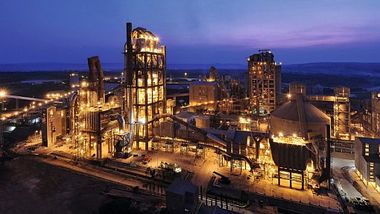
In 2016, Cimsa produced about 5.6 Mt/a of cement. The company has a grey cement capacity of 6.6 Mt/a from its five integrated plants in Afyon, Eskisehir, Kayseri, Mersin, Nigde and a grinding and packing plant in Ankara. The Mersin plant is also one of the largest white cement plants in the world with a capacity of about 1.5 Mt/a of white cement. Akcanca, which is a 50/50 joint venture of Sabanci and HeidelbergCement, achieved a total of 7.9 Mt/a cement sales in 2016, of which 1.5 Mt/a were exports. The company operates three integrated plants close to Istanbul, Canakkale (Figure 9) and Ladik (Samsun), with 7.0 Mt/a clinker and 9.2 Mt/a cement capacity. The Canakkale plant, with its 4.45 Mt/a clinker and 5.5 Mt/a cement capacity, is one of the largest plants in Turkey. Beside the production plants, the company operates a total of nine terminals with 3.4 Mt/a capacity.
The Oyak Group holds 2nd place in the clinker capacity ranking with 11.3 Mt/a and 1st place in the cement capacity ranking with 21.6 Mt/a. Oyak Cimento was established in 2015 to bring the different cement companies Adana, Bolu, Aslan, Ünye, Mardin and Denizli Cimento (Figure 10) and corresponding concrete manufacturers under one roof. In 2016, the group produced 11.3 Mt/a white and grey cement. Adana Cimento is the second-largest white cement producer in Turkey with a capacity of 0.35 Mt/a. The Limak Holding has become the 3rd largest cement group with production capacities of 8.1 Mt/a of clinker and 14.9 Mt/a of cement. In Turkey, the company operates ten cement plants (Figure 11) and achieved a clinker production of 7.2 Mt/a and 8.6 Mt/a cement sales in 2016.
The next three places in the capacity ranking go to Askale Cimento, Cimko (Sanko Group) and As Cimento with clinker capacity shares of 7 %, 6 % and 6 %, respectively.
Askale Cimento operates five cement plants in Askale, Trabzon, Van, Gümüshane and Erzincan with a combined clinker capacity of about 5.6 Mt/a. The Sanko Holding has a combined production capacity of 4.7 Mt/a of clinker and 7.45 Mt/a of cement from its three cement plants Bartin Cement, Cimko Adiyaman and Cimko Narli. As Cimento, the former Ado Cimento, developed rapidly from a first clinker line in 2005 to a clinker capacity of 4.3 Mt/a and a cement capacity of 6.5 Mt/a in 2016. The company operates one kiln line with 9 000 t/d capacity and an export terminal with 9 000 t/d capacity in the Port of Antalya.
Cementir, Vicat, Nuh Cimento and Votorantim are the other TOP 10 cement groups by clinker capacity. Cementir entered the Turkish market in 2001 with the acquisition of Cimentas and Cimbeton. Today, it operates 5.4 Mt/a of cement capacity at four cement plants. Vicat owns the Bastas (Figure 12) and Konya cement plants in Anatolia and achieved cement sales of 4.0 Mt/a in 2016. Nuh Cimento operates the Hereke-Izmit cement plant (Figure 13) with three kiln lines, a clinker capacity of 4.4 Mt/a and a cement capacity of 5.7 Mt/a. Votorantim operates four cement plants and two grinding mills in Turkey, with an installed clinker capacity of about 2.4 Mt/a. In 2017, the € 140 million upgrade of the Sivas cement plant from 0.6 Mt/a capacity to 1.8 Mt/a, was inaugurated.
Beside the TOP 10, there are almost 20 other cement producers, including some larger producers such as the Bati Anadolu Group with two plants (Baticim, Batisöke) and 3.2 Mt/a of cement capacity, Adocim Cimento (a 50/50 joint venture with the Titan Group) with one cement plant and two grinding mills (1.2 Mt/a clinker capacity, 3.0 Mt/a cement capacity), Medcem Cimento with a gigantic 10 000 t/d cement plant in Akdere (Silifke region), SYCS Cimento with its 2.4 Mt/a Elazig project, Göltas Cimento with two kiln lines and 2.0 Mt/a clinker capacity, as well as Tracim Cimento, Kahramanmaras Cimento (Kipas Holding) and Yurt Cimento, all with 2.0 Mt/a cement capacity.
5 The market trends
5.1 Cement consumption and investments
The Turkish population is expected to grow from 79.8 million in 2017 to 84.7 million in 2023, 88.4 million in 2030 and 93.5 million in 2050. In line with the growing population urbanization, it is expected that housing demand, infrastructure and cement demand will also increase. Figure 14 depicts our projection of the PCC in Turkey. Accordingly, a peak of around 916 to 917 kg is expected in 2021/22, which is a significant increase over today’s figure. After 2023, it is expected that the PCC will decline to below 900 kg. Figure 15 shows the development of cement demand and demand growth. Accordingly, the cement demand will grow in 2017 by a CAGR of 1.3 % to 69.1 Mt/a and finally to 77.1 Mt/a by 2023. In the coming years, the demand growth will be strongest in 2019 with a CAGR of 2.7 %.
The introduction of new capacity is likely to be one of the main trends. A recent market report [3] disclosed that nine new kiln contracts with a combined clinker capacity of 14.7 Mt/a were ordered by Turkish cement manufacturers from 2013 to 2015. The projects include 4 x 5 000 t/d, 2 x 4 000 t/d and 3 x 3 500 t/d kiln lines by companies such as Oyak (Bolu Cimento), Limak (Ankara, Trakya), Cimsa (Afyon Cimento), Bati Anadolu (Batisöke) and SYCS (Elazig plant). However, cement and clinker production has become very competitive and with plant contracts based on US$ or other foreign currencies and with the weak Turkish Lira, the profitability of such projects is always questionable. A number of companies, for example HeidelbergCement, are refraining from making investments in Turkey for the time being.
5.2 Cement & clinker exports
Turkey is the 5th largest cement and clinker exporter, after China, Vietnam, Iran, and the UAE. In the European/Middle East/North African regions it mainly competes with exports from Iran, UAE, Greece, Spain, Croatia and Malta. Figure 16 shows the development of Turkish exports in the last few years. In the period under review the cement and clinker exports declined from about 17.8 Mt/a in 2010 to 11.2 Mt/a in 2016, with the lowest figure (10.5 Mt/a) in 2014. The trends show a decline in cement exports and an increase in clinker exports. In the last five years, the TOP 5 cement export recipient countries were Russia, Iraq, Syria, Israel and Libya (Figure 17). As all of these are conflict countries in different ways, this shows how vulnerable the Turkish exports are.
5.3 Waste fuels
In Turkey, about 28 million t of municipal waste are produced today. The recovery potential of alternative fuels (AF) for the cement industry from these wastes is about 7 million t, which corresponds to 1.7 Mt/a of CO2 from fossil fuels. According to the TCMB, the use of AF started in Turkey in 2004. Ten years later, 30 of the 50 integrated cement plants already used AF. Figure 18 shows the development of the AF rate from 2010 to 2016, with an AF rate increase from 1.7 % to 4.3 %. On a European scale, a substitution rate below 5 % is still very low; the average here is 38.0 %. The Netherlands have the highest with 85 % and Greece has the lowest with 7.0 % [4]. In Turkey, of the 50 integrated cement plants in 2014 20 still used no AF at all, eleven plants used less than 1 %, ten used between 1 % and 5 %, only seven used more than 10 % and the best in the class only used 26.5 %, which increased in 2016 to 33.1 %.
6 Outlook
At the moment, the projections concerning domestic cement demand growth in Turkey vary greatly. Data by the TCMB for the cement demand for April 2017 shows a year-on-year decline of 5.3 %. HeidelbergCement expected a stagnant Turkish cement market in 2017. Other companies are projecting a 2.0 % increase. From our point of view, an increase of 1.3 % for this year may be realistic, especially if the GDP growth continues in the 2nd half of the year and confidence in the economy returns after the political uncertainties and recession in the 2nd half of 2016. For a medium-term outlook, much will depend on Turkey’s relationship with the EU and on whether Turkey becomes a new member or not.
//www.onestone.eu" target="_blank" >www.onestone.eu:www.onestone.eu

Überschrift Bezahlschranke (EN)
tab ZKG KOMBI EN
This is a trial offer for programming testing only. It does not entitle you to a valid subscription and is intended purely for testing purposes. Please do not follow this process.
This is a trial offer for programming testing only. It does not entitle you to a valid subscription and is intended purely for testing purposes. Please do not follow this process.
tab ZKG KOMBI Study test
This is a trial offer for programming testing only. It does not entitle you to a valid subscription and is intended purely for testing purposes. Please do not follow this process.
This is a trial offer for programming testing only. It does not entitle you to a valid subscription and is intended purely for testing purposes. Please do not follow this process.