Projects, Products and Problem Solutions
Building Materials Engineering Day, Essen/Germany (27.03.2009)
Actually innovative special cements and advanced high-performance concretes as well as projects, products and problem solutions involved should be in the focus of the Dyckerhoff Building Materials Engineering Day 2009. Due to the current economic development, also the impact of the economic crisis on the cement industry was on the agenda in Essen. Above all, the decline in the steel industry led to a strongly reduced offer of granulated blastfurnace slag, which is needed for the production of CEM II cements.
A wide range of topics all about the building material concrete and a...
Actually innovative special cements and advanced high-performance concretes as well as projects, products and problem solutions involved should be in the focus of the Dyckerhoff Building Materials Engineering Day 2009. Due to the current economic development, also the impact of the economic crisis on the cement industry was on the agenda in Essen. Above all, the decline in the steel industry led to a strongly reduced offer of granulated blastfurnace slag, which is needed for the production of CEM II cements.
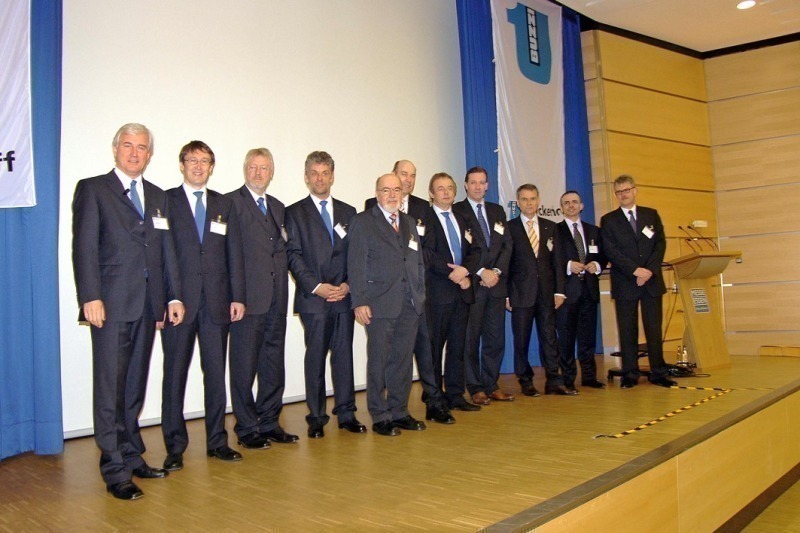
A wide range of topics all about the building material concrete and a distinguished circle of recognized experts in this field – these were the best prerequisites for a high-calibre event (Fig.). With this event Dyckerhoff wanted to pick up the thread of the successful Building Materials Engineering Day organized in Essen three years ago and to underline once again the importance of the Ruhr area metropolis, explained Dr. Stefan John, board member of Dyckerhoff AG, when he welcomed the about 150 participants. The specialist topics started with basic aspects of the concrete technology and design, covered field reports as regards the use of cement and concrete with a special durability up to the appropriate future management and, finally, again ended in the present with the current raw material situation.
From the MIKRODUR to the NANODUR technology
Dr.-Ing. Ditmar Hornung from the consulting department and Dipl.-Ing. Thomas Deuse from the product marketing department of Dyckerhoff AG emphasized that the new technologies are mainly based on the carefully controlled ultrafine cement components. In their lecture “From the MIKRODUR to the NANODUR technology” they showed that Dyckerhoff’s MIKRODURÒ technology only was a first step in the development of premium cements to be used for particularly difficult concrete requirements. In the meantime it is the NANODUR technology and the binder NanodurÒ, which is prepared in various high-speed mixing steps, that form the basis on which standard cements have been developed for the production of practical UHPC (Ultra High Performance Concrete).
Positive experience gained in practice
Dipl.-Ing. Werner Schultz from the consulting department of Dyckerhoff AG and Dipl.-Ing. Hans-Georg Müller, managing director of DW Betonrohre, showed where “Cement and concrete with a special durability” are successfully used in practice. Their impressive examples ranged from power plant construction to exacting sewer and infrastructure projects. Additionally the participants had the opportunity to visit the new building project of E.ON in Datteln already the day before. In this case, the use of concrete with an increased resistance to acid attacks makes it possible to set up the natural-draught cooling tower without an expensive coating.
The lecture given by Dr. Josef Strunge, manager of the Wiesbaden-based Wilhelm Dyckerhoff Institut, and Dipl.-Ing. Stefan Heeß from the white cement sales department of Dyckerhoff AG dealt with “Reports based on the experience gained during 60 years of white cement application”. While Stefan Heeß showed impressive pictures illustrating the self-cleaning of concrete surfaces by means of titanium dioxide that is known and has been proved for about 60 years, Dr. Strunge explained the mode of action of photocatalytic building materials both well-founded and generally understandable. It is an established fact that noxious gases can be reduced and organic fouling be prevented due to the photocatalytic effect. However, the efficiency of the latter strongly depends on the density of the surface, e.g. the concrete part containing titanium dioxide. There is still need for research in this field. Currently the photocatalytic effects on building materials are being investigated within the framework of a project of the Federal Ministry of Education and Research with the participation of Dyckerhoff. The aim is to increase the efficiency of photocatalysts.
A glimpse into the future
The conference in Essen again clearly showed that concrete is the “Building material of the future”. Nobody could impart this better than Prof. Dr.-Ing. Bernd Hillemeir from Berlin TechnicalUniversity. As always, his well-founded and committed reflections on the “innovative, charming and resistant material” were a highlight for the audience. Dr. Pero Micic from the Eltville-based FutureManagementGroup AG mainly dealt with the future and less with concrete. In his opinion it is a must for every company “to see more of and know more about the future markets”, i.e. a deliberate and target-oriented “future management”. This can be dominated using the methods he described.
The present raw material situation
The Bachelor of Commerce Rüdiger Körner, member of the board of Dyckerhoff AG, brought the audience back from future visions to the present time for current reasons. The reason was the economic crisis and its impact on the cement industry. Certainly the decline of the cement consumption in 2009 will keep within limits, not least because of the positive effects of the planned business-boosting programs. However, the situation as regards the raw materials is more problematic. In particular manufacturers like Dyckerhoff, which have replaced clinker by granulated blastfurnace slag not least for reasons of CO2 reduction, are confronted with a market-induced decreased offer of granulated blastfurnace slag amounting to about 3 million tons. Nevertheless, Dyckerhoff will stick to their basic strategy to further reduce the clinker factor.

Überschrift Bezahlschranke (EN)
tab ZKG KOMBI EN
This is a trial offer for programming testing only. It does not entitle you to a valid subscription and is intended purely for testing purposes. Please do not follow this process.
This is a trial offer for programming testing only. It does not entitle you to a valid subscription and is intended purely for testing purposes. Please do not follow this process.
tab ZKG KOMBI Study test
This is a trial offer for programming testing only. It does not entitle you to a valid subscription and is intended purely for testing purposes. Please do not follow this process.
This is a trial offer for programming testing only. It does not entitle you to a valid subscription and is intended purely for testing purposes. Please do not follow this process.