Influence of the granulation conditions and ­performance potential of granulated blastfurnace slag – Part 2: Chemistry and physical properties
Laboratory granulation is highly suitable as a means of demonstrating both the influence of different chemical compositions of granulated blastfurnace slag on its reactivity and the influence of different granulation conditions on the physical properties of granulated blastfurnace slag. The second part of this article deals with the chemistry.

3.2 Physical properties and reactivity
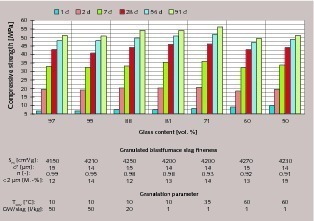
It is theoretically possible that changed grain morphology could be associated with a changed glass structure, and therefore also with changed reactivity of the granulated blastfurnace slag, even if the glass content and chemical composition are constant. However, using the examples of granulated blastfurnace slags HS D, HS D.0 and HS D.9 Fig. 13 shows that the mortar strengths (DIN EN 196-1) of blastfurnace cements (slag/­clinker = 75/25) containing granulated blastfurnace slags with widely differing grain morphology (­Table 2) but virtually constant...
3.2 Physical properties and reactivity
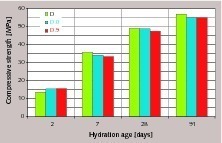
It is theoretically possible that changed grain morphology could be associated with a changed glass structure, and therefore also with changed reactivity of the granulated blastfurnace slag, even if the glass content and chemical composition are constant. However, using the examples of granulated blastfurnace slags HS D, HS D.0 and HS D.9 Fig. 13 shows that the mortar strengths (DIN EN 196-1) of blastfurnace cements (slag/­clinker = 75/25) containing granulated blastfurnace slags with widely differing grain morphology (­Table 2) but virtually constant fineness (4150–4280 cm2/g Blaine) do not differ significantly. This shows that provided there is a constant glass content the granulation conditions mainly affect the physical granulated blastfurnace slag properties but not the reactivity. This finding is of particular interest for work on alternative methods for cooling blastfurnace slag, especially water-free methods [2–4].

Fig. 13 also shows that laboratory granulation (HS D.0 and HS D.9) does not in itself change the reactivity of the granulated blastfurnace slag when compared with industrial granulation (HS D). This is an important requirement for the applicability of findings obtained in the laboratory to operational problems.

3.3 Chemical composition and reactivity
The chemical composition of a granulated blastfurnace slag has a major influence on its reactivity [5]. The influence of the basicity and the levels of Al2O3, TiO2 and MgO was examined (granulation G1) as part of the investigations. An example of the influence of basicity based on variation of granulated blastfurnace slag HS D (C/S 1.2) is discussed below.

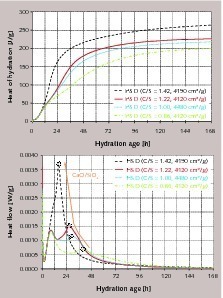
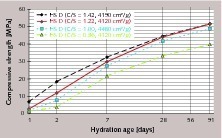
The granulated blastfurnace slags were to be ground to comparable finenesses. However, the fineness of granulated blastfurnace slag D with a basicity of 1.00 of 4480 cm2/g (d’ = 15 µm) was greater than the ­finenesses of the other granulated blastfurnace slags (4120–4190 cm2/g, d’ = 16-17 µm). This should be borne in mind when evaluating the reactivity, expressed as the heat of hydration or the strength development of blastfurnace cement, as not only the chemical composition but also the fineness of the granulated blastfurnace slag has a crucial effect on its reactivity. Fig. 14 shows the evolution of heat hydration from blastfurnace cements (slag/clinker = 75/25). It can be seen that the 2nd heat peak, attributed to the granulated blastfurnace slag, is displaced forward in times and is also changed significantly in intensity with rising basicity CaO/SiO2. The changed heat of hydration is also reflected in changed compressive strengths, as shown in Fig. 15. This means that, as expected, a higher basicity has a very positive effect on the reactivity of the granulated blastfurnace slag. The spread from 0.86 to 1.42 employed covers a wide range of the basicities found in industrial practice. According to the “Granulated Blastfurnace Slag File” at the FEhS Institute the granulated blastfurnace slag basicity (CaO/SiO2) averages 1.10 worldwide and the extreme values recorded so far range from 0.72 to 1.65. It is well known that blastfurnace slags with very high basicities form crystalline phases very readily and therefore under operational conditions cannot always achieve the very high glass contents normally found.

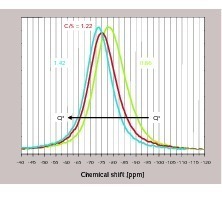
Investigations into granulated blastfurnace slag structure were carried out for some chemically altered granulated blastfurnace slags with high-resolution 27Al and 29Si nuclear magnetic resonance (NMR) spectroscopy in the cbm at Munich Technical University [6]. This method makes it possible to investigate the bond state and the surroundings of individual atoms. In silicates the degree of linkage Qn of the silicon t­etrahedron can vary between Q0 for an orthosilicate to Q4 for a three-dimensional network. The chemical shift (relative distance of the sample resonance line from the resonance line of the chosen standard) decreases in 10 ppm steps from about –65 ppm for Q0 to about –110 ppm for Q4. It should be noted that it is not possible to compare the absolute heights of the peaks with one another as they depend partly on the duration of the measurement and partly on the absolute Si content of the sample. Peak positions and shapes are therefore only used for qualitative comparison. The greatest changes in glass structure at different CaO/SiO2 basicities were found for the granulated blastfurnace slags that had been granulated in the laboratory (Fig. 16). The higher the basicity the lower is the value of the chemical shift, which means that the degree of linkage decreases. This correlates with the model of the glass network that is often employed and the role of CaO as a network modifier as well as the well-known higher reactivity and greater corrodibility of granulated blastfurnace slags with higher basicities.

The positive effect of increased basicity on the granulated blastfurnace slag reactivity has in fact been known for a long time. However, the present results also make it possible to quantify these effects, initially for the “average” HS D granulated blastfurnace slag, as well as other effects that have already been known qualitatively. Other investigations into the influence of the chemical composition were carried out by varying the HS V granulated blastfurnace slag with a significantly lower initial basicity (C/S = 0.8) with the aid of the G3 granulation head geometry. After completion of the investigations these results will be reported elsewhere.

3.4 Fusion temperature and reactivity
From the thermodynamic point of view it would be plausible that a granulated blastfurnace slag produced from blastfurnace slag fused at a higher temperature would have a higher reactivity [7]. The information on this subject in the literature varies [8, 9] so HS D granulated blastfurnace slag (C/S = 1.2) was fused again at temperatures of 1400 °C and 1550 °C (as used in blastfurnaces) and at the significantly higher temperature of 1800 °C and then granulated under standard laboratory granulation conditions (G1). The main characteristic values are listed in Table 3. For the blastfurnace cements (slag/clinker = 75/25) produced with the 3 laboratory-granulated granulated blastfurnace slags there were no significant differences in the development of either the heat of hydration or the strength. Contrary information in the literature that relates to industrial granulated blastfurnace slags may be based on the fact that the changed operating temperatures involved simultaneous chemical changes [10].

3.5 Glass content, crystalline constituents and reactivity
Industrially produced granulated blastfurnace slags in Central and Western Europe practically always have glass contents > 95 vol. %. It is the glass content of the granulated blastfurnace slag that is responsible for its latent-hydraulic behaviour so it is interesting to check for lower glass contents, such as are occasionally found in some Eastern European granulated blastfurnace slags, whether, and how strongly, the granulated blastfurnace slag reactivity is adversely affected in these cases. HS D.10 granulated blastfurnace slag with a glass content of only 61 vol. % was produced by changing the granulation conditions (G1). The investigations carried out on the blastfurnace cement (slag/clinker = 75/25) show that there is a significant decline in the development of heat of hydration and strength (Table 4). X-ray investigations confirm that the crystalline fraction consists of melilite (C2AS-C2MS).

Laboratory granulations were carried out at the FEhS Institute for investigations, some of which are described in [11], in which the glass content of the HS Z granulated blastfurnace slag (C/S = 1.2) was varied between 50 vol. % and 97 vol. % by varying the granulation conditions at constant slag temperature (1600 °C). Fig. 17 shows that the blastfurnace cement (slag/­clinker = 75/25) made with the granulated blastfurnace slag with the lowest glass content but with constant fineness had the highest 1-day compressive strength, although the other strengths either did not vary systematically (2, 7, 28 days) or else tended to decrease somewhat (56, 91 days) when the glass content was below the limit of 66 vol. % laid down in the standard. X-ray investigations confirm the formation of merwinite (C3MS2) in the crystalline fraction instead of the formation of melilite (C2AS-C2MS) that is usually observed with air-cooled blastfurnace slags. At constant chemical composition this results in enrichment of the aluminium in the glass phase [12], which leads to an increased 1-day strength. It should be noted that this was only achieved because the MgO content of the granulated blastfurnace slag had been raised from the original value of 7 mass % to 15 mass %. This means that the advantageous change in the glass chemistry can only become effective if the blastfurnace slag has a suitable chemical composition and a below-average glass content is obtained because of unfavourable granulation conditions, very low slag temperature or very high basicity.

3.6 Chemical composition and viscosity
The dynamic viscosity of the liquid blastfurnace slag is an important parameter. It depends on the temperature and chemical composition and must be as low as possible for metallurgical and process engineering reasons. On average the viscosity in the temperature range under consideration lies between 0.6 Pa · s at 1450 °C and 0.3 Pa · s at 1600 °C [13]. This means that it is substantially lower than for molten glass (10 Pa · s at 1400-1500 °C). Experience, including that gained during the above-mentioned laboratory granulation work at the FEhS Institute, has shown that blastfurnace slag can be granulated to form granulated blastfurnace slag in the viscosity range between 0.3 Pa · s and 0.5 Pa · s. A target value for obtaining low-viscosity slag for producing low-porosity air-cooled blastfurnace slag is ≤ 0.42 Pa · s at 1500 °C. Calcareous slags tend towards crystallization, which causes their viscosity to rise faster with decreasing temperature (“short slag”) than for siliceous slags (“long slags”). For these slags, which are more common nowadays, the viscosity increases steadily with falling temperature over a wide temperature range. It must be borne in mind that changes in viscosity in the range of only 0.01 Pa · s have an appreciable effect on the flow behaviour, and therefore on the processing characteristics, of the slag.

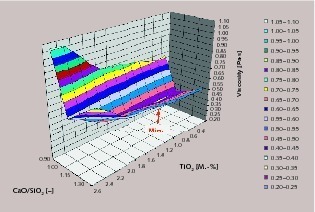
The viscosities of numerous re-melted granulated blastfurnace slags that were produced for the above-mentioned investigations were also calculated in relation to different temperatures and chemical compositions. A viscosity model that had been refined at the FEhS Institute and has proved successful in practice was used [14]. Fig. 18 shows how the viscosity of the liquid slag varies as a function of the CaO/SiO2 basicity and the TiO2 content for granulated blastfurnace slag D at a constant temperature of 1500 °C and a constant Al2O3 content of 11.5 mass %. It can be seen that a viscosity minimum is formed in the range of 0.35-0.40 Pa · s at a basicity of about 1.0 and a TiO2 content of about 0.4–0.8 mass %, which corresponds to a “natural” burden concentration. The aim of a blastfurnace operator is to adjust the charge composition to achieve minimum viscosity. This can naturally result in a conflict of interest if, for example, the higher basicity that is desirable from the cement technology aspect (cf. Fig. 15) leads to an unacceptable increase in viscosity of the liquid blastfurnace slag.

4 Summary

The results of the investigations show that laboratory granulation is highly suitable as a means of demonstrating the influence of different chemical compositions of granulated blastfurnace slag on its reactivity and the influence of different granulation conditions on the physical properties of granulated blastfurnace slag. It can therefore be used to obtain a precise description of possible changes in the properties of industrial granulated blastfurnace slags or to demonstrate the potential performance of blastfurnace slags that have not yet been granulated. The influence of the chemical composition is dominated by the positive effect of high basicity. However, at the same time a very high basicity (above C/S = 1.4) limits the formation of glass. The positive effect of merwinite formation that has been postulated in a variety of ways is confirmed provided that the granulated blastfurnace slag has a suitable chemical composition and the glass content is actually below average. One surprising finding is that – contrary to theoretical considerations – the fusion temperature before the slag enters the granulation process apparently has only a slight influence on the reactivity of the granulated blastfurnace slag. Variation of the granulation water temperature mainly affects the physical properties (porosity) and therefore the processing characteristics in the plant process (e.g. floating) and the dewatering characteristics. There is a complex interaction between chemical composition and fusion temperature with respect to the viscosity of the slag, which is an important parameter for its behaviour in the blastfurnace and in the granulation plant.

Acknowledgements

IGF Project 16457 N of the VDEh Association for the Promotion of Iron and Steel Research was supported by the Federal Ministry of Economics and Technology based on a decision by the German Federal Parliament via the AiF as part of the programme for Promotion of Joint Industrial Research and Development (IGF), for which particular thanks are due.

Überschrift Bezahlschranke (EN)

tab ZKG KOMBI EN

4,99 € / Woche* (Test EN)

This is a trial offer for programming testing only. It does not entitle you to a valid subscription and is intended purely for testing purposes. Please do not follow this process.

This is a trial offer for programming testing only. It does not entitle you to a valid subscription and is intended purely for testing purposes. Please do not follow this process.

Bestellbutton in Angebotsbox (EN)

tab ZKG KOMBI Study test

2,49 € / Woche* (Test EN)

This is a trial offer for programming testing only. It does not entitle you to a valid subscription and is intended purely for testing purposes. Please do not follow this process.

This is a trial offer for programming testing only. It does not entitle you to a valid subscription and is intended purely for testing purposes. Please do not follow this process.

Bestellbutton in Angebotsbox (EN)

Related articles:

Issue 01/2013

Influence of the granulation conditions and performance potential of granulated blast-furnace slag – Part 1: Granulation conditions

1 Introduction As a rule the liquid blastfurnace slag, which is usually at temperatures of 1440–1540?°C, is cooled rapidly in a steel works by quenching with a large excess of water (about 10:1)....

more
Issue 4/2020 FEHS – BUILDING MATERIALS INSTITUTE | INSTITUTE OF NON-METALLIC MATERIALS

The thermal history of granulated blast furnace slag and its impact on reactivity

About 400 million t of blast furnace slag are produced annualy world-wide, together with about 1247 million t of hot metal (2018). About 300 million t are quenched forming the glassy granulated blast...

more
Issue 07/2025 FEHS | THYSSENKRUPP STEEL EUROPE

„Granulated blast furnace slag 2.0“ on basis of DRI slag - Results of tests in pilot scale

1 Background The steel and cement industries belong to the raw material-, energy-, and CO2-intensive sectors, each responsible for around 7 to 9% and 5 to 8% of global anthropogenic CO2 emissions. To...

more
Issue 03/2010

Current developments in the manufacturing and utilization of granulated blast furnace slag

1 Introduction Because of its latent-hydraulic properties, granulated blast furnace slag (GBFS) has been employed as a cement component and as a concrete additive for more than 100 years. Formed from...

more
Issue 04/2009 Materials Science

Characterization of the microstructure and mineral phases of German iron and steel slags

1 Introduction The recycling of iron and steel slag is currently an urgent and important problem for all scientists throughout the world, but particularly for Chinese scientists. In Germany there is...

more