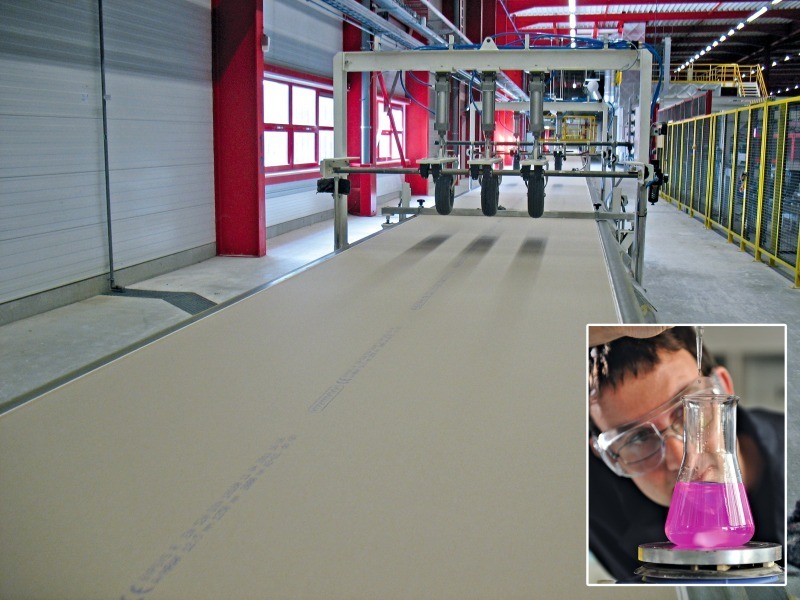
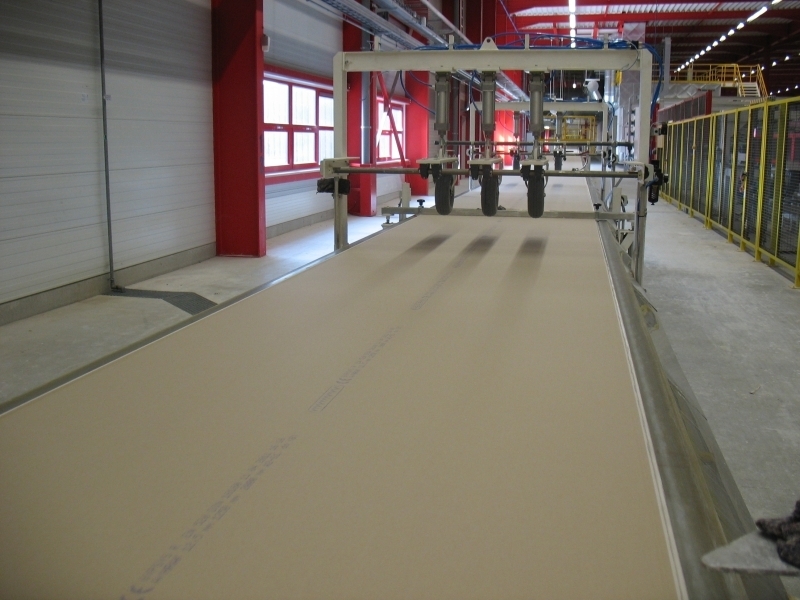
In recent years, PCE-based plasticizers have not only been used in cementitious binders, they have also increasingly been selected for a range of gypsum applications. It became apparent at this time that the various applications (gypsum board, floor screed, etc.), and the various binders, in particular, demanded greatly differing properties from the plasticizers. The structure of PCE-based plasticizers was therefore modified in order that these products would exhibit their greatest water-reduction efficiency in pure gypsum phases, such as alpha- and beta-hemihydrate or anhydrite. Heterogeneous gypsum systems generally occur as a function of gypsum raw material, calcining process and binder formulations during the production of gypsum-based building materials, i.e., a number of gypsum phases are present simultaneously. Natural gypsums, furthermore, in addition contain various impurities, such as dolomite, calcite and clay minerals, which also influence the system.
The systematic combination of various polymers makes it possible to boost water-reduction efficiency, adjust the required workability times and optimise insensitivity to fluctuations in the gypsum composition.
1 Introduction
At present, there are four different families of plasti-cizers used as dispersants in cementitious and gypsum-based systems: lignosulfonates (LS), sulphonated naphthalene formaldehyde condensates (NFS), sulphonated melamine formaldehyde condensates (MFS) and polycarboxylate ethers (PCE). Lignosulfonates have a robust but extremely slight capability for reduction of water content, whereas the polycarboxylate ethers are the most effective plasticizers. PCE plasticizers have, up to now, primarily been used in the concrete industry. The mechanism of action of the polycarboxylate ethers in cementitious systems has now been explained in principle [1-2]. Flexibility in the production of PCE-plasticizers with respect to variation of the length and type of the main chain, and variation of the side chains, in order to modify polymer properties, is not limited to these systems alone, however. The systematic design of the polymers also makes it possible to produce plasticizers tailored specifically to the gypsum industry. The fundamental correlations between polymer structure and the mechanism of action of the plasticizers as water-reducers in beta-hemihydrate-based systems have been demonstrated in systematic studies of polycarboxylate ethers of various polymer architectures [3-4]. Investigations into the action of plasticizers in various gypsum plasters of diverse origin also revealed highly diversified behaviour [5-6]. Influencing factors with complex actions may be assumed due to the most diverse range of impurities to be found, in particular, in natural gypsums, due to the diverse production methods used and due to ageing-induced processes. Retardation of setting in the various gypsum compositions is frequently observed when PCE plasticizers are used. This is a great disadvantage in the production of “drywall” (plasterboard), in particular, since the setting performance here determines the speed (and therefore rate) of production. Systematic combination of various polymers should make it possible to exploit synergy effects, and thus to produce higher performance additives [7].
2 Methods and materials
2.1 Determination of flowability (Flow Test):
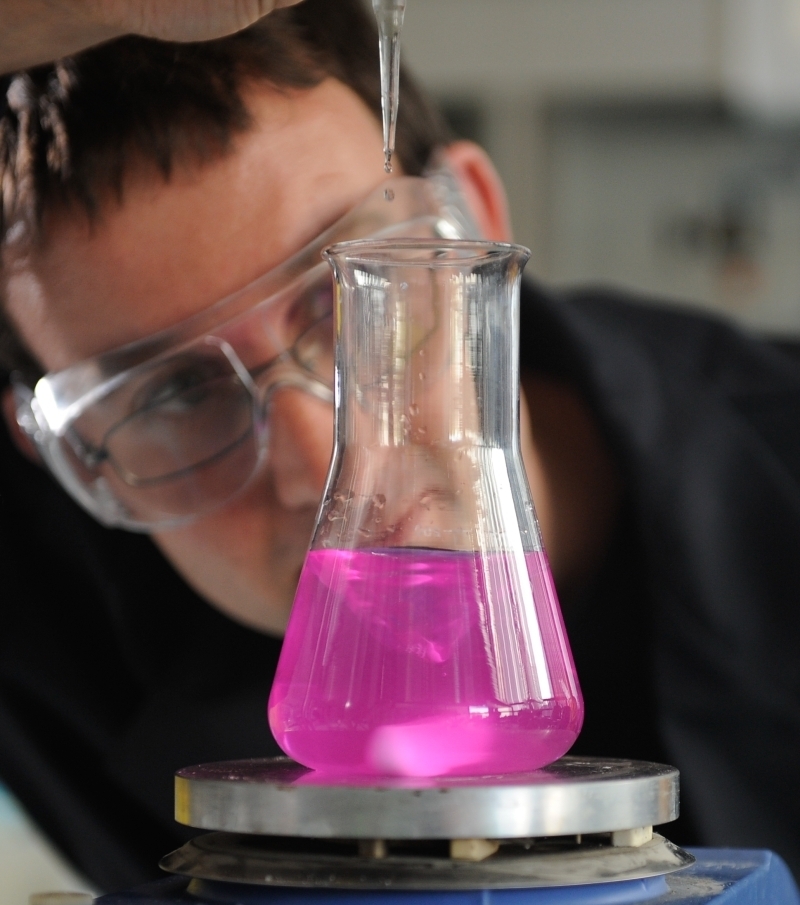
For the determination of the flowability, water containing the corresponding quantity of plasticizer is put into a beaker first. The binder, mixed with the accelerator, is sprinkled into the water over a period of 15 s, and the gypsum slurry is allowed to soak for another 15 s. Then, these components are vigorously stirred by hand using a whisk for 30 s. A mini-cone (50 x 50 mm) positioned on a glass plate is then filled with the gypsum slurry. After further 15 s (à total time 75 s), the cylinder is lifted vertically upward. The diameter of the “gypsum cake” thus produced indicates the flowability.
2.2 Determination of setting times:
The workability period of the gypsum slurry is characterised by the two specific variables of initial setting (VB) and end of setting (VE). Measuring procedures widely used in the gypsum industry are the knife-cut method and the thumb-penetration method. The gypsum cake produced in the flow test (see above) is used to determine setting times.
In accordance with DIN EN 13279, Part 2, initial setting is reached if, after a knife cut through the gypsum cake, the edges of the cut no longer heal. The end of stiffening occurs when water no longer escapes from the gypsum cake when finger pressure with a force of about 50 N is applied.
One disadvantage of this test method is the subjective element in estimation of the test results. All measurements were performed by the same laboratory employee, in order to assure good repeatability.
2.3 Binders and additives:
Three different gypsum plasters were used for the tests: two natural gypsum plasters (1 and 2) and one FGD gypsum plaster. Four polycarboxylate ethers, two lignosulfonates and their combinations were tested. Constant plasticizer dosage was 0.2 wt %. As accelerator, 0.1 wt % of finely ground gypsum (referred to the gypsum plaster) was added to each mixture, to approximate conditions during the production of gypsum boards.
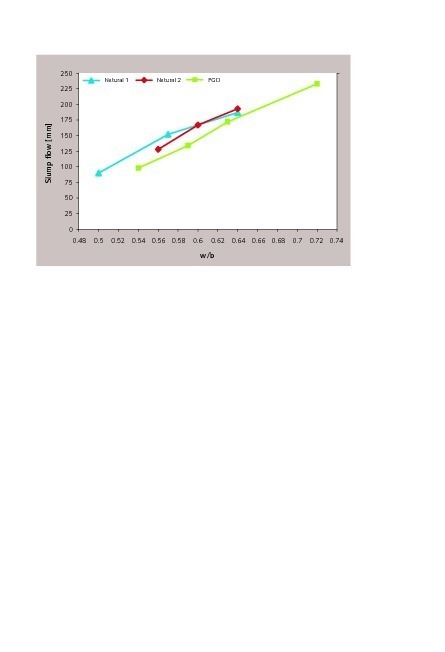
Figure 1 shows the influence of the water-binder ratio (w/g) on the flowability of the gypsum plasters. A linear correlation exists in the range examined, i.e., the flowability of the gypsum plasters increases as water content rises.
The w/g value at which the flowability without plasticizer was 140 mm was used for each gypsum plaster in subsequent tests. Table 1 shows the w/g values selected for the gypsum plasters and their setting times, when 0.1 wt % of accelerator is added. It should be noted that Natural Gypsum Plaster 2 is differentiated from the other two gypsum plasters by its significantly retarded setting behaviour.
3 Combinations of polymers
for optimisation of performance
Four PCEs with defined differences in their polymer architecture were selected as the plasticizers. In a second series of tests, the polymers were combined at various ratios with one another. The flowability of the gypsum plaster slurry provides information on the fluidising action of the PCEs and of their combinations. Determination of initial setting and end of setting is a measure of the retarding action of the plasticizers.
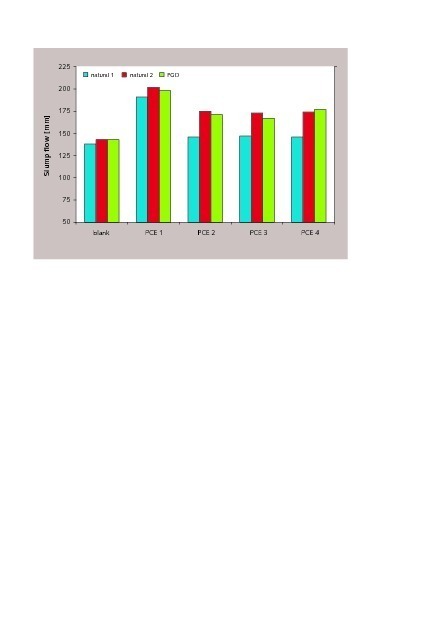
The four different polycarboxylate ethers were tested separately in an initial series of tests. The polymers differ in terms of their backbones and their side-chain lengths. The results for the rheology of the PCEs in the three different gypsum plasters are summarised in Figure 2. Plasticizer PCE 1 shows the greatest fluidising effect compared to the other polymers. The flowability of all three gypsum plasters is of approximately the same magnitude in the presence of PCE 1.
On the other hand, plasticizers PCE 2-4 exhibit a lower fluidising effect in the various gypsum plasters, and a simultaneously significantly lower retardation of setting (Table 2).
The combination of PCE 1 with one of the other three plasticizers makes it possible to combine the flowability advantages of PCE 1 with the low setting retardation of the other polymers [8]. The following combinations of PCE 1 and PCE 2 were then selected and tested:
Combination 1: 90 % PCE 1 + 10 % PCE 2
Combination 2: 70 % PCE 1 + 30 % PCE 2
Combination 3: 50 % PCE 1 + 50 % PCE 2
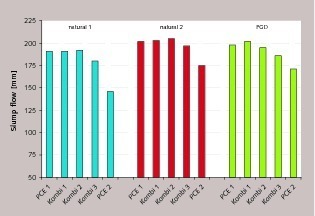
Figure 3 shows flowability virtually identical to that of PCE 1 for the PCE-PCE combinations 1 and 2. Rheology in the two natural gypsum plasters is identical, while performance regresses slightly as PCE 2 content increases in the case of the FGD gypsum plaster. Setting times on the other hand can be reduced by combining the two PCEs (Table 3). In the case of Natural Gypsum Plaster 1, the setting time can be significantly reduced (from 14:30 min for PCE 1 to 10:40 min for Combination 3), with an only slightly decreased fluidising action, by using Plasticizer Combination 3. The differences are less pronounced in the case of Natural Gypsum Plaster 2 and the FGD gypsum plaster.
It can be noted, that plasticizer optimisation is possible by systematic combination of PCE-based polymers tailored to the particular binder. The plasticizers formulated are characterised by an extremely good fluidising action and a simultaneously slight retarding effect.
4 Combinations of polymers
for optimisation of cost efficiency
PCEs are superplasticizers. Their high performance requires low fluctuation in process parameters only, such as varying gypsum raw material qualities. By systematic combination of polymers, increased robustness of the plasticizers and, simultaneously, optimised cost benefit ratio will be reached.
PCE 1 was mixed with two different lignosulfonate-based polymers (LS 1 and LS 2) in differing compositions in a further series of experiments, and tested against the FGD gypsum plaster. A sulphonated naphthalene formaldehyde condensate (NFS), such as is frequently used in the production of gypsum boards, served as the control. The PCE-ligno combinations had the following compositions:
Combination 4: 50 % PCE 1 + 50 % LS 1
Combination 5: 30 % PCE 1 + 70 % LS 1
Combination 6: 50 % PCE 1 + 50 % LS 2
Combination 7: 30 % PCE 1 + 70 % LS 2
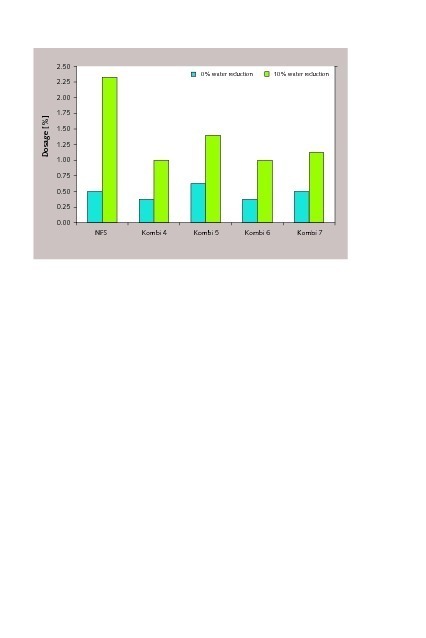
A constant flowability of 170 to 175 mm was set by means of variation of plasticizer input, in order to compare cost efficiency. In addition to the water-binder ratio of w/g = 0.60, all plasticizers were also tested for a water reduction capability of 10 % (w/g = 0.54).
As can be seen from Figure 4, the input quantity for all polymer combinations is in the same range as the NFS at high water-binder values. For a 10 % water reduction, on the other hand, the plasticizer quantity can be reduced by more than 50 % compared to the sulphonated naphthalene formaldehyde condensate (NFS) when using the PCE-lignosulphonate combinations, in order to obtain a comparable rheology. The plasticizers based on a combination of PCE and lignosulphonate thus present the potential for reducing gypsum board production costs. Not only reduced formulation costs, but also savings on gypsum board drying, can thus be achieved. It must, however, be noted that combinations of differing plasticizer technologies must be selected systematically and only after exhaustive clarification of their compatibility, in order to eliminate the possibility of detrimental interactions.
5 Conclusions
Following their adoption in cementitious systems, superplasticizers based on polycarboxylate ethers have also increasingly come into use in gypsum applications. The various applications and, in particular, the various binders demand greatly differing properties of plasticizers. The systematic combination of various polymers makes it possible to achieve enhanced insensitivity to fluctuating binder qualities. By binder-specific optimisation of additives plasticizers are produced with enhanced water reduction capability and simultaneously reduced influence on plaster setting times. The systematic combination of various plasticizer technologies is, in addition, a suitable method of reducing costs in the production of gypsum boards.