Nanocem Consortium – 7th Open Meeting


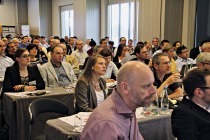
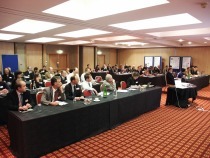
On 25.04.2017, the partners in the Nanocem Consortium met for their 7th Open Meeting with interested guests at the Portland Forum in Leimen, to discuss current research activities and the latest research findings. Besides the technical papers, a poster show with more than 50 presentations provided a comprehensive display of knowledge. Attendees from 17 countries, industry partners and academic representatives of a wide range of research institutes discussed the current progress in research, future challenges for the cement industry and other development tasks.
Dr. Wolfgang Dienemann, Director Global Research at the Development HeidelbergCement Technology Center, warmly welcomed the attendees, also in the name of the management. As one of the founding members and industrial partner of Nanocem, HeidelbergCement was pleased to host the event. Dienemann stressed the importance of the HeidelbergCement Campus. With the Portland Forum event centre and the R&D Centre next door, this spanned a bridge between history and the future. The importance of the Nanocem Consortium lies especially in the shared discussions amongst researchers and with the users....
Dr. Wolfgang Dienemann, Director Global Research at the Development HeidelbergCement Technology Center, warmly welcomed the attendees, also in the name of the management. As one of the founding members and industrial partner of Nanocem, HeidelbergCement was pleased to host the event. Dienemann stressed the importance of the HeidelbergCement Campus. With the Portland Forum event centre and the R&D Centre next door, this spanned a bridge between history and the future. The importance of the Nanocem Consortium lies especially in the shared discussions amongst researchers and with the users. Although Nanocem did not actually develop products itself, its fundamental research provided the necessary preconditions for the industry. The cement industry would face big challenges in the future, one of the most important was the environment and especially the reduction of emissions. Here was a need for further development and Nanocem offered the ideal conditions for this.
Karen Scrivener, EPFL, Switzerland, informed the attendees on “Highlights of research and roadmap of the Nanocem network”. The increasing global population was leading to an increasing consumption of cement and consequently, how-ever, rising CO2 emissions. Today, cement-containing materials account for around 5 to 10 % of the manmade CO2 emissions. For Scrivener, it is therefore a key challenge. “We need to do more with less and do it better.” Strategies to reduce CO2 include:
increase levels of clinker substitution
reduce cement in concrete
alternative binders for niche applications
With its nine industry partners and 24 academic partners, Nanocem was pursuing two flagship achievements: Thermodynamics and pore structure. Scrivener explained the research findings concerning these two major topics.
In a subsequent panel discussion moderated by Lukas Neumannn, University of St Gallen, Switzerland, the former Nanocem-funded researchers Luis Baquerizo, LafargeHolcim, France; Vanessa Kocaba, Chryso, France; Arnaud Muller, HeidelbergCement Technology Center, Germany, and Luis Pegado, Sika Technology AG, discussed the topic “How knowledge is implemented in the network”. All four spoke on their own development path, projects and results. Common to all is that they rate the possibilities of research work in Nanocem Consortium projects as very important. Besides the research activity, the discussion with many other researchers all over Europe was excellent. Nanocem provided an important platform for shared discussions on an international level and to pool the knowledge of many specialists. It was important that other manufacturers get involved and that users of the products are brought on board.
In the following three papers, the researchers reported on their development results. Luis Pegado, Sika Technology AG, Switzerland, spoke on “Cementitious systems at the molecular level.” Bernhard Pichler, TU Vienna, Austria, reported on “Upscaling on nanoscience research results to macromechanical properties” and Maciej Zajac, HeidelbergCement, Germany, on “Nanocem work on supplementary cementitious materials”.
In another panel discussion, Nanocem senior researchers from industry and academia discussed the “Nanocem roadmap”. Mohsen Ben Haha, HeidelbergCement Technology Center, Germany; Emmanuel Gallucci, Sika Technology AG, Switzerland; Hong Wong, Imperial College London, UK; and Peter McDonald, University of Surrey, UK, agreed that the time at Nanocem had been very intensive for everyone. In this pool of good universities and researchers, fundamental knowledge was developed, for the acquisition of which industry often simply didn’t have the time. The sustainability of the processes was very high, the contact between the researchers extremely intensive. For these four attendees, the reduction of CO2 emissions in cement production is an important aspect of the future roadmap.
In his concluding paper, Francois de Larrard, LafargeHolcim, France, presented fundamental considerations on “Industrial perspectives for the future”. Besides planet and social trends for the XXIst century, he presented requirements for buildings, transport and energy infrastructures and civil engineering and other areas. He closed with the statement, “The world is changing and there are many challenges for the cement and construction materials industry”. For de Larrard “R&D is the key to facing all these challenges” and Nanocem is playing an important role. Currently, there is no material that could replace cement and the industry simply couldn’t go on with a “business as usual” attitude. Part of the research must be to better understand the scientific basis underlying the current technologies.
In her concluding remarks, Karen Scrivener called on several attendees to speak who gave their comments on the event and stressed the benefit of the event for them personally.
Scrivener finished with an appeal to encourage even greater involvement in research.
//www.nanocem.org" target="_blank" >www.nanocem.org:www.nanocem.org

Überschrift Bezahlschranke (EN)
tab ZKG KOMBI EN
This is a trial offer for programming testing only. It does not entitle you to a valid subscription and is intended purely for testing purposes. Please do not follow this process.
This is a trial offer for programming testing only. It does not entitle you to a valid subscription and is intended purely for testing purposes. Please do not follow this process.
tab ZKG KOMBI Study test
This is a trial offer for programming testing only. It does not entitle you to a valid subscription and is intended purely for testing purposes. Please do not follow this process.
This is a trial offer for programming testing only. It does not entitle you to a valid subscription and is intended purely for testing purposes. Please do not follow this process.