Fundamental research for sustainability
Nanocem Fifth Open Meeting, Leeds/United Kingdom (28.04.2009)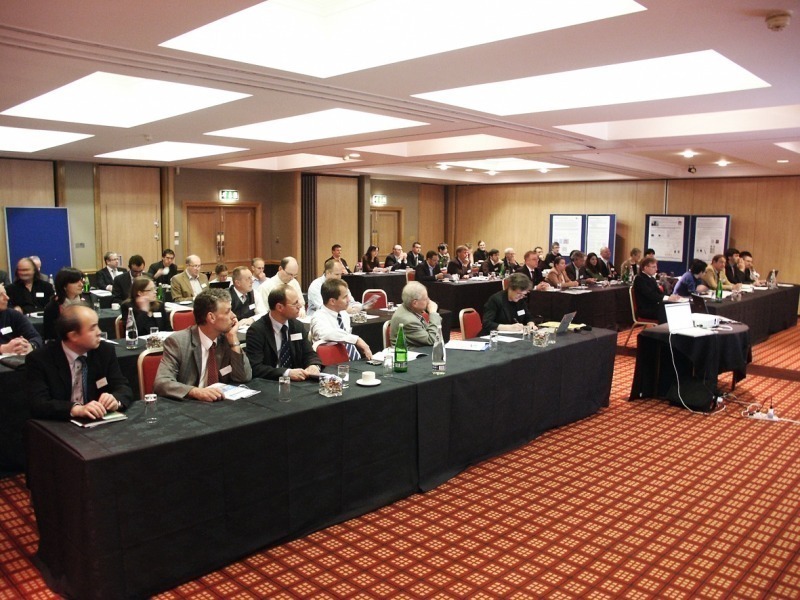
Every year, the current status and future perspectives of the Nanocem industrial-academic research network on cement and concrete are presented in an open meeting. This year, Ian Richardson, University of Leeds, welcomed almost 70 participants to the Nanocem Open Meeting at the Village Hotel in Leeds/GB (Fig. 1). In his opening speech he highlighted the long tradition in building materials research in Leeds going back to John Smeaton and Joseph Aspdin, both originating from Leeds.
Karen Scrivener, Ecole Polytechnique Fédérale de Lausanne/Switzerland, focused in her presentation on “Cement...
Every year, the current status and future perspectives of the Nanocem industrial-academic research network on cement and concrete are presented in an open meeting. This year, Ian Richardson, University of Leeds, welcomed almost 70 participants to the Nanocem Open Meeting at the Village Hotel in Leeds/GB (Fig. 1). In his opening speech he highlighted the long tradition in building materials research in Leeds going back to John Smeaton and Joseph Aspdin, both originating from Leeds.
Karen Scrivener, Ecole Polytechnique Fédérale de Lausanne/Switzerland, focused in her presentation on “Cement for the future and the role of Nanocem”. As one of the main points she claimed that global warming is one of the greatest challenges of the 21st century. Even though concrete has, amongst other building materials such as steel and wood, a very low embodied energy of around 800 MJ/t, it must be kept in mind that cement production accounts for 5–8 % of global CO2 emissions. Then Davies Mulenga, Halcrow Group Ltd, presented a paper co-authored by himself and by Peter Robery, Technical Director of Halcrow Group Ltd. He asked “Can nanotechnology address today‘s civil engineering challenges?”. As an example he stated that smart sensors can be used to continuously monitor structural performance. After a short break, Robert Flatt, Sika Technology AG, Zurich/Switzerland, presented a report on “Drivers of innovation in the cement and concrete industry”. He emphasized that life-cycle costs must be included in future projects. Phil Purnell, University of Leeds/UK followed with his report on “Novel uses of cement”. There already exist applications for building materials, such as waste immobilisation, but also new, emerging applications, such as biomaterials and substrates for 3-D printing.
Initial results on “Surface analysis for a deeper understanding of cement prehydration” were then the topic of Leon Black’s (University of Leeds/UK) presentation. Further research will be performed within the Nanocem Core Project 7 “Fundamental mechanisms of cement prehydration”. Peter McDonald, University of Surrey, UK, showed the latest findings on “1H NMR as a probe of porosity and water transport in cements”. He presented results on a portable device for magnetic resonance imaging in-situ. The next speaker was Donald Macphee, University of Aberdeen, Scotland/UK giving a talk on“Alkali activation of aluminosilicates”. This research field is covered by a core project entitled “Alkali activation of aluminosilicates – an assessement of fundamental aspects”.
Finally, the “Industrial perspective on sustainable cements” was presented by Jesper Sand Damtoft, Aalborg Portland A/S/Denmark, encouraging the audience to take a life-cycle perspective. The meeting was closed with concluding remarks by Karen Scivener. A number of interesting posters were presented during the breaks.
For the future Nanocem has decided to focus on scientific meetings on specific projects rather than continuing the “open meeting” series. The first such conference will present the results of the Marie Curie Research Training Network – “Fundamental understanding of cementitious materials for improved chemical, physical and aesthetic performance” from 1–3 September 2009 in Villars/Switzerland. Details can be found on the homepage.

Überschrift Bezahlschranke (EN)
tab ZKG KOMBI EN
This is a trial offer for programming testing only. It does not entitle you to a valid subscription and is intended purely for testing purposes. Please do not follow this process.
This is a trial offer for programming testing only. It does not entitle you to a valid subscription and is intended purely for testing purposes. Please do not follow this process.
tab ZKG KOMBI Study test
This is a trial offer for programming testing only. It does not entitle you to a valid subscription and is intended purely for testing purposes. Please do not follow this process.
This is a trial offer for programming testing only. It does not entitle you to a valid subscription and is intended purely for testing purposes. Please do not follow this process.