Mitigation of the consequences of the crisis due to economic stimulus packages
Press conference of the Federal German Association of the Cement Industry (BDZ), Berlin/Germany (04.05.2009)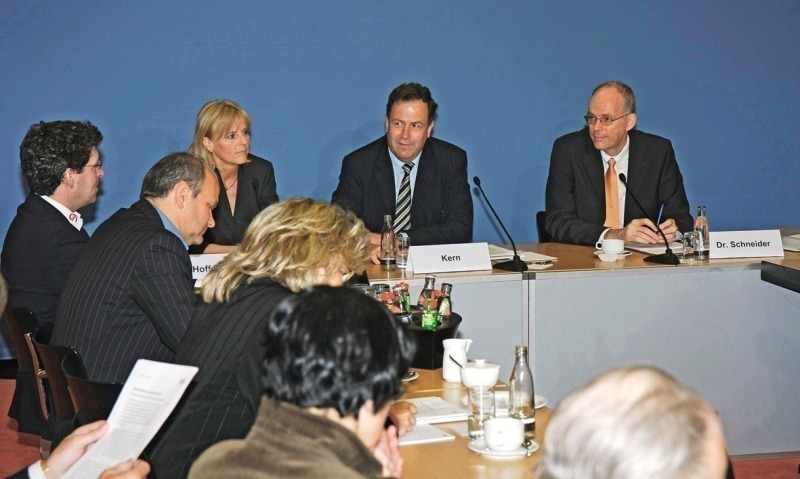
The German cement industry considers the first and second economic stimulus packages of the Federal Government to be appropriate approaches to mitigate the consequences of the financial and economic crisis for the building trade and the building materials industry. According to Andreas Kern, President of the Federal German Association of the Cement Industry (BDZ), it is particularly the focus of the programs to improve the infrastructure, which involves good opportunities to lay the foundations for a further safeguarding of competitiveness in the present dramatic development of the economy (...
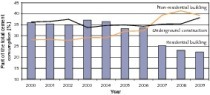
The German cement industry considers the first and second economic stimulus packages of the Federal Government to be appropriate approaches to mitigate the consequences of the financial and economic crisis for the building trade and the building materials industry. According to Andreas Kern, President of the Federal German Association of the Cement Industry (BDZ), it is particularly the focus of the programs to improve the infrastructure, which involves good opportunities to lay the foundations for a further safeguarding of competitiveness in the present dramatic development of the economy (Fig.).
Kern stated that the German cement industry would of course not get off lightly due to the shrinkage process of the economy. Though the crisis had tightened its grip, the cement manufacturers had not been affected so adversely in 2008. With total sales of 34.6 million t of cement, the level of the previous year 2007 had more or less been maintained. Of these 26.3 million t were sold in the domestic market and 8.3 million t were exported. Due to the increased energy costs, the total turnover of the branch, amounting to 2.3 billion €, was slightly higher than in the previous year. Including the rather marginal imports amounting to 1.1 million t, the domestic cement consumption amounted to a total of 27.3 million t in 2008.
At best BDZ expects a decline of the domestic cement consumption by 5 % to approximately 26 million tons in 2009. The prospects for the individual market segments are very different. There is no prospect of improvement for residential construction, both as regards private homes and apartment houses, which could counteract the negative trend of the last few years in 2009. A decline of 6 % should be expected in this field. The cement branch expects an even stronger decline in non-
residential construction that had recently been developed into the most important market segment. Due to the economic situation and the increased caution regarding new investments at many companies, a minus of 11 % is predicted for this sector. The expected development in civil engineering will be different, explained Kern, at least as regards the public sector. Here the economic stimulus packages of the government will probably have a certain effect. The additional capital spending relevant for the cement demand would amount to a total of close to 14 billion €. The major part of this, i. e. 9 billion €, applies to civil engineering projects, which would lead to an additional cement demand of 750 000 t in 2009 and of approximately 2.25 million t in 2010. Even if the civil engineering demand will probably decline in industry and trade due to the general crisis, the cement industry expects a slight increase of a total of 3 % for civil engineering in 2009.
The additional capital spending for the infrastructure linked with the program of the Federal Government will not only contribute to the support of the building trade, in the opinion of Kern. It is also an important signal that thus the public funds for the federal roads amounting to annually 12 billion € in 2009 and 2010, which include budgetary funds and tolls, are increased to a value that is the lower limit for the required traffic capital spending of the Federal Government according to an estimation of traffic experts. “The funds of the economic stimulus packages must be integrated into the systematic development of the quality and quantity of our infrastructure in order not to fizzle out like a flash in the pan,” said Kern. Therefore, the level of the traffic capital spending of the next two years has to be maintained beyond 2010. Referring to the burden on the energy-intensive cement branch caused by high electricity rates, Kern continued that an overall concept for the German energy policy is still lacking as announced by the coalition at the end of 2005. BDZ, together with other energy-intensive industries, champions a safe and cost-effective power supply. One of the most important cornerstones in this respect is a balanced energy mix taking into account all energy sources, reliable general conditions for capital spending to streamline the power plants and the infrastructure as well as a functioning competitive environment on the energy markets.

Überschrift Bezahlschranke (EN)
tab ZKG KOMBI EN
This is a trial offer for programming testing only. It does not entitle you to a valid subscription and is intended purely for testing purposes. Please do not follow this process.
This is a trial offer for programming testing only. It does not entitle you to a valid subscription and is intended purely for testing purposes. Please do not follow this process.
tab ZKG KOMBI Study test
This is a trial offer for programming testing only. It does not entitle you to a valid subscription and is intended purely for testing purposes. Please do not follow this process.
This is a trial offer for programming testing only. It does not entitle you to a valid subscription and is intended purely for testing purposes. Please do not follow this process.