Cement industry demands that capital expenditure for infrastructure continues steadily
The German cement industry has been more affected by the crisis and the recession than as the branch had expected at the end of last year. This is substantiated by provisional figures for turnover and cement consumption in 2009. It will certainly not be possible to reverse this unfavourable trend completely in 2010. However, the industry increasingly hopes to return to the growth path after this lean time. In this connection, however, it is essential that federal politics create the general conditions for finance and infrastrucure in such a way that the building trade will again be able to...
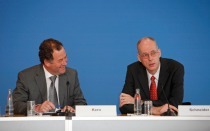
The German cement industry has been more affected by the crisis and the recession than as the branch had expected at the end of last year. This is substantiated by provisional figures for turnover and cement consumption in 2009. It will certainly not be possible to reverse this unfavourable trend completely in 2010. However, the industry increasingly hopes to return to the growth path after this lean time. In this connection, however, it is essential that federal politics create the general conditions for finance and infrastrucure in such a way that the building trade will again be able to fulfil its role as growth factor for the overall economy, underlined Dr. Martin Schneider, general manager of the Federal German Association of the Cement Industry, in Berlin. Even if the GDP estimates have been adjusted upwards in the meantime, the cement consumption in
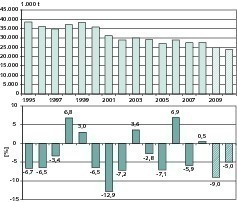
Germany (Fig. 1) will be 9 % below the value of the previous year and will go down to 25 million tons. The decline will continue in 2010, however, with minus 5 % it will only be half the value.
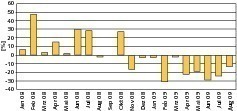
The turnover of the cement industry dropped by 7.6 % from January to September 2009. However, the number of jobs could be maintained with about 7350 employees. The trends in the individual segments of the cement market are very different. As regards the residential construction, the branch expects that the low point will have been passed after the downtrend in 2009 and a stabilization is expected in 2010. From 2011 a gradual recovery ccould be expected. The decline in the field of commercial buildings caused by the recession was a clear setback for the total building trade including the cement industry. The building permits (Bild 2) suffered a severe defeat during the first eight months of 2009, i. e. they dropped by almost a third (29.3 %) compared to the same period in the previous year. A conflicting development happened in the field of public buildings, where the effect of the economic stimulus packages of the government has become apparent.
Only civil engineering cushioned slightly the general downward trend as regards the demand for cement in 2009. The additional resources of the economic stimulus packages led to a recovery of the building demand from the middle of 2009 and will probably support this market segment well into the year 2011.
However, according to Dr. Schneider, this also involves a risk the way, since after the increase of the public capital expenditure for the federal roads by a total of approximately 4 billion € in 2009 and 2010, a decrease of the investment volume as well as an investment gap will again be imminent after the expiry of the economic stimulus packages. In order to handle the great challenges which still exist for the safeguarding and the extension of the traffic infrastructure, they must not return to a traffic policy “according to the cash situation”, explained Dr. Schneider. It is more necessary that the investment capital including some measures have to continue steadily on the increased level. Amongst other things, this includes stable financing cycles for the Traffic Infrastructure Society, a reliable project tying of the truck toll for the major roads as well as the strengthening of public private partnership projects, in particular as regards roads.
Due to innovative market strategies, the cement sector considerably contributes to return to the growth path. This includes, not least, the development, promotion and improvement of potentials in the field of the energy infrastructure and, in particular, also of the renewable energies. One of these attractive growth markets for the cement industry is the expansion of the offshore wind power stations in the North Sea and the Baltic Sea. The building industry estimates the investment volume in this field at more than 80 billion €. Dr. Schneider further explained that, considering all the commitment for the climate friendly, new energy technologies, the use of renewable energy must be consistently subjected to the principle of profitability as soon as possible, which must have a high priority. So as to ensure the competitiveness of the German industry, a well-balanced energy mix is required to meet the highest requirements as regards the security of energy supplies and profitability.
www.BDZement.de

Überschrift Bezahlschranke (EN)
tab ZKG KOMBI EN
This is a trial offer for programming testing only. It does not entitle you to a valid subscription and is intended purely for testing purposes. Please do not follow this process.
This is a trial offer for programming testing only. It does not entitle you to a valid subscription and is intended purely for testing purposes. Please do not follow this process.
tab ZKG KOMBI Study test
This is a trial offer for programming testing only. It does not entitle you to a valid subscription and is intended purely for testing purposes. Please do not follow this process.
This is a trial offer for programming testing only. It does not entitle you to a valid subscription and is intended purely for testing purposes. Please do not follow this process.