Change-management leadership
When it comes to change processes, managers often feel forgotten and forsaken by their own superiors. As such processes progress from phase to phase, they do not know what behaviour to expect from their subordinates. Consequently, they are unable to give the operatives the required assistance.
1 Do not trivialize change processes
Improve service, raise productivity, increase profits – hardly any company nowadays does not face such challenges. As such, numerous change projects have to be embarked upon – often in parallel.
As a result, most companies are now sufficiently experienced in managing change processes at the structural level (cycles, processes, procedures). At the cultural level, however, when the objective is to ensure that the employees alter their behaviour accordingly, things often look different. In many cases, the higher hierarchy regards this point as a local...
1 Do not trivialize change processes
Improve service, raise productivity, increase profits – hardly any company nowadays does not face such challenges. As such, numerous change projects have to be embarked upon – often in parallel.
As a result, most companies are now sufficiently experienced in managing change processes at the structural level (cycles, processes, procedures). At the cultural level, however, when the objective is to ensure that the employees alter their behaviour accordingly, things often look different. In many cases, the higher hierarchy regards this point as a local management task, i.e., as a job for the team leader and/or department manager. Sometimes, rightly so, since top management is not always able to provide more than a general set of information concerning targeted changes. The larger the company, the more likely this will happen. At the local level, though, leaders have to explain to the staff why change is necessary and what the consequences will be for the workaday routine. They also have to give the employees the feeling that, “We can do it, if ...” and then help and encourage them to develop new patterns of thought and behaviour.
At times, in one or the other company, this task is not only regarded as a local leadership function, but is even trivialized to the extent that project planning is based on the maxim “We shall do all right.” Questions like how the leaders should prepare for the change are never asked. Consequently, the project design includes no events which give the leaders advance answers to questions like: What is being planned? What are we to expect? What reactions do we, as leaders, have to reckon with? And, of course: How should we react?
2 Give the leaders (moral) support
What this all leads to is that line managers and supervisors have no good answers to give, when employees bombard them with questions and confront them with their fears. Naturally, they feel marooned and betrayed and, understandably, start to feel negative toward the project. As long as they remain unaware of how the change process is supposed to proceed, they remain unable to assess which reactions to expect. And they certainly cannot be expected to react adequately when employees begin to raise concerns or to show resistance.
All this means that leaders require the following information in advance of impending change processes:
how such processes are normally executed
which behaviour patterns most employees tend to show during the seven phases of a change process and
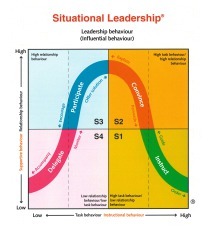
which leadership behaviour is most expedient in such cases
3 Which phase-specific behaviour is appropriate?
The typical change process can be expected to comprise the following seven phases:
Phase 1: Initial rumours about planned changes cause agitation and anxiety within the organization before they are officially announced. In this phase, it is important for leaders to stay in touch with the workers and to involve them in working out a set of rules for contending with the unclear situation
Phase 2: When a change – restructuration, for example – is officially announced, the attendant need for change becomes definitive. Hopes and fears find expression, but hardly anyone is yet able to picture what is actually going to happen. At this point, listening, informing and showing understanding are important
Phase 3: Once they get over the initial shock, the stakeholders tend to get angry. They go on the defensive and may even increase their productivity in an attempt to show that no such change is necessary. Now is the time to explain that the intended change is nevertheless both necessary and unavoidable
Phase 4: Eventually, the change will find rational acceptance, and the stakeholders will begin to deal with it: What is this going to mean for me? What challenges will I have to cope with? Will I be able to handle them and, if so, how? In this phase, the stakeholders cannot be expected to accurately judge the situation, so it is important to help them deal with this state of uncertainty
Phase 5: The low point of the process is when the stakeholders realize that there is no turning back. For the new situation to find emotional acceptance, the old situation must first be properly appreciated. The staff needs a time and place for lamentation and leave-taking – perhaps in the form of workshops and/or one-on-one talks
Phase 6: Not until this process has been completed can the stakeholders begin to invest any energy in the new situation. Now, the aim is to arouse their curiosity and give them the knowledge and skills they will need for dealing with the new circumstances. Encouragement and patience are helpful now, as are some opportunities to compare notes
Phase 7: The new situation gradually turns to normality, and as the workers learn the ropes, they gain more self-confidence. As a result, the system‘s performance increases beyond the original level, and it is now time to evaluate the process: What has gone well, and what has not? What has proven reliable? Based on the experience gained, each and every employee and the organization as a whole should now be in a better position to cope with future changes
Leaders who are familiar with the typical phases of change processes are also better able to help their subordinates deal (emotionally) with new challenges while improving their own self-confidence. They also become better able to backstop processes of change, hence expanding the company‘s competence in dealing with change in a professional manner. All this will bear fruit for subsequent projects.
//www.im-prove.de" target="_blank" >www.im-prove.de:www.im-prove.de

Überschrift Bezahlschranke (EN)
tab ZKG KOMBI EN
This is a trial offer for programming testing only. It does not entitle you to a valid subscription and is intended purely for testing purposes. Please do not follow this process.
This is a trial offer for programming testing only. It does not entitle you to a valid subscription and is intended purely for testing purposes. Please do not follow this process.
tab ZKG KOMBI Study test
This is a trial offer for programming testing only. It does not entitle you to a valid subscription and is intended purely for testing purposes. Please do not follow this process.
This is a trial offer for programming testing only. It does not entitle you to a valid subscription and is intended purely for testing purposes. Please do not follow this process.