
Cutting-edge classic: Situational Leadership
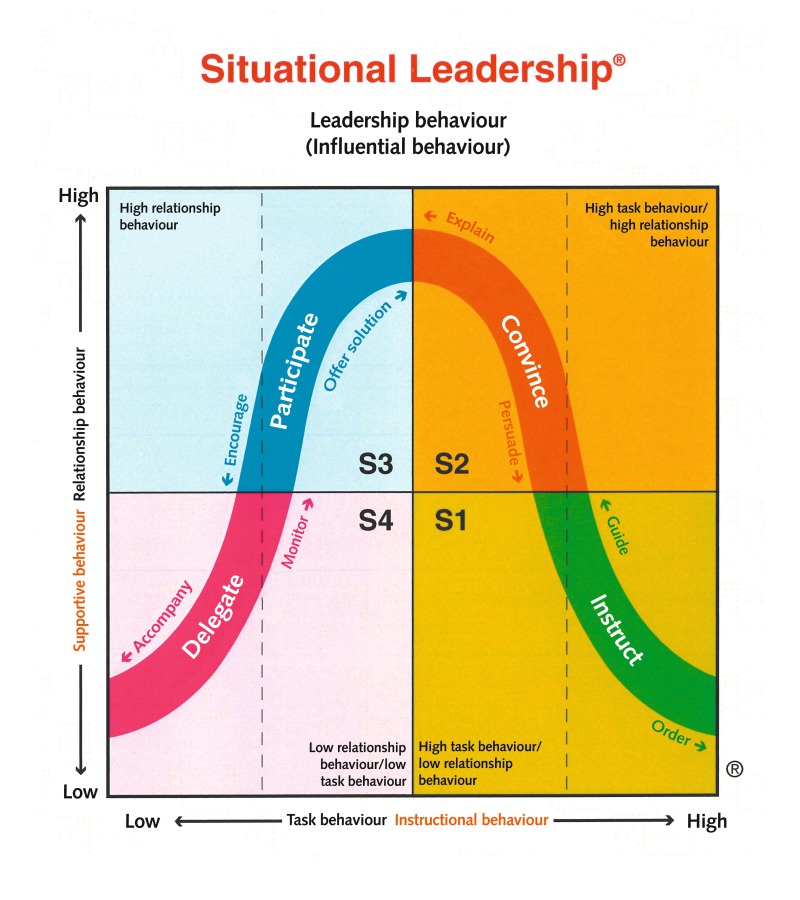
Leaders have to adapt their leadership style both to the as-found situation and to those they wish to lead. That thesis was developed by Paul Hersey, who helped invent the Situational Leadership theory more than 40 years ago. Now, at a time in which market requirements are changing rapidly and employees’ needs are becoming increasingly individual, that theory has become more topical than ever before.
There is no such thing as an ideal style of leadership. That, in a nutshell, is Paul Hersey’s main message. One core element of the message that the “inventor” of Situational Leadership wishes to convey is that the most successful leaders are those who show the most flexibility in their day-to-day approach. Sometimes, employees need praise, and sometimes a reprimand, sometimes active assistance is required, and sometimes a leader just needs to keep out of the way.
Frequently, a leader’s daily routine will consist of giving instructions and providing feedback, with no time left for personnel...
There is no such thing as an ideal style of leadership. That, in a nutshell, is Paul Hersey’s main message. One core element of the message that the “inventor” of Situational Leadership wishes to convey is that the most successful leaders are those who show the most flexibility in their day-to-day approach. Sometimes, employees need praise, and sometimes a reprimand, sometimes active assistance is required, and sometimes a leader just needs to keep out of the way.
Frequently, a leader’s daily routine will consist of giving instructions and providing feedback, with no time left for personnel development. That is unfortunate, because it marks the beginning of a vicious circle: Leaders who fail to foster their subordinates will never be able to gradually entrust them with additional, more complex tasks. Consequently, the leaders’ own burden grows heavier over time, because the workaday routine can always be counted on to pose new challenges. In addition, employees who receive too little support tend to keep nibbling away at their superiors’ time budget by asking lots of questions – or making lots of mistakes.
1 Consider the maturity level
There are four general stages of maturity with which to describe employees:
Level 1: The employee is neither able nor willing to perform a new job or task (perhaps because he or she still lacks the requisite skills)
Level 2: The employee is willing to tackle the new job or task, but still lacks the requisite competence
Level 3: The employee is capable of performing the new task, but remains insufficiently motivated, perhaps due to lack of confidence
Level 4: The employee is both willing and able to perform the task without help, perhaps because he or she has already mastered a number of similar challenges
The chosen style of leadership must be made dependent on the respective employee’s momentary maturity level.
2 Adapt your leadership style
There are two basic categories of leadership behaviour:
task-oriented behaviour: Here, the focus is on what has to be done and how. The main objective of this leadership style is to develop the employee’s competence
relationship-oriented behaviour: This style focuses on people’s self-initiative, their motivation and their attitude towards the job to be done. Typical examples of relationship-oriented behaviour include praise, listening and encouragement
Depending on how these two basic categories are formed and combined, they inspire one of the following four leadership styles:
Style 1 – instructing: This style of leadership is characterized by extensively dirigistic, one-way behaviour. The leader tells the employee exactly how to do the job and meticulously supervises the person’s work and performance
Style 2 – convincing: This style of leadership is still very dirigistic, but also quite supportive. The leader explains decisions, lauds suggestions (even if they are not fully on target) and provides detailed instructions. The employee is encouraged to develop own ideas, although the leader still makes the decisions
Style 3 – participating: This style of leadership is very supportive, but much less dirigistic. It is tailored to strengthening and/or preserving the employee’s motivation. This kind of leader values, trains, listens to and encourages employees to make independent decisions
Style 4 – delegating: This style of leadership is hardly dirigistic and only faintly supportive. The employee is expected to work independently, while the leader simply supplies the requisite resources. Nevertheless, the latter still defines the desired results and maintains clarity of purpose while monitoring progress
3 Carefully develop your staff
A leader who is familiar with the four basic styles of leadership and is aware of each employee’s own level of maturity can recognize which style of leadership is appropriate to a given task. If the employee is new to the job and still has little relevant competence, an instructive approach is called for. In the case of a rather inexperienced but highly motivated employee being assigned to a new job, the trick is to maintain that motivation while providing adequate explanation and training. If an employee is already highly competent but lacks the corresponding confidence, then moral support is of primary importance. And finally, if an employee is both well practiced and well motivated, the leader can simply assign him or her the targeted task.
Such a flexible style of leadership successively expands the employee’s competence and performance level. For leaders, this means that they will have fewer flames to douse and more time for attending to their core tasks. In addition, the overall time saved will be many times over that which was invested in employee development. Finally, both productivity and staff morale will improve.
Voss+Partner will be hosting workshops on “Situational Leadership” in Hamburg on 19/20 September and 21/22 November, for example.
//www.voss-training.de" target="_blank" >www.voss-training.de:www.voss-training.de

Überschrift Bezahlschranke (EN)
tab ZKG KOMBI EN
This is a trial offer for programming testing only. It does not entitle you to a valid subscription and is intended purely for testing purposes. Please do not follow this process.
This is a trial offer for programming testing only. It does not entitle you to a valid subscription and is intended purely for testing purposes. Please do not follow this process.
tab ZKG KOMBI Study test
This is a trial offer for programming testing only. It does not entitle you to a valid subscription and is intended purely for testing purposes. Please do not follow this process.
This is a trial offer for programming testing only. It does not entitle you to a valid subscription and is intended purely for testing purposes. Please do not follow this process.