Safe and clean material transport
Summary: With the exchange of the two cold-regenerated adsorption dryers for the powerful heat-regenerated adsorption dryer, Andreas Jaculy’s planning team, the selected maintenance partner of the H. Oetelshofen GmbH & Co. KG, created an exceptional win-win situation for both companies – for the lime works and for its maintenance partner. While the lime works saves enormous energy costs, the maintenance partner profits from the significantly reduced maintenance requirements at the compressors. The benefits for all those involved result from the different operating principles of cold- and heat-regenerated adsorption dryers.
Just imagine a kind of pneumatic tube in the XXL size. In the H. Oetelshofen GmbH & Co. KG lime works, limestone powder is transported according to the plug-conveying principle from the production sites to the storage silos. Compressed air serves as the transport medium and in this respect one thing is of utmost importance: it must be absolutely dry. With its
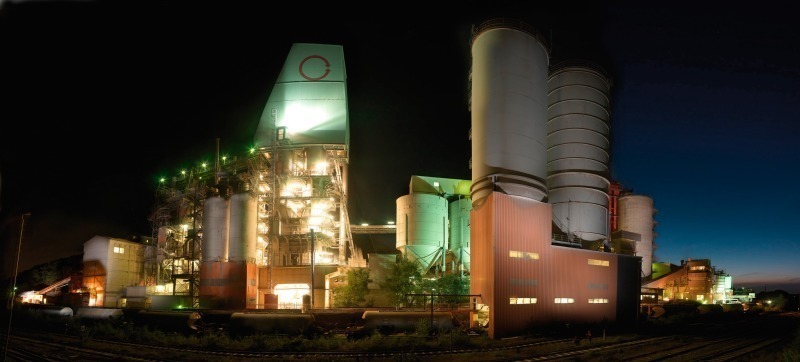
Osterholz stone quarry in Wuppertal-Hahnenfurth/Germany, and the adjacent works, the medium-sized enterprise ranks among the pioneers and pacemakers of industrial lime production. Situated in the heart of one of the most...
Just imagine a kind of pneumatic tube in the XXL size. In the H. Oetelshofen GmbH & Co. KG lime works, limestone powder is transported according to the plug-conveying principle from the production sites to the storage silos. Compressed air serves as the transport medium and in this respect one thing is of utmost importance: it must be absolutely dry. With its
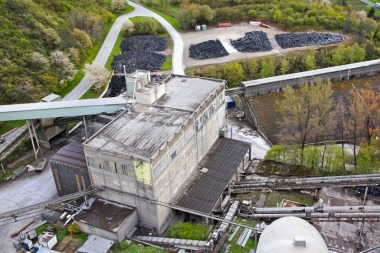
Osterholz stone quarry in Wuppertal-Hahnenfurth/Germany, and the adjacent works, the medium-sized enterprise ranks among the pioneers and pacemakers of industrial lime production. Situated in the heart of one of the most important European limestone deposits, in the Bergisch Dornap district, Oetelshofen calcines more than 220 000 t of lime per annum from the excavated rock.
The lime industry consists of a broad range of users which need to be served – with both silo tanker lorries and silo wagons. But already before the valuable cargo leaves the works, a great transportation challenge has to be overcome: the material flow within the production site, for example between the individual production units and the storage silos. While coarser-grained products, such as mineral aggregates, lump lime or limestone gravel can be moved relatively easily, this is not the case with limestone powder.
This finely-ground material is wind-sensitive and hydrophilic in equal measure. Open transport, or even transport in the open air, is therefore not advisable. The alternative for the limestone powder at Oetelshofen: conveyance via compressed air through a closed pipe system. The pipe network of the gigantic “pneumatic tube system” for limestone powder on the Oetelshofen factory premises, which is subdivided into three lines and branched by means of guides, is just under 1.2 km long. Via this system, “powder packages” are sent by compressed air according to the pneumatic plug-conveying transport principle.
For this purpose, pneumatic capsules are available at the respective starting points of the pipe system, filled with the transport material and charged with compressed air. Via a valve that opens at regular intervals, the limestone powder is sent in gushes from this point into the 125 mm pipework. This transport mode is so efficient and powerful that even vertical tubing sections can be negotiated over long distances without problems, for example up to the inlet piece of the storage silos for the limestone powder with a height of 45 m.
Many parameters determine the functioning or the non-functioning of the system. Above all, reliably dry compressed air. Limestone powder is sensitive to humidity. Even the slightest introduction of humidity can lead to agglutination, and thus to a narrowing of the pipe cross-sections. Or the plugs become so tight that they stop gliding and clog the pipe. This would involve extensive maintenance and repair efforts, not to mention the losses caused by production stoppages. A reliably constant supply of absolutely dry compressed air is therefore vital for process assurance.
Reliability was also the decisive criterion for the selection of the Jaculy Drucklufttechnik GmbH from Oberhausen/Germany as consulting partner and maintenance service provider. Oberhausen is the place where, among other things, all concepts and plans for the complete restructuring of the compressed-air supply at Oetelshofen, initiated in 2003, were developed.
Up to that time, there were several small “stand-alone” solutions with compressors at different places, spread over the factory premises. The maintenance involved considerable time and costs, so that the economic effectiveness and efficiency of the entire system was no longer guaranteed. “Both for the customer and for us as the maintenance company”, said Andreas Jaculy, summing up the situation. A central compressor station was finally configured, in which all the main networks of the site are consolidated. The existing compressed-air pipework systems were re-arranged and reasonably restructured.
And finally, an exceptional complete maintenance package was offered to Oetelshofen, which included full warranty for all components of compressed-air processing and supply. “An all-around carefree package with full financial risk protection, so to speak”, explained Jaculy. “Of course a maximum amount of technical safety for this was also required. My own calculation as a maintenance company and guarantor can only work out if I myself do not experience any unpleasant surprises regarding the installed devices.”
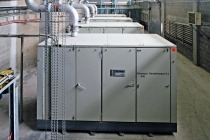
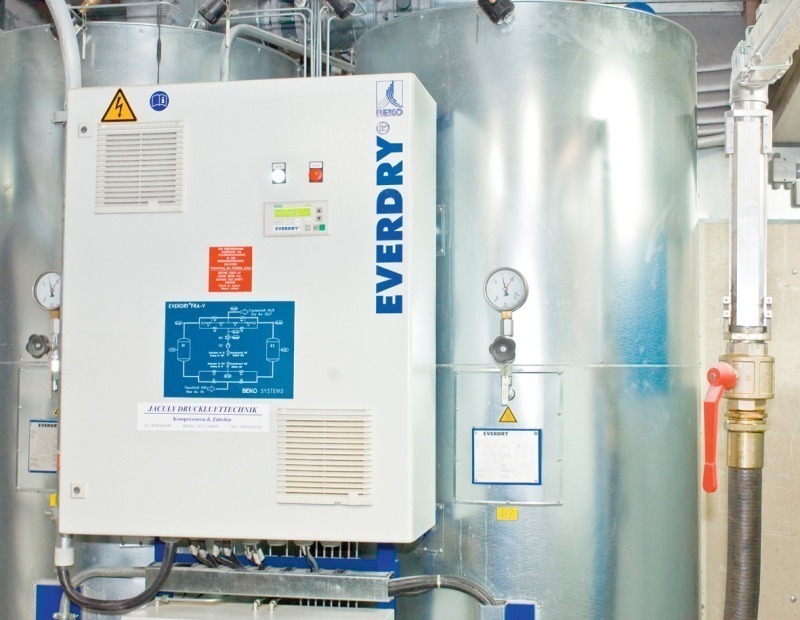
The compressed-air expert evaluates the heat-regenerated adsorption dryer of the EVERDRY FRA-V series (Fig. 1), installed at Oetelshofen at the end of 2009, as an important pillar of the entire plan, as far as technology and costs are concerned. The device, developed and distributed by the German compressed-air system specialist BEKO Systems GmbH fully replaces the two cold-regenerated adsorption dryers, employed until then, during the winter season.
With the exchange of the two cold-regenerated models for the powerful heat-regenerated adsorption dryer, Andreas Jaculy’s planning team created an exceptional win-win situation for both companies – for the lime works and for its maintenance partner. While Oetelshofen saves enormous energy costs, Jaculy profits from the significantly reduced maintenance requirements at the compressors. The benefits for all those involved result from the different operating principles of cold- and heat-regenerated adsorption dryers.
Cold-regenerated adsorption dryers consume approx. 15 % of the compressed air provided by the compressor as purge air – meaning for their “own needs”. This amount of air is completely lost for the actual intended use of the compressed air in the respective plant. Nevertheless it needs to be produced by the compressors, with the corresponding energy and cost requirements. These “unnecessary” costs through purge air losses quickly add up to unacceptable amounts. This neutralises the low to medium investment costs for cold-regenerated devices.
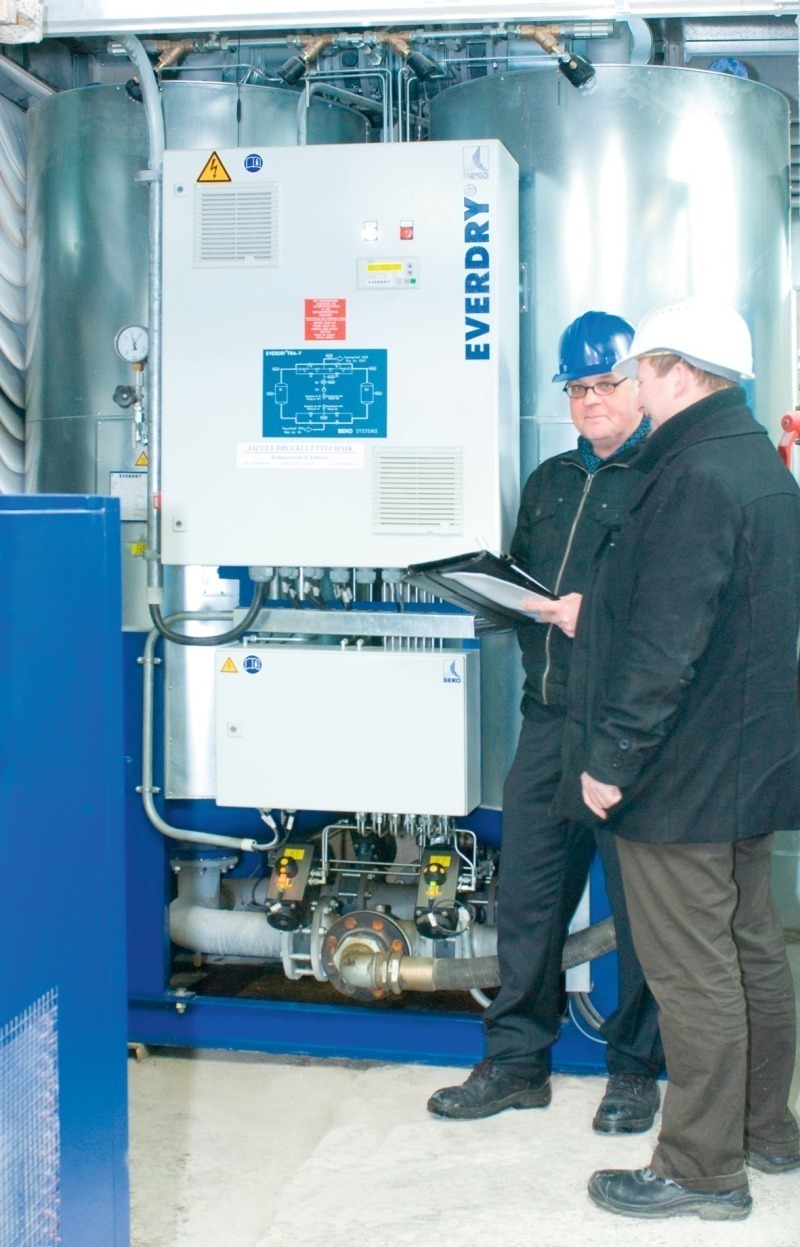
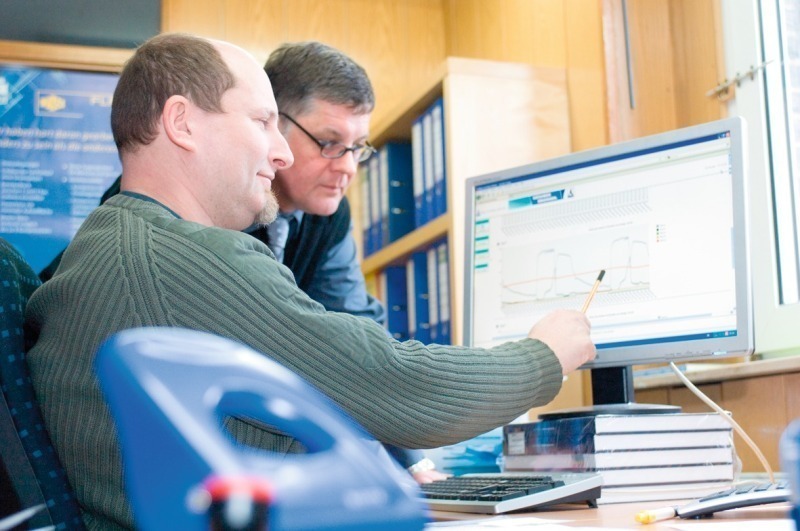
When exactly analysing the user‘s application and consumption situation, a heat-regenerated device turns out to be significantly more cost-effective, as is the case with Oetelshofen. According to the prognosis, the investment costs for the EVERDRY FRA-V will have been fully paid off within only one and a half years. Andreas Jaculy (Fig. 2 right) and BEKO-sales engineer Udo Mueller (left) discuss the optimum system configuration at regular intervals.
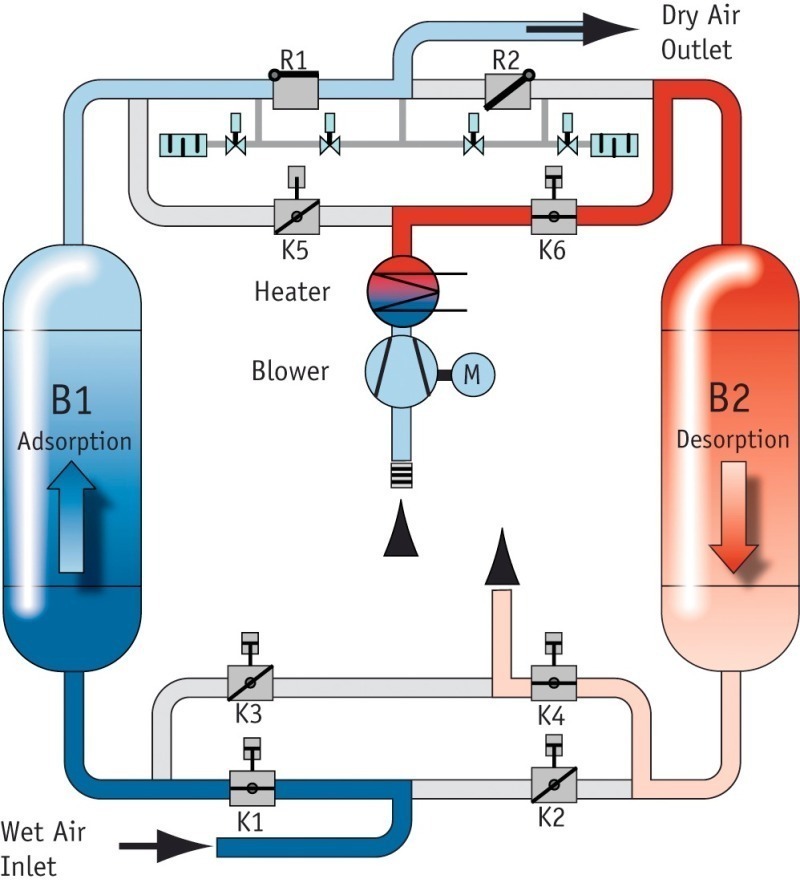
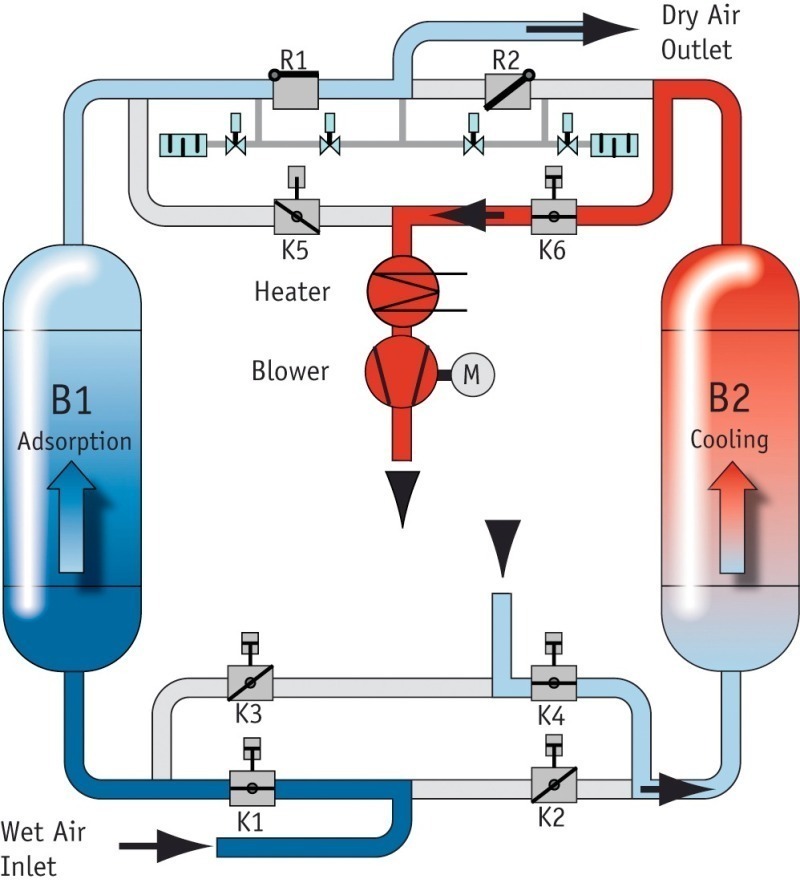
The heat-regenerated EVERDRY FRA-V from BEKO, which was chosen for Oetelshofen, is a so-called “zero purge” adsorption dryer, which does not require compressed air either for the desorption process or for the subsequent cooling of the heated desiccant (Figs. 3 and 4). During the desorption phase, the regeneration blower works under pressure conditions. While the drying of the compressed air takes place in one of the adsorption containers, the second adsorption container – which was saturated with moisture beforehand – is regenerated. Prior to the start of regeneration, a gentle pressure relief to atmospheric pressure is implemented. The regeneration blower conveys ambient air to the downstream heater. There, heating to the required desorption temperature takes place.
The pressure operation of the regeneration blower results in a temperature increase which has a positive effect on the power consumption of the heater. The heater air flow from the blower vaporises the moisture taken up by the desiccant. Subsequently, this moisture is discharged into the atmosphere along with the air flow from the blower. Desorption takes place in an energetically-optimised way using a reverse-current process, meaning opposite to the adsorption direction.
The cooling phase takes place under vacuum conditions. Temperature and dew point peaks subsequent to the switch-over are prevented by removing the heat accumulated in the desiccant after the desorption phase, along with the cool air flow from the blower. In the cooling phase, the blower switches to suction operation, whereby the ambient air flows directly into the adsorption container to be cooled. The negative pressure, produced during the suction operation, causes a change of the “physical balance” in the desiccant. The desorption temperature decreases as a result of the negative pressure, thus effecting after-desorption during the cooling phase. Due to the after-desorption, there is a lower residual load in the desiccant after the regeneration phase (heating and cooling). The residual load in the desiccant decisively influences the quality of the drying phase.
The EVERDRY FRA product line from BEKO offers numerous variation possibilities. The standardised series is available for volume flows of up to 20 000 m³/h. The portfolio also includes special solutions for over 20 000 m³/h. With a volume flow of approximately 2700 m³/h, which is currently required at Oetelshofen, all expansion options are available for the future with the EVERDRY FRA-V.
At first glance only the lime works benefits from the saving in energy costs. “I can ensure that the compressors installed at Oetelshofen operate at a reduced load, as they do not need to produce useless purge air for the dryer”, Andreas Jaculy explains. “This noticeably preserves the devices and significantly reduces my expenses for maintenance and repair, or even for the replacement of a device. Therefore, the EVERDRY from BEKO is virtually a kind of survival guarantee for my overall concept at Oetelshofen.”
Another decisive point made this particular heat-regenerated adsorption dryer first choice for him: the EVERDRY FRA-V can be fully remote-monitored, online, via Internet access (Fig. 5). Down to the position of the smallest flap in the device, maintenance specialist Jaculy can control every function of the dryer using his company PC in Oberhausen – or any other computer. This saves him a lot of travelling expenses and journey time to the place of action. Incidently , the EVERDRY is not the only plant component from the German compressed-air system specialist BEKO there. Further components, such as a DRYPOINT RA refrigeration dryer and several CLEARPOINT filters, are also employed.

Überschrift Bezahlschranke (EN)
tab ZKG KOMBI EN
This is a trial offer for programming testing only. It does not entitle you to a valid subscription and is intended purely for testing purposes. Please do not follow this process.
This is a trial offer for programming testing only. It does not entitle you to a valid subscription and is intended purely for testing purposes. Please do not follow this process.
tab ZKG KOMBI Study test
This is a trial offer for programming testing only. It does not entitle you to a valid subscription and is intended purely for testing purposes. Please do not follow this process.
This is a trial offer for programming testing only. It does not entitle you to a valid subscription and is intended purely for testing purposes. Please do not follow this process.