Studies into the wetting behaviour
of polymer-modified cement stones
![1 Pores lined with polymer [1]](https://www.zkg-online.info/imgs/101524097_ad94320c3d.jpg)
Summary: Polymer modifications cause changes in the porosity of cement stones. The redispersible powder used here resulted in a rise in total porosity as the amount of powder added increased. The polymer dispersion used resulted, in particular, in a reduction in the proportion of capillary pores in the cement stones and in a more compact matrix. Despite these differing effects on the porosity of the cement stones, both types of modification achieved significantly lower rates of capillary water absorption compared to an unmodified sample. The hydrophobing action of polymers in polymer-modified cement stones was verified by means of measurement of the contact angle using the Washburn method.
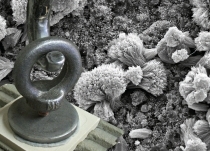
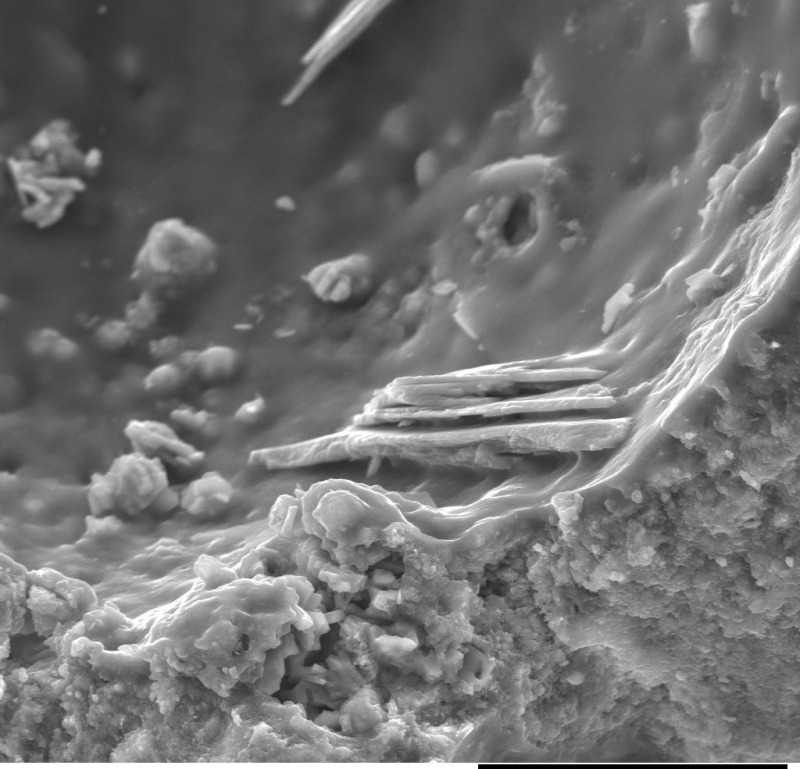
Polymer-modified mortars and concretes are referred to both within Germany and internationally as polymer cement concretes (PCC). The input materials take the form of cement, aggregate, water, polymers and, where necessary, further additives. In an ideal case, the polymer particles are uniformly distributed in the structure and form a binder matrix together with the solidified cement (Fig. 1).
Modification with selected polymers makes it possible to systematically achieve specific PCC properties. These include, on the one hand, green-mortar and green-concrete properties; worthy...
Polymer-modified mortars and concretes are referred to both within Germany and internationally as polymer cement concretes (PCC). The input materials take the form of cement, aggregate, water, polymers and, where necessary, further additives. In an ideal case, the polymer particles are uniformly distributed in the structure and form a binder matrix together with the solidified cement (Fig. 1).
Modification with selected polymers makes it possible to systematically achieve specific PCC properties. These include, on the one hand, green-mortar and green-concrete properties; worthy of mention, in particular, is easier workability and application, since the polymers frequently possess a liquefying action. This makes it possible to reduce the water/cement ratio, resulting in a decrease in capillary porosity. The addition of polymers also increases water-retention capacity. Solids properties, on the other hand, are also modified. PCCs generally exhibit higher tensile and tensile bending strengths, the modulus of elasticity is reduced, and adhesion to the substrate is significantly improved. In addition, provided capillary porosity has been reduced, PPCs are normally less permeable to liquids, compared to standard mortars and concretes. It is surmised that this higher impermeability of PCCs can also be attributed to a certain hydrophobing action by the polymers. This results in lower binder-matrix wettability, even in cases in which the modification does not decrease capillary porosity. As can be seen from Figure 1, polymer particles accumulate to form films in the PCC structure. The generation of such polymer films in the pore structure of the PCC is another factor promoting the greater impermeability of PCCs to infiltrating substances. Possible swelling of the polymers upon contact with moisture could be a further cause of the greater impermeability of PCCs.
Various polymers are used to modify cement-bound systems. One modification route is the use of redispersible powders, which are obtained from dispersions by means of spray drying. Mixing with water restores them to the state of stable dispersion, containing not only the original dispersion, but also spraying aids, anti-caking agents and other additives. A further modification technique utilizes polymer dispersions, consisting of two phases, namely water, as the continuous phase, also occasionally referred to as the dispersant phase, and polymer particles, as the dispersed phase [1, 2].
The objective of the investigations performed was that of verifying the hydrophobing action of polymers in PCCs by means of suitable mensurational methods. Since the binder matrix is critical for the generation of the impermeability properties, the tests were performed exclusively on cement stones. This also made it possible to exclude any influences exerted by the aggregate.
A redispersible powder with the internal designation KS 2 and an aqueous dispersion bearing the internal designation KS 4 were used as the polymers for the modifications. Both polymers are based on acrylic acid ester styrene copolymers. Three formulation variants with the same water/cement (w/c) ratio of 0.50 were prepared using each of the two polymer systems. The polymer/cement (p/c) ratios were varied in each case, as follows:
p/c = 0.05
p/c = 0.10 and
p/c = 0.15
An unmodified sample (NP) with the same w/c ratio was also prepared, to permit comparative evaluation of the effects of the polymer modifications. The porosity characteristics of the samples were determined, their water-absorption rates quantified, their contact angles measured and their surface energies calculated.
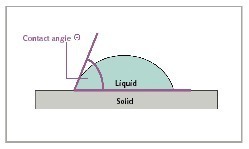
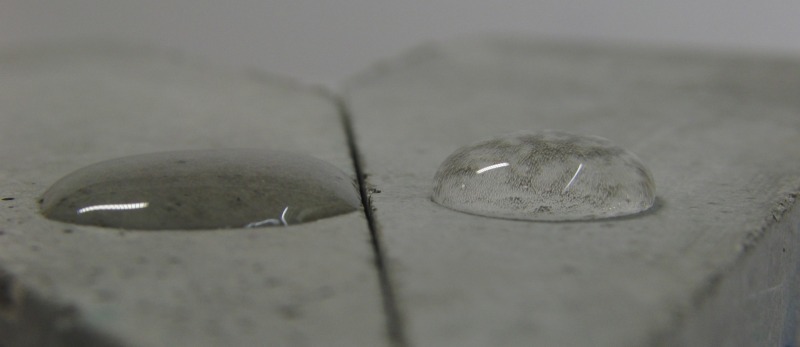
The term “wetting” signifies the spread of a liquid on the surface of a solid. The term “contact angle” is also closely associated with wetting. Contact angle Q is defined as the angle which a drop of liquid forms on the surface of a solid (Fig. 2). An equilibrium of forces is the reason for the occurrence of a contact angle Q. The magnitude of angle Q depends in this context on the interaction between the liquid and the solid at the contact surface. The lower these interactions, the larger the contact angle and the poorer wettability will be. Complete wetting occurs at a contact angle of Q = 0 °, i. e., a drop of the liquid will then spread uniformly across the surface of the solid, forming a surface film. Wetting is referred as “incomplete” in cases in which the value of the contact angle Q is between 0 ° and 90 °. Where the boundary angle is > 90 °, the corresponding liquids are designated “non-wetting” liquids [3, 4, 5, 6].
A further term frequently used in conjunction with wettability is “free surface energy”. This is calculated from contact angle data and is made up of a polar and a dispersive component (Equation 1).
Free = polar + dispersive
surface energy component component(1)
s = sP + sD
The polar component of surface energy can be attributed to dipole/dipole interactions, hydrogen bonds or Lewis acid-base interactions. The dispersive component is generated by Van der Waals interactions. All materials possess this dispersive component of surface energy. There are, however, a number of substances which have no polar component; these are referred as “non-polar” substances [7, 8].
Since cement stone is a porous, absorbent material, the so-called sorption or Washburn method is used for determination of the contact angle. This procedure permits the investigation of powder and more compact samples possessing a pronounced absorption behaviour. The increase in weight resulting from absorption of the test liquid across time is measured.
For the purpose of measurement of the contact angle, the fully solidified cement stone samples were firstly comminuted to powders of a particle size of < 63 µm, in order to minimize any effects caused by pores and/or cracks in the cement stone structure. It is assumed that, from a particle size of less than 63 µm onward, all accessible pores in the cement stone are opened, as is also assumed, for example, for determination of particle density using the Blaine tester.
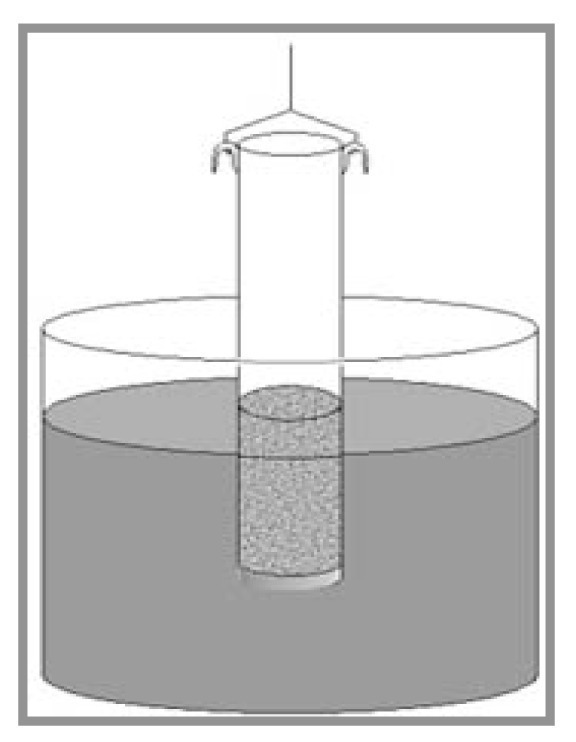
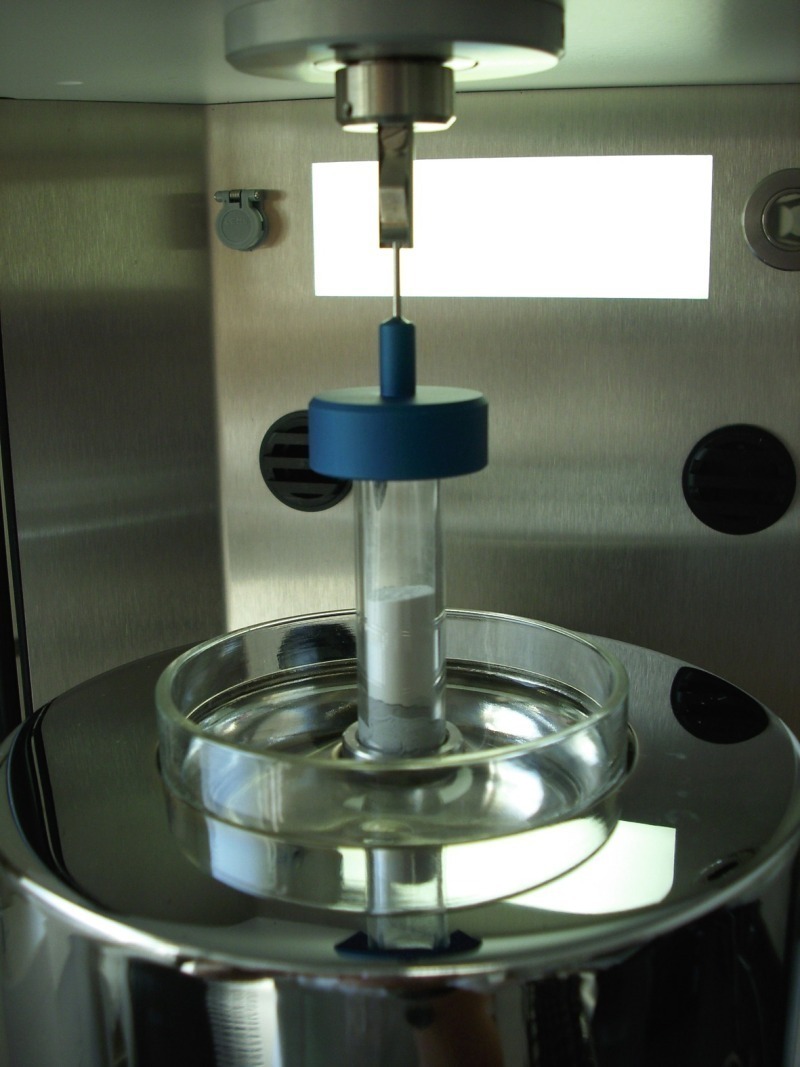
The powder samples were put into a glass tube with a filter base and brought into contact with the surface of the measuring liquid (Figs. 3 and 4). Constant amounts weighed in and a constant degree of compaction of the bulk samples must be ensured in each case during sample preparation. The greatest attention must also be devoted to achieving maximum cleanness, since even the slightest contamination of the liquid can cause significant fluctuations in the measured data obtained.
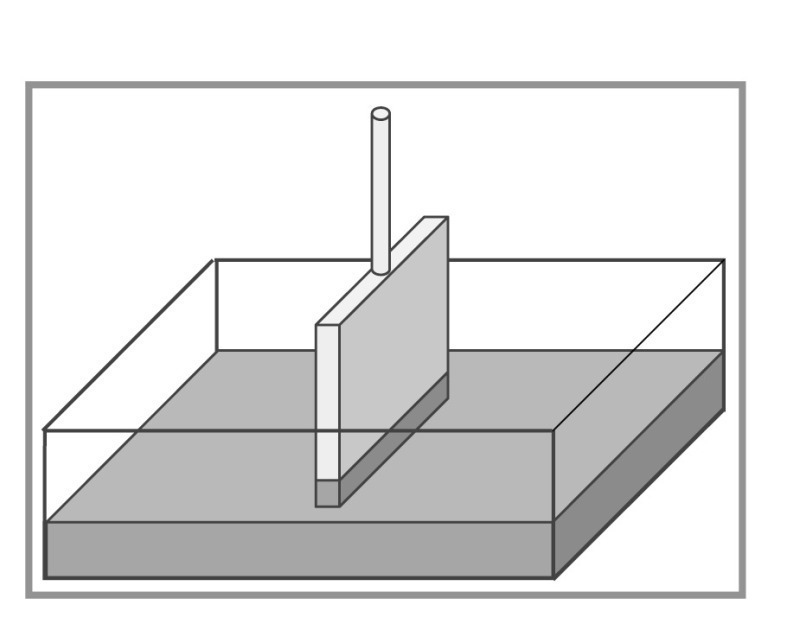
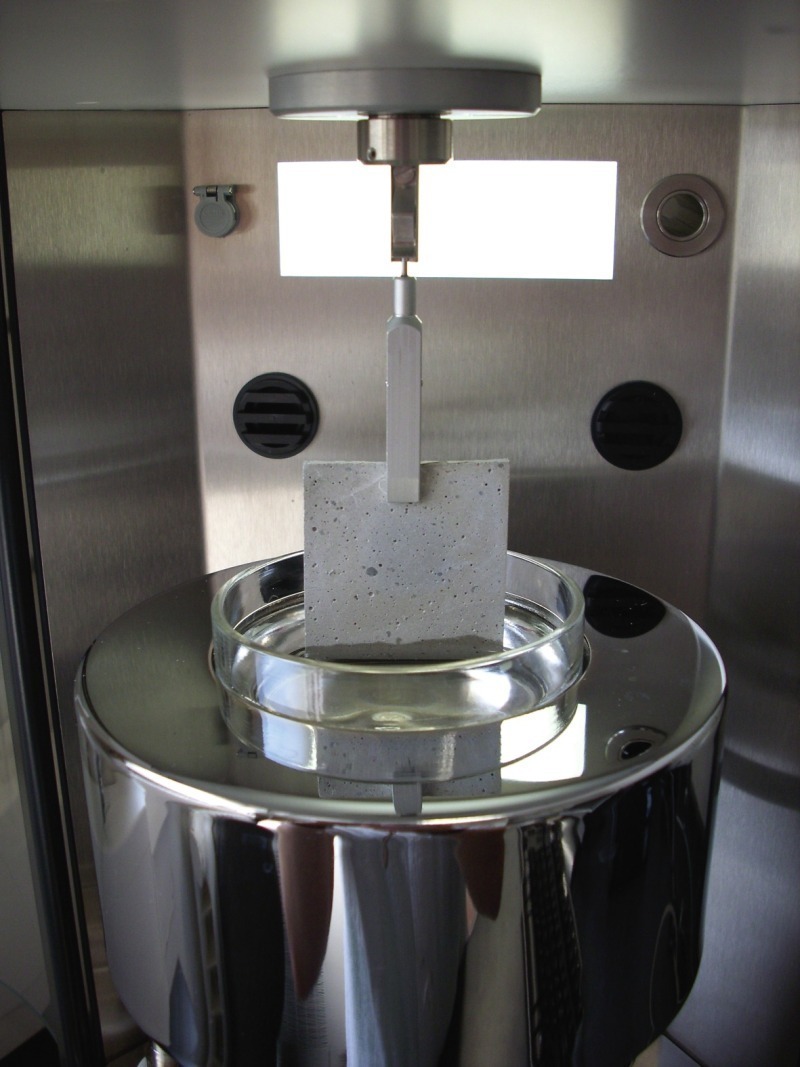
Tile-shaped solid samples were also tested. For this purpose, cement stone prisms of 4 x 4 x 16 cm³ were firstly prepared, and after solidification were cut into tiles of approx. 5 mm in thickness. The tiles were suspended on a mounting and brought into contact with the surface of the liquid in such a way that the test solution was able to ascend in the sample (Figs. 5 and 6).
In the sorption method, the sample is considered as a bundle of capillaries. In this measuring method, the contact angle is calculated using the Washburn equation (Eq. 2):
l2 = (sl · r) · cos Q (2)
t 2 h
in which:
l ➝ Flow path
t ➝ Flow time
sl ➝ Surface tension of the liquid
r ➝ Capillary radius
Q ➝ Advancing angle/contact angle
h ➝ Viscosity of the liquid
Capillary radius r must be replaced by a constant which describes the mean radius. This constant is calculated from the density of the test liquid and the increase in weight occurring during measurement. The viscosity and surface tension of the liquid used must also be known. Measurement is firstly conducted using an optimally wetting liquid, such as heptane, for example, the contact angle of which is virtually 0 °. The ma-terial constant sought, i. e., the characteristic capillary radius r for each sample, derives from the measurement in the linear range of the measuring curve. This constant, which is specific for each sample, is used in the Washburn equation for all further measurements, generally using deionized water as the test liquid. The surface energy of the sample can be calculated from the contact angle data obtained using a non-polar liquid, such as hexadecane or diiodmethane [7].
The measurements of the contact angles were performed using the K 100 tensiometer manufactured by KRÜSS GmbH and evaluated with the related “KRÜSS Laboratory Desktop” software package. The tensiometer software includes various procedures for calculation of surface energy; this program also features a database containing all the necessary physical data for a large range of liquids.
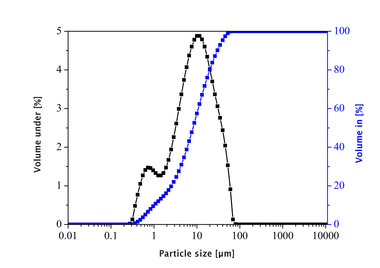
As is known from previous publications, polymer modifications have influences on the porosity characteristics data of cement stone [1, 2]. Classification of pore sizes was performed in accordance with SETZER [9] (Table 1).
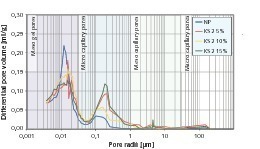
KS 2 increased porosity. These modified systems exhibited significant increases in the percentage of pores in the capillary-pore range as p/c ratio increased (Fig. 7). A simplified classification of the porosity contents into
– gel pores (GP) 1 nm to 30 nm
– capillary pores (KP) 30 nm to 1 mm
(classification as per SETZER [9])
and the total porosities determined by means of mercury porosimetry is compiled in Table 2. These numerical data also illustrate that modification with the redispersible KS 2 powder significantly increased porosity, in the capillary-pore range, in particular, compared to the unmodified cement stone sample (Table 2).
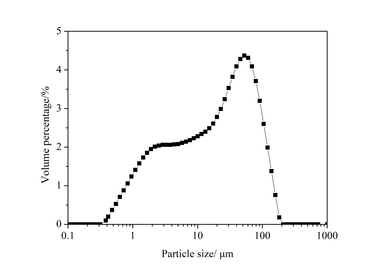
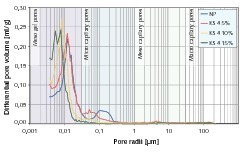
The samples modified with KS 4 manifested a significantly denser matrix. Porosity shifted into the gel pore range as polymer content increased (Fig. 8). The cement stone thus acquired a denser structure, compared to unmodified cement stone, as a result of the addition of KS 4.
As from polymer contents of 10 %, modification with the KS 4 polymer dispersion resulted primarily in reduction of the proportion of capillary pores compared to the unmodified cement stone (Table 3).
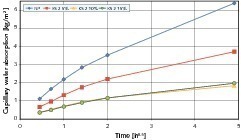
Capillary water-absorption rates were determined in accordance with DIN EN 13057: 2002. Cement stone prisms of dimensions 4 x 4 x 16 cm3 were used as the test objects. Test surface area was 0.0064 m2. Weighing was performed after 12 min., 30 min., 1 h, 2 h, 4 h and 24 h, to determine any changes in weight. The polymer-modified cement stones, despite their in some cases higher porosities, exhibited lower capillary water-absorption rates than the unmodified sample. The capillary water absorption rates of the modified cement stones are compared to those of the non-modified cement stones in Table 4.
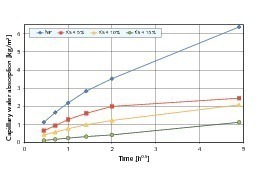
Even at the early initial measuring times, the cement stones modified with KS 2 absorb less water than the non-modified sample (Fig. 9). Particularly significant differences became apparent after 24 hours. All the data measured for the modified samples were below the results obtained for the control sample. The results for the modifications with polymer contents of 10 % and 15 % were approximately identical. Capillary water absorption was reduced by the modifications to around 1/3 of the water-absorption rates of the control sample.
The samples modified using the KS 4 dispersion also exhibited significantly reduced rates of capillary water absorption compared to the unmodified cement stone (Fig. 10). Unlike the samples modified with KS 2, the results obtained here differed extremely significantly for differing polymer contents. The samples absorbed less water as the amount of polymer in the cement stone structure increased. At the maximum polymer content of 15 %, capillary water absorption was reduced to around 1/6 of that of the control sample.
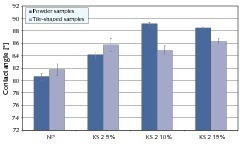
In the case of the modified cement stone samples, the results of contact angle measurements indicated a significant correlation between polymer/cement ratio and contact angle, depending, in particular, on the type of polymer used. The samples modified with the KS 2 redispersible powder exhibited, as from p/c ratios of 0.10, significant differences between the data measured for powder and for tile-shaped samples (Fig. 11).
The results for measurement of the contact angle obtained from the powder samples reflected the results for capillary waterabsorption rates extremely well. The contact angles of the powder-type cement stones with p/c ratios of 10 % and 15 % also scarcely differed from one another.
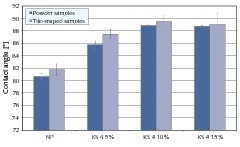
In the case of the cement stones modified with the KS 4 dispersion, an increase in the contact angle as p/c ratio became greater was also apparent in both the powder and the tile-shaped samples (Fig. 12). The slightly lower values obtained for the powder samples were probably the result of the increase in surface area caused by grinding, which would have increased wettability and reduced the contact angles.
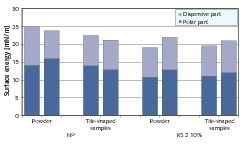
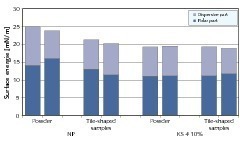
The dispersive and polar components of surface energy are shown in Figures 13 and 14. All the modifications exhibited lower surface energies compared to the unmodified control sample. The polar components, in particular, are definitive for the lower total values for free surface energy. These components decreased as the polymer content in the cement stone samples increased.
Polymer modifications result in changes in the porosity of cement stones. The redispersible powder used here caused a rise in total porosity as the amount added increased. The polymer dispersion used resulted in the capillary pore content of the cement stones, in particular, being reduced, and in the matrix becoming more compact. Despite these differing effects on the porosity of the cement stones, both modification types produced significantly lower rates of capillary water absorption compared to an unmodified sample.
Measurement of the contact angle using the Washburn method made it possible to verify the hydrophobing effect of polymers in polymer-modified cement stones. The contact angles measured were significantly larger in the case of the modified samples than in the case of the control sample.
The contact angle data obtained using various measuring liquids made it possible, using the existing data-base, to calculated the free surface energies of the samples examined, with their dispersive and polar components. The polymer modifications in all cases resulted in a reduction of surface energy. It became apparent during evaluation of the results that the addition of polymers reduced the polar components of the surface energy of the cement stones in particular. The results of the analyses performed here confirm the thesis that polymer modification can produce hydrophobation of the cement stone matrix.
The authors express their thanks to the European Regional Development Fund (ERDF) for supporting the project.

Überschrift Bezahlschranke (EN)
tab ZKG KOMBI EN
This is a trial offer for programming testing only. It does not entitle you to a valid subscription and is intended purely for testing purposes. Please do not follow this process.
This is a trial offer for programming testing only. It does not entitle you to a valid subscription and is intended purely for testing purposes. Please do not follow this process.
tab ZKG KOMBI Study test
This is a trial offer for programming testing only. It does not entitle you to a valid subscription and is intended purely for testing purposes. Please do not follow this process.
This is a trial offer for programming testing only. It does not entitle you to a valid subscription and is intended purely for testing purposes. Please do not follow this process.