PCE 2017 – Polycarboxylates at the frontier of modern concrete technology

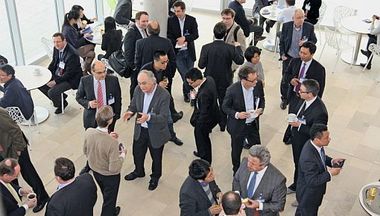
Polycarboxylate (PCE) superplasticizers were the focus of a high-level conference which took place on 27.09.–28.09.2017 at Technische Universität München. The event was attended by more than 200 delegates from 29 countries, with a strong participation from China, the world’s largest PCE producer. Hosted by Prof. Johann Plank and Dr. Lei Lei from the Chair for Construction Chemistry at TUM, the conference provided insight into the latest trends and future perspectives of PCE technology.
1 Full day workshop
The event started on 27.09.2017 with a full day workshop on the chemistry, analysis and industrial production aspects of PCE polymers and was attended by 120 delegates. There, Prof. Plank pointed out that nowadays PCEs present a huge family of chemically often significantly different copolymers such as methacrylate ester (MPEG), allyl ether (APEG), vinyl ether (VPEG), methallyl ether (HPEG), isoprenyl ether (IPEG) or phosphated (PHOS) polycarboxylates. Their common structural motif is the shape of a comb polymer which provides the steric hindrance effect in dispersion and...
1 Full day workshop
The event started on 27.09.2017 with a full day workshop on the chemistry, analysis and industrial production aspects of PCE polymers and was attended by 120 delegates. There, Prof. Plank pointed out that nowadays PCEs present a huge family of chemically often significantly different copolymers such as methacrylate ester (MPEG), allyl ether (APEG), vinyl ether (VPEG), methallyl ether (HPEG), isoprenyl ether (IPEG) or phosphated (PHOS) polycarboxylates. Their common structural motif is the shape of a comb polymer which provides the steric hindrance effect in dispersion and makes them such powerful admixtures. In her presentation Dr. Lei explained that in typical synthesis processes 100 % pure PCE polymers are never achieved, therefore it is useful to analyze the reaction product via anionic charge titration and size exclusion chromatography to determine its actual composition. Moreover, 13C NMR spectroscopy can provide insight into the repartition of the side chains along the polymer trunk, thus giving information about whether a random (statistical) or a gradient polymer was achieved in the synthesis. Dr. Lei also recommended that prior to performance testing, the synthesized PCE polymers should be purified by dialysis to remove any non-reacted monomers or by-products; only after such a purification step, the actual performance of a specific polymer is revealed.
The second half of the workshop was opened by Dr. Ara Jeknavorian, formerly W.R. Grace and now an independent consultant, with an in-depth presentation on defoaming issues of PCEs. He first explained why all PCEs possess a significant surfactancy and therefore require a defoamer to be blended into their solution. However, most defoamers are incompatible with PCE solutions and separate after some time as fish eyes on the surface. Dr. Jeknavorian introduced several stabilization technologies including defoamers which form ion-pairs with PCEs or defoamer emulsions which have proven successful under diverse climate conditions. Application aspects of PCEs were addressed by Prof. Plank in the last part of the workshop. There, the reason behind the cement incompatibility of specific PCE polymers was attributed to their ability to reduce the size of ettringite to nanoscale, thus creating huge mineral surfaces which need to be occupied by PCE via adsorption. Furthermore, the interaction of PCEs with clay minerals occurring in aggregates as impurity was discussed in detail. It was shown that via their EO side chains, PCEs can incorporate chemically into the layered structure of montmorillonite clay and thus are used up, having no effect on the cement. As mitigation strategies, PCEs with side chains other than polyEO, sacrificial agents or cationic polymers were suggested. Finally, new research results on how to solve the problem of “sticky” concrete observed from PCEs at low w/c ratios were introduced. It was shown that non-ionic polymers or small molecules such as polyethylene glycol or diethylene glycol can act as co-dispersant (auxiliary admixture) for PCEs and greatly improve the flow speed of such concretes prepared with PCEs.
2 Presentation of the laboratories
After these presentations which provided ample opportunities for questions and discussions the delegates were invited to visit the laboratories of Prof. Plank’s institute. There, a typical synthesis was demonstrated, analytical instrumentation for the characterization of PCEs was displayed and application testing in the mortar lab was presented.
The day ended with an informal get-together dinner at Gasthof Neuwirt in Garching where delegates could digest not only the delicious Bavarian food, but also the huge amount of information on PCE technology which for good reason the organizers had compiled in a book about the workshop.
3 Dr. Hirata – special guest at the conference
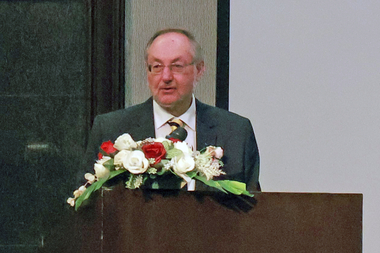
On 28.09.2017, Prof. Plank and Dr. Lei opened the conference by highlighting that polycarboxylates have been the main invention in concrete technology over the last 30 years, because only PCEs have made advanced products such as self-compacting concrete or ultra-high strength concrete possible. It was a special honor for the delegates that Dr. Hirata from Nippon Shokubai Co., Osaka/Japan, the inventor of PCE, attended the conference and shared his experience on the development of this “magic” admixture.
In the first invited speech, Dr. Jeknavorian gave deep insights into the practical application of PCEs in North America. He presented the fact that the current trend there in home building using prefabricated concrete elements is significantly increasing the market for PCE. Furthermore, Dr. Jeknavorian predicted that once PCEs were developed which were as clay tolerant as BNS and which no longer require a defoamer, then BNS and all other polycondensate - based superplasticizers would be replaced by PCE. The following presentation given by Dr. V. Feldmann from Clariant was focused on the manufacturing and supply of macromonomers for PCE producers. Dr. Feldmann informed that from this year, Clariant now can also offer HPEG macromonomers which have been shown in the workshop to yield especially powerful PCE polymers. Dr. Ch. Trieflinger (BASF) then gave insights into viscosity modifying agents (VMAs) which can stabilize concretes and mortars fluidized with PCEs against segregation. A surprisingly effective new polymer for application in clay-contaminated systems was introduced by Dr. R. Baumann from Dow Chemical. He showed that styrene-maleic anhydride – MPEG methacrylate ester copolymers are hardly affected by montmorillonite clay and thus can provide a clay-tolerant PCE polymer. The session ended with Dr. J. Ren from CABR, Peking/China explaining the mechanisms for the delayed plasticizing effect characteristic for specific PCE polymers and Prof. O. Akbulut from Sabanci University, Istanbul/Turkey about a new dispersant for calcium aluminate cement based on vinyl phosphonate.
After having lunch in the mensa of TUM, the conference continued with a speech by C. Limone of Cemex, Switzerland about kinetic modelling of PCE synthesis, and a presentation by Dr. T. Li from CBMA, Peking/China about super slow-release PCEs which can provide slump retention for up to four hours. A highly remarkable insight into the PCE market was then given by Dr. Kong from Oxiranchem, the largest macromonomer producer in China. First, he presented the fact that in China, HPEG PCEs hold about a 60 % market share, followed by IPEG PCEs with a 25 % share, APEG PCEs about 10 % and MPEG PCEs roughly 5 %. According to him, the PCE market in China continues to grow, fired by large high-speed railway projects. About 80 % of the ethylene oxide produced in China are used for PCE macromonomers, thus signifying the huge market for PCEs there, which is estimated at more than 2 million tons/year.
Prof. Plank then gave an outlook into the future of PCE. He predicated that the consumption of PCEs which is currently more than 4 million t (with more than half of this in China!) can triple within the next 10 years, provided that PCE structures are developed which no longer require a defoamer and which are more robust in the presence of clay impurities. Furthermore, he urged macromonomer producers to supply a greater variety of long-chain macromonomers (Mw 4,000 – 5,000 Da) and to introduce novel hyperbranched or oxygen-free macromonomers, e.g. based on polyamines. Relative to PCE chemistry, he expects that the final competition will be only between HPEG and IPEG PCEs, because of their superior cost-performance relationship in comparison to other PCE types.
4 PCE 2017 Award
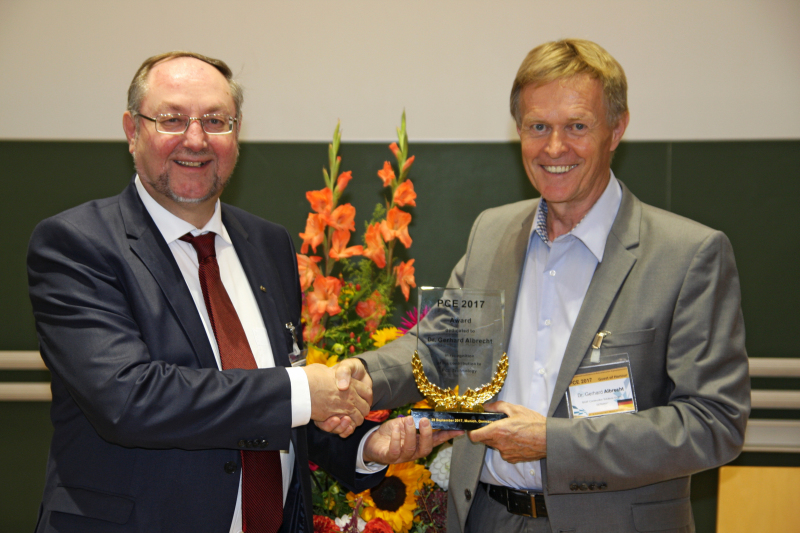
At the end of the conference, Prof. Plank presented the PCE 2017 award to Dr. Gerhard Albrecht of BASF in recognition of his invention of the vinyl ether (VPEG) type PCE and his outstanding contribution to PCE technology over more than 20 years. In a lively speech, Dr. Albrecht mentioned all the obstacles which had to be mastered to transform a lab product into a commercially successful product.
The conference ended with a superb dinner at Hofbräuhaus in the center of Munich, where delegates could not only enjoy delicious Bavarian cuisine and beer, but also an exciting performance of a Bavarian “Trachtler” (folklore) group. More information on the conference is available at //www.pce-conference.org" target="_blank" >www.pce-conference.org:www.pce-conference.org, and the conference proceedings can still be purchased there.
The next conference PCE 2019 will take place in Berlin.
//www.pce-conference.org" target="_blank" >www.pce-conference.org:www.pce-conference.org

Überschrift Bezahlschranke (EN)
tab ZKG KOMBI EN
This is a trial offer for programming testing only. It does not entitle you to a valid subscription and is intended purely for testing purposes. Please do not follow this process.
This is a trial offer for programming testing only. It does not entitle you to a valid subscription and is intended purely for testing purposes. Please do not follow this process.
tab ZKG KOMBI Study test
This is a trial offer for programming testing only. It does not entitle you to a valid subscription and is intended purely for testing purposes. Please do not follow this process.
This is a trial offer for programming testing only. It does not entitle you to a valid subscription and is intended purely for testing purposes. Please do not follow this process.