First German railway bridge with UHPC


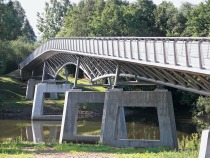
Using Ultra High Performance (fibre-reinforced) Concrete, or UHPC, made it possible for a railway bridge to be built over the Dürnbach River within a few days. With a comparably light pre-fabricated component, replacing only the superstructure and maintaining the historic abutments was possible. This avoided any long periods of new construction. During construction of the innovative pre-fabricated component, the UHPC compound “Effix PLUS” from HeidelbergCement was used.
The bridge over the Dürnbach River dates back to 1882. It was restored for the first time at the end of the 1920s. The small railway bridge will now go down in history as a pilot project for concrete construction in Germany, as the old bridge superstructure has been replaced by a pre-fabricated component made from high performance concrete. This construction design stops the need for any full new construction, which would have been a slow process. Compared to a conventional solution, this bridge construction also has a significantly lower construction height. This therefore met the...
The bridge over the Dürnbach River dates back to 1882. It was restored for the first time at the end of the 1920s. The small railway bridge will now go down in history as a pilot project for concrete construction in Germany, as the old bridge superstructure has been replaced by a pre-fabricated component made from high performance concrete. This construction design stops the need for any full new construction, which would have been a slow process. Compared to a conventional solution, this bridge construction also has a significantly lower construction height. This therefore met the requirements of the building contractor, Tegernsee-Bahn GmbH, who wanted a slim and light structure to facilitate the construction process as much as possible. The company also wanted short closure periods of the railway line and a larger flow cross-section for the Dürnbach River which is prone to regular flooding.
At Lake Tegernsee, various players needed to come together for the nationally significant pilot project to become reality. Tegernsee-Bahn railway employees had found out about a concrete with a high lifespan which is said to be extremely resistant and to permit very slim construction methods through contacts with the Technical University of Munich (TUM), specifically Professor Oliver Fischer from the Chair of Concrete Structures. For the construction of the bridge, the decision was made to opt for a comparatively light pre-fabricated component made from Ultra High Performance( fibre-reinforced) Concrete. In contrast to conventional reinforced concrete construction methods, this approach permitted routing over the Dürnbach to be re-established within a few days. Produced in the Max Bögl pre-fabrication factory as a trough-shaped, pre-stressed panel, the part’s low dead weight of less than 22 t meant that it could be used with the available substructures. As a result, the abutments of the old bridge could be retained due to the low dead weight of the new pre-fabricated bridge component. The construction height of only 20 cm also yielded the required increased clearance under the bridge.
Concrete concept for the pilot project
The solution for the small but complex and ground breaking construction task was designed by the TUM Chair of Concrete Structures together with the Munich-based Büchting + Streit engineering office. They both worked hand in hand for the conception of the structure, the expert’s report to obtain the necessary individual case approval for the design planning and structural inspection. Final planning was assured by the Munich-based SSF Ingenieure AG engineering office. “HeidelbergCement provided the concrete technology concept”, explains Lisa Wachter, Project Engineer in the Engineering & Innovation Department at HeidelbergCement in Leimen. “It was a lucky coincidence, since we were already planning the market launch of our UHPC, an ultra high performance concrete which was very suitable for the special requirements of the planners. Starting with our compound, we developed the formula for the self-compacting coarse concrete, with strength class C150/155, and adjusted this on-site in the pre-fabrication factory.” The powdery UHPC Compound Effix PLUS, made from high-quality cement, additives, rock flour and sand with very finely coordinated grading curves, was mixed in a double-shaft mixer with super plasticisers, much less water than is used for “normal” concrete, basalt and micro steel fibres.
Ultra High Performance (fibre-reinforced) Concrete
For Professor Oliver Fischer from TU Munich, Ultra High Performance Concrete – or UHPC – is “a milestone in the development of concrete materials.” This is because the Ultra High Performance (fibre-reinforced) Concrete opens up completely new opportunities and applications in the construction sector. For the replacement of the superstructure of the bridge over the Dürnbach, an extremely dense concrete was used with UHPC. Due to its optimised grain composition, an extremely thick structure, very high compressive strengths and excellent properties in relation to durability can be achieved. UHPC has a very high compressive strength, which is typically over 150 MPa. This means that the strength is around three to five times higher than the conventional concrete currently used in bridge construction. It is also characterised by a high chemical resistance and mechanical stress resistance. Adding micro steel fibres as reinforcement results in very high tensile strengths and the fibre-reinforced UHPC reacts in a significantly more ductile way at the limit state of the load-bearing capacity, according to a TU Munich report.
Research with long-term aims
Professor Fischer, together with his colleagues from the Chair of Concrete Structures, has been dealing with basic research in Ultra High Performance Concrete for a long time, which is considered one of the most important developments in concrete technology and concrete applications worldwide. UHPC has already been used in other countries, with engineers in many cases relying on insights gained in Germany. “Here in Germany, the promising technology is still in its infancy, as initial step-by-step testing is necessary and rigorous technical regulations are required,” says Oliver Fischer. The regulations for using UHPC for superstructure replacement at Dürnbach, which were defined by TUM as part of an expert’s report, were specifically based on the current draft of the new German Committee for Reinforced Concrete (DAfStb) Guideline on Ultra High Performance Concrete. In some cases, these regulations were supplemented by additional application rules based on internal research results, the chair’s laboratory experience, and international regulations. With the guideline of the German Committee for Reinforced Concrete (DAfStb), which is currently being developed, a well-founded planning basis for broader applications of Ultra High Performance Concrete in German construction practice will be available for future applications.
A concrete application
Only a few specialists who were sufficiently experi-enced in constructing pre-fabricated components were considered for the pilot project. Sengenthal-based Max Bögl had already gained experience with Ultra High Performance Concrete for bridge parts in Austria, and was commissioned with the design of the pre-stressed, pre-fabricated part with a total volume of more than 10 m3. In the company’s mixing plant, four separate mixes were combined in a truck mixer to continuously concrete the component, with almost no interruptions. The operation of two vehicles, each with five cubic metres of the special concrete, was actuated precisely during manufacture. Including insertion of the steel fibres, the mixing time of the UHP compound from HeidelbergCement was less than five minutes. The concrete with the self-compacting properties then needed to be processed in the factory within 90 min. At this location, all of those involved were able to gain further important insights into the specific application of the new material in construction practice. For Jochen Hafner, concrete technologist in Bögl’s central laboratory, this concrete is “definitely an alternative” where advantages such as slender design and weight reduction for specific components are concerned. As a last step, the pre-fabricated component – weighing almost 22 t – was placed on the available supports, over the Dürnbach, by the construction company PORR. The TUM is now providing measurement technology and scientific support for rail operation (including load tests with defined axle loads) to gain corresponding insights into real operation, in addition to its laboratory and manufacturing experience.
//www.heidelbergcement.de" target="_blank" >www.heidelbergcement.de:www.heidelbergcement.de

Überschrift Bezahlschranke (EN)
tab ZKG KOMBI EN
This is a trial offer for programming testing only. It does not entitle you to a valid subscription and is intended purely for testing purposes. Please do not follow this process.
This is a trial offer for programming testing only. It does not entitle you to a valid subscription and is intended purely for testing purposes. Please do not follow this process.
tab ZKG KOMBI Study test
This is a trial offer for programming testing only. It does not entitle you to a valid subscription and is intended purely for testing purposes. Please do not follow this process.
This is a trial offer for programming testing only. It does not entitle you to a valid subscription and is intended purely for testing purposes. Please do not follow this process.