Extending the reach of our future


The lime industry is investing in modern kiln technology and fully automated hydration plants with the aim of improving quality, reducing costs, and minimizing the impact on the environment. The article describes the individual phases of EPCM projects and concludes with a case study.
Introduction
The production of quicklime is one of mankind’s oldest industries, but quicklime cannot be generally described as a primary commodity that is widely traded internationally. In fact, most countries have their own limestone or dolomite deposits and produce quicklime basically for domestic consumption.
In the report [1], world lime production, including that in China, was estimated to total around 350 million t of quicklime, hydrated lime, and slaked lime, indicating a stable trend. This total does not take captive plants into account, which means the total volume produced worldwide...
Introduction
The production of quicklime is one of mankind’s oldest industries, but quicklime cannot be generally described as a primary commodity that is widely traded internationally. In fact, most countries have their own limestone or dolomite deposits and produce quicklime basically for domestic consumption.
In the report [1], world lime production, including that in China, was estimated to total around 350 million t of quicklime, hydrated lime, and slaked lime, indicating a stable trend. This total does not take captive plants into account, which means the total volume produced worldwide could be potentially increased.
In this market scenario, the lime industry is currently undergoing significant changes: investments are being made in modern kiln technology and fully automated hydration plants with the ultimate goal of improving quality, reducing costs and lessening any impact on the environment.
Since investing in a lime plant does not require any considerable economic commitment compared to, for instance, investing in a cement plant, new projects and new investments generally involve a limited supply from technology providers, for instance the engineering package and key component, allowing the customer to achieve whatever the market is demanding. Clients with large complicated capital projects, sometimes in challenging locations, often appoint Cimprogetti as a general contractor to manage and supervise their projects.
In such projects, Cimprogetti also acts as the single point of contact, coordinating all contractors and subcontractors, often from diverse cultures and backgrounds, to deliver a successful project.
This type of project is commonly referred to as EPCM; this stands for Engineering, Procurement, Construction and Management, for so-called “extended projects”.
It is a prominent form of contracting agreement in the various complex engineering and construction industries. The engineering and construction contractor carries out the detailed engineering design of the project, procures all the equipment and materials necessary, and manages plant construction to deliver a functioning facility or asset to its clients. Companies that deliver EPC projects are commonly referred to as EPC contractors.
Using a consolidated worldwide network, Cimprogetti also operates as a contractor, providing integrated engineering design from the quarry to the final product, in line with requirements, and based on its proven experience in mechanical and structural engineering, civil engineering, crushing, milling, handling and dedusting. It executes all phases of a quicklime project, from the feasibility study to plant commissioning, in order to guarantee high-performance, reliable and user-friendly plants.
Project feasibility
Figure 1 shows the project appraisal development. Before an “extended project” is started, it is necessary to conduct a feasibility study, which represents a premise for the project, providing initial background for evaluation of opportunities, risks as well as costs and values to be attained.
Generally, the success of a complex plant engineering project is strongly related to a well-designed feasibility study, which constitutes the preamble for the EPC.
A well-designed feasibility study should provide a description of the product or service, accounting statements, details of the operations and management, market research and policies, financial data, legal requirements and tax obligations. Generally, feasibility studies precede technical development and project implementation.
To realize a feasibility study, an engineering company should understand that three important factors need to be evaluated: realization time, estimated cost +/- 10% and final performance quality. The responsibility of the engineering team is therefore to assure the correct and coordinated realization of the design activities, procurement phase, workshop fabrication and site construction.
Experienced engineers forming part of the Cimprogetti Academy with specific know-how coordinate internal and external teams using integrated software and an in-house database to ensure evaluation enabling in-time project execution.
Parallel to the feasibility study for a new quicklime plant, the requisite permits or approvals must be obtained and the environmental review requirements applicable to the construction and operation of the proposed project satisfied.
Cimprogetti can provide assistance worldwide, executing projects based on a feasibility study, an environmental assessment or comparable documents, complying with the procedural requirements using a full database of technical information to significantly reduce time and expense during project development.
Generally, a feasibility study can be conducted over three to four months, taking into account the necessity to detail as far as possible the selection of all the machines and solutions to be undertaken in the final engineering phase.
Phase I – Basic engineering and commercial phase
Figure 2 shows the basic engineering and commercial phase. Providing the feasibility study predicts a satisfactory outcome in terms of the required plant, the next step is the so-called basic engineering phase and the final quotation for the so-called commercial phase.
In this phase, Cimprogetti develops the engineering to a level at which orders can be potentially placed with sub-vendors, selecting, together with the client, a specified vendor list based on the following values:
a) Global quality consistency: continuous improvement of the processes and application of state-of-the-art IT tools to ensure efficiency in processes and procedure standardization
b) Strategic sourcing: continuous maintenance of an approved vendor list based on careful selection of vendors and contractors along with global procurement
Both the global quality consistency and the strategic sourcing concur on minimizing the time for project execution along with the more economical solution outcome.
In such a phase, Cimprogetti also introduces “raw material evaluation” as an important step to evaluate, together with the client, the source that corresponds to the market demand; these important tasks become a relevant contractual document.
A fundamental step in this phase is the realization of the layout, which aims at minimizing the overall cost of the project, the process flow diagram which includes the mass and energy balance of the entire plant, and last but not least, concise technical specifications of the main equipment including control/automation concepts.
Phase II – Project design and technology process
Figure 3 shows the typical sequence for project development. This includes the final definition and the negotiation of Phase I, which generally involves issuing of a letter of intent or purchase order marking the starting point of the project execution, generally referred to as the EDC (effective date of the contract).
On the basis of the design input data of each project, the Cimprogetti Design and Engineering Department issues the relevant drawings, part lists, technical specifications and technical reports for the design and development activity.
During design development, applicable statutory and regulatory requirements, national and international standards to be adopted are identified.
In such a crucial phase, Cimprogetti manages and integrates with the engineering the procurement and construction phases, thus getting to the crux of the project with full responsibility for timing and overall cost.
After the approval of the project design by the client, purchasing activity ensures that purchased products and services meet the specified requirements.
Cimprogetti avails itself of a long-standing international exchange concept with the aim of drastically reducing manufacturing costs. Products and services from foreign subcontractors are accurately evaluated according to quality standards with a consolidated internal organization and qualified worldwide network. This is able to pinpoint workshops and suppliers with proven quality. Cimprogetti’s engineering vision for extended projects is the reduction of the overall investment thanks to full coordination of various sources of expertise.
In certain cases, Cimprogetti can also identify local staff with relevant experience, maximizing the deployment of local regional staff, transferring values and knowledge.
One of the major points in such an extended project is to focus on the details in defining requirements, aligning stakeholder teams, preparing monthly summaries, ensuring a disciplined approach to implement fabrication and construction while focusing on safety, schedule, costs, quality, and methods with the outcome of successful facility construction.
This phase is generally executed over eight to twelve months, including the delivery of the equipment to the site.
Phase III – Erection, start-up and commissioning
Figure 4 shows a plant start-up. In this phase, Cimprogetti can draw on long-standing experience in delivering complex projects worldwide, provide site supervision offering an optimized project execution scheme to the client, working in parallel with different areas, and allowing rapid execution in compliance with the safety policy.
The purpose of such a phase is to bring the plant to mechanical completion, ensuring it fulfils contractual obligations in terms of performance.
If the plant is ready to start up with strict adherence to the original technical specifications, Cimprogetti process teams leverage their expertise to enable the client to reach the desired outcome in terms of performance.
After-sales consultancy services are also a key Cimprogetti commitment for performance optimization and technical/technological improvement of the supplied plant over time.
With the plant commissioning, the client‘s staff is able to autonomously operate a performance-tested plant thanks to the training that Cimprogetti provides directly on-site or at its headquarters.
Cimprogetti also offers a long-term plant maintenance service, which includes periodic visits of our technical staff to the site, for process control and regulation, ordinary or extraordinary maintenance and emergency intervention. This package features the supply of spare parts kits for the ordinary maintenance of those components subject to wear.
Cimprogetti’s spare parts department becomes increasingly important in the following years. Thanks to an advanced enterprise resource planning system, required spare parts are quickly identified and supplied, avoiding any production downtime.
Case study
In the last two decades, Cimprogetti has managed more than fifteen extended projects in which it has acted as the main contractor, delivering key components, equipment, refractories and steel structures.
Based on its network, Cimprogetti has also been able to provide site management after plant commissioning to support customers in familiarizing themselves with operating procedures, and even delivering remote training by Cimprogetti experts.
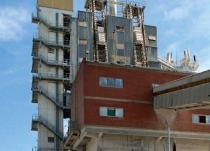
One of the latest extended projects was executed in the Gulf region; in December 2017, Cimprogetti was awarded a contract by an important steel producer for a complete lime plant complex.
The scope of work consisted mainly of the:
a) Lime kiln including the execution of civil, mechanical, and electrical engineering, more than ten thousand drawings and technical specifications being delivered
b) Fabrication of the overall steel structures, for a total of approximately two thousand tonnes
c) Upstream and downstream handling including the raw material deposit and the finished product
d) The complete dedusting system for the entire plant in compliance with the Gulf region norms
e) The innovative briquetting plant, which transforms powder into lumped material as an added value for the overall mass balance
f) The modern electrical and automation system (motors, smart MCC, PLC, automation, cables and installation materials), more than two hundred motors installed, fifteen kilometres of cables and two thousand digital inputs and outputs
In three months, Cimprogetti delivered more than three hundred containers, taking into consideration the custom regulations and the project construction with the aim of improving construction performance as a value to be used by the client.
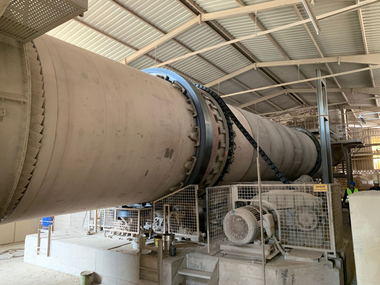
The twin-shaft regenerative kiln installed has a nominal production of 350 t/d, is fired with diesel oil, equipped with instrumentation, controls and a customized design to allow smooth operation and the flexibility to work in a company with limestone and dolomite.
This option allows the customer to be flexible, using appropriate storage to serve the steel plant without any interruption.
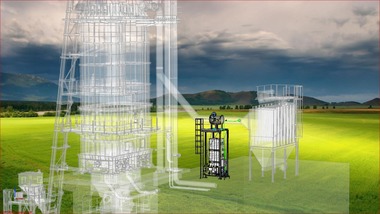
The layout of the entire plant has been studied by Cimprogetti to minimize all the civil works and the impact on upstream and downstream handling.
The kiln was fired up in December 2019, after only 24 months of intensive activity in design execution, steel fabrication, procurement, delivering and commissioning.
Through extensive experience, technologies, project management, integrated expertise and EPC capabilities, Cimprogetti continues to break through boundaries, extending the reach of the future, increasing the importance of what will happen tomorrow as a consequence of what is done today, enhancing what we have experienced.
//www.cimprogetti.com" target="_blank" >www.cimprogetti.com:www.cimprogetti.com

Überschrift Bezahlschranke (EN)
tab ZKG KOMBI EN
This is a trial offer for programming testing only. It does not entitle you to a valid subscription and is intended purely for testing purposes. Please do not follow this process.
This is a trial offer for programming testing only. It does not entitle you to a valid subscription and is intended purely for testing purposes. Please do not follow this process.
tab ZKG KOMBI Study test
This is a trial offer for programming testing only. It does not entitle you to a valid subscription and is intended purely for testing purposes. Please do not follow this process.
This is a trial offer for programming testing only. It does not entitle you to a valid subscription and is intended purely for testing purposes. Please do not follow this process.