Doubling up as management executive and change manager
On top of the day-to-day work in their departments, management executives are often faced with challenges associated with ongoing change projects. For this reason, they may have to double up as a change manager and need special expertise for this.
1 Seeing “change” as normality
Technical development is progressing at breakneck speed; just like(digital) networking in the companies as well as between the companies and their environment. For this reason, change is a permanent issue in day-to-day business today. That means the necessity to reflect on one’s own behaviour and change it wherever necessary to grow into new roles is an elementary part of everyday work. And the task of initiating, managing and controlling change processes? This has evolved into a core task for management. Awareness of this is something many management executives...
1 Seeing “change” as normality
Technical development is progressing at breakneck speed; just like(digital) networking in the companies as well as between the companies and their environment. For this reason, change is a permanent issue in day-to-day business today. That means the necessity to reflect on one’s own behaviour and change it wherever necessary to grow into new roles is an elementary part of everyday work. And the task of initiating, managing and controlling change processes? This has evolved into a core task for management. Awareness of this is something many management executives have not yet internalized. Often, they still regard the managing of change processes as an additional task. For this reason, they often set the wrong priorities in their management work – which often leads to a real or perceived overload.
2 Being able to handle complexity
As a consequence of technological innovation and growing networking, the structures in companies and their markets are becoming increasingly complex. That means that managing executives have to expect changing goals, take more and more influencing factors into consideration as well as experiment more and take risks. Despite this they have to be ready and capable of making decisions, even with the risk of making potentially wrong decisions. At the same time, they have to be prepared to revise their decisions – for example, when certain assumptions on the basis of which they had made their decisions prove inaccurate or environmental factors change. That requires a great capacity and willingness for self-reflection.
3 Being able to live with
uncertainty and limited plannability
How will our market look in five or even ten years? What (technical) problem solutions will be available then? No company knows that today. For that reason, the decisions made by company top managers have an increasingly short half-life. This means for the management executives that they are acting more frequently in an environment characterized by uncertainty.
Moreover, they are more often faced with challenges and tasks with the solution of which they still don’t have any experience. For this reason, they must take leave of the fiction that complex tasks and change projects are plannable from the start to the finish. Instead, it is important to “feel the way” to a potential problem solution with small, well-considered change steps and reflect on the consequences of each step, before the next steps are planned and implemented. Awareness of such an iterative procedure has to be conveyed to the employees; also the awareness that plans are not some “holy cow” that cannot be slaughtered. On the contrary, they must be “slaughtered” if …
4 Knowing the typical course of change processes
In every change project, there are different phases. Initial euphoria is often followed by the “vale of tears”. That means the employees realize, for example: The consequences for us are greater or the new procedure is more difficult than first thought. The executives must know the typical phases of a change process – not only so that they are not completely surprised and unprepared when their employees suddenly start complaining, but also because these need different support in the various phases of a change project.
5 Being sensitive communicators
Employees react – owing to their personality, professional experience and position – differently to the same information. While one might take the news “We’re introducing a new IT system” as a challenge, for others it’s a threat. Executives have to package and convey their message with the appropriate sensitivity. In addition, they must take care not to overload their employees – for example because they pass on to them a flood of unfiltered information. They should separate the relevant from the irrelevant and compact the individual pieces of information so that clear messages can be drawn from them. In addition, they should agree with their colleagues in the other departments on what information they give to their employees, so that these do not get different information. In addition, they should not give any promises to their employees which they cannot be 100 percent sure that they can keep – no matter how the employees might pressure them.
6 Being able to communicate
and create sense and meaning
Business goals such as “We want to increase revenue by 10 %” or “We want to shorten processing time by 30 %” are significant with regard to steering companies, but they convey no sense to the employees. Therefore, they do not motivate them to commit themselves to achieving these goals. For this purpose, the management executives need to do a bit of translation work. For example, “If we increase revenue, we can spend more money on research so that the existence of our company and therefore your job is assured in the long term.” Or: “We want to shorten the processing time so that customers are more satisfied. This will have a positive effect on the atmosphere during the talks that we hold with them.” It is important that the sense is directly related to the employees affected; moreover, that the constructed context is credible because the employees are not stupid. In addition, the executives who communicate the sense must believe it themselves. Otherwise what they say comes across as implausible – amongst other thing because their body language and their spoken word diverge from each other.
7 Being able to build acceptance
When a planned change is announced to employees, they often find it difficult to accept this – sometimes because they doubt that it can be realized. Then their managers face the challenge of conveying to them not only the sense of the project, but that achieving the goal set out is realistic – even if they themselves do not yet know how this will be possible.
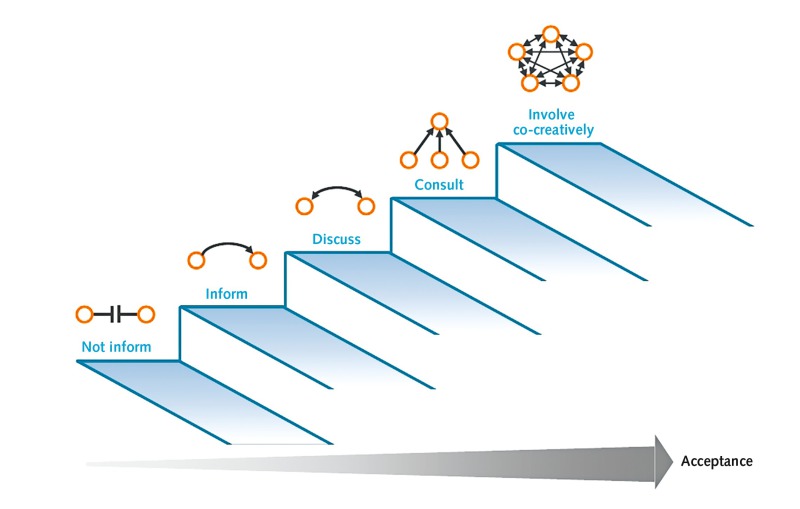
This is simplest if they integrate their employees in working out the solution to the problem – amongst other things, not only by informing their employees, but also discussing it with them; furthermore by listening to their advice and allowing the employees develop solutions together (Figure 1).
It should, however, be clear to the management executives: With complex change projects in which there are always losers, it is (almost never) possible in a start phase to achieve a consensus for the new project. It is crucial to find sufficient co-supporters for the project, who are committed to the goals, so that the project can start off full of energy. For then, with time, more and more “fence-sitters”, that is employees taking a wait and see approach to the project, can be won over as supporters. And the few people who, so to speak, “boycott” the project? They become increasingly isolated.
8 Being able to motivate people for change
Especially older, professionally experienced employees are often initially sceptical about planned change projects – often less because they doubt the sense of them, but rather their realizability. Many management executives tend not to take the concerns of the employees seriously, but see in them an expression of their lacking willingness to change. The employees are or feel as if they are being pushed into a corner fast, which turns them into genuine “resistance fighters”. That often has fatal consequences for projects, also because these experienced employees, in the eyes of their colleagues, do have “something to say”. It is accordingly important to take the concerns of these employees seriously and to win them over as supporters – e.g. by integrating them in the development of possible solutions.
Sometimes behind apparently objectively justified concerns are also fears of losing certain privileges or vested rights. Then it is important to show consistence by communicating to those affected that the change is necessary and inevitable. And anyone who is not prepared to embrace the new situation will be one of the losers in the mid-term.
9 Being able to integrate
individualists and specialists
The more complex a change project is, the more management executives must rely on the speciality know-how and cooperation of specialists – as they themselves often lack the knowledge to develop the problem solution. Therefore, they not only have to be prepared to listen to the specialists’ recommendations, they must integrate them in the working teams. That often demands a great deal of tact, partly because the specialists usually know the significance of their knowledge for success. They are correspondingly confident and they are accordingly difficult to manage. For this reason, management executives must take special care to win over these employees as supporters. For example, by regularly talking to them and seeking advice from them, signalling their appreciation. Or publicly praising their contribution in team talks; further by specifically integrating them in project teams that are of key importance for success.
10 Being able to steer energy process change
In change projects that extend over a relatively long time, it is normal for the initial optimistic energy to flag – for example, if successes don’t come quickly. Then it is the task of the management executives to spread optimism. LikeThomas Edison is reported to have done after the 1000th failed attempt to develop a light bulb when an employee said to him: “We’ve failed.” Edison is said to have retorted: “We haven’t failed. We now know 1000 ways how not to develop a light bulb.”
It is important in such situations that management executives can fall back on an attractive target image that they can hold up to their employees, that is a vision of how their everyday work and work situation will look when the desired change has been realized – linked to the question whether all the effort would not be worth it for the end result.
Moreover, in change projects that extend over a relatively long period, part successes must be communicated and celebrated. For cultural changes often take place in companies so slowly that those involved have the feeling “Nothing’s moving forward” even if the organization is on the right road.
11 Having backbone as well
as perseverance and patience
Particularly because culture-changing projects often take a very long time, managing executives must have backbone. That means they should stand for certain values and not waver when encountering resistance. As only then can they provide the employees with the desired stability and necessary orientation. Moreover, they have to radiate relative calmness – even when a project appears to be on the brink of failure. This requires that the management executives lead a balanced life, and within this there should be oases in which they can recharge their batteries.
//www.ilea-institut.de" target="_blank" >www.ilea-institut.de:www.ilea-institut.de

Überschrift Bezahlschranke (EN)
tab ZKG KOMBI EN
This is a trial offer for programming testing only. It does not entitle you to a valid subscription and is intended purely for testing purposes. Please do not follow this process.
This is a trial offer for programming testing only. It does not entitle you to a valid subscription and is intended purely for testing purposes. Please do not follow this process.
tab ZKG KOMBI Study test
This is a trial offer for programming testing only. It does not entitle you to a valid subscription and is intended purely for testing purposes. Please do not follow this process.
This is a trial offer for programming testing only. It does not entitle you to a valid subscription and is intended purely for testing purposes. Please do not follow this process.