Climate friendly and energy-saving raw
material handling using belt conveyors
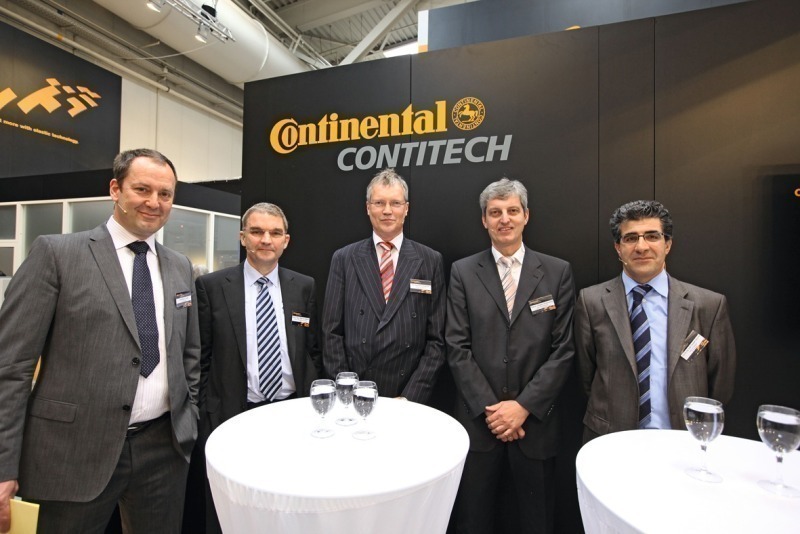
ContiTech Round Table at Hanover Fair 2009, Hanover/Germany (21.04.2009)
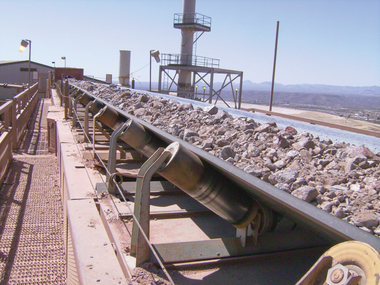
Belt conveyor systems save energy and protect the climate in material handling. Compared to traditional means of conveyance, they consume only a fraction of the energy and emit clearly less CO2. In the next 30 years 340 million t of the climate gas could be saved. This is the result of the study “Energyefficient material handling and climate protection”, which was drawn up under the direction of Prof. Dr. Hossein Tudeshki from the Institute of Opencast and International Mining at Clausthal Technical University. Professor Tudeshki presented his investigation for the first time within the...
Belt conveyor systems save energy and protect the climate in material handling. Compared to traditional means of conveyance, they consume only a fraction of the energy and emit clearly less CO2. In the next 30 years 340 million t of the climate gas could be saved. This is the result of the study “Energy-
efficient material handling and climate protection”, which was drawn up under the direction of Prof. Dr. Hossein Tudeshki from the Institute of Opencast and International Mining at Clausthal Technical University. Professor Tudeshki presented his investigation for the first time within the framework of a round table event of ContiTech AG at the Hanover Fair and discussed the results with experts from industry and mining (Fig.).
Raw materials make the world go round and, accompanied by the economic growth of emerging and developing countries as well as a rapidly increasing world population, the need for metal ores, industrial minerals, fossil energy raw materials and building raw materials has been increasing for years. These are materials, which are found in almost all basic commodities, everyday essentials and in all buildings. An annual average growth of the demand of four percent is predicted.
What is the impact of material handling on the environment and climate?
The increased extraction of raw materials will not be without consequences for the environment and climate. For this reason Clausthal Technical University investigated the effects of different ways of handling on the energy consumption and CO2 emission, because raw materials are seldom processed where they are extracted. On an average 25 % of the energy used for the extraction process are needed for the in-plant transport of the extracted solid mineral raw materials (at present more than 12.3 billion t per year worldwide) and of the overburden (approx. 28.84 billion t). Thus, the question for the operators of mining plants is: what are the most efficient, cost-effective and safest processes as technical solutions, from the point of view of climate protection, to remove the raw material from the place of extraction? Therefore, belt conveyor systems were compared in the study with heavy trucks especially designed for mining purposes, which so far have to bear the brunt of the necessary bulk material handling.
The most important results are that 340 million t of CO2 could be saved in the next 30 years alone by using conveyor belt systems more persistently in the field of raw material extraction. The investigations have also shown that conveyor belts need only about 20 % of the energy required by heavy trucks. Thus, they have a clearly better energy balance, which is an advantage for the environment and economy.
Energy generation during raw material handling
Hans-Jürgen Duensing, division manager of the ContiTech Conveyor Belt Group, demonstrated by the example of a plant in Jamaica during the round-table discussion that conveyor belts not only reduce the energy consumption and CO2 emission but are even able to generate power. There a RopeCon belt conveyor system transports 1200 t of bauxite per hour over a distance of 3.4 km negotiating a difference in altitude of 470 m. Due to the downward movement during transport, electric energy is generated by the braking force – 1300 kW in this case. “At the same time the RopeCon concept offers advantages wherever a high conveying capacity is required in rough terrain or over forests and wide rivers”, continued Hans-Jürgen Duensing. “Thus, the construction of a road for removal was not necessary in Jamaica and the complete forest stand could be conserved. The conveyor system is an equivalent of 1200 truck tours per day and, consequently, a corresponding amount of fuel as well as emissions of CO2 and fine dust are saved.”
Belt conveyor systems for environment and climate protection
The reasons for the better energy balance and the lower CO2 emission of the belt conveyor systems are obvious compared to the heavy trucks normally used in mining: As discontinuously operating conveying equipment the heavy trucks do not only carry loads but there are also no-load trips. The high dead weight of the vehicle must also be taken into account. The ratio between the total weight moved and the payload amounts to between 2.2 and 2.6 to 1. With belt conveyor systems as continuously operating handling equipment this ratio is 1.2 to 1 only, i.e. they are essentially more efficient. The conveying resistance of belt conveyor systems is also clearly lower as opposed to that of heavy truck transport.
No wonder that the specific energy demand for heavy truck handling amounts to 1.09 up to 1.17 kWh per ton and kilometre, while belt conveyors systems only require 0.14 up to 0.25 kWh per ton and kilometre, i.e. one fifth only.
Lower CO2 emission
Of course, there are also differences as regards the emission of the greenhouse gas CO2. On an average 0.285 kg CO2 per kWh are emitted in the global electricity production. When burning diesel fuel the value is 0.293 kg/kWh. “If these values are applied to the handling equipment”, said Professor Tudeshki, “it turns out that the specific CO2 emission of a heavy truck amounts to 0.331 kg per ton and kilometre, on average. With conveyor belt systems it is only 0.055 kg per ton and kilometre. Thus, the specific saving potential amounts to 0.276 kg CO2 per ton and kilometre.”
What are the prerequisites that actually have to be met to save 340 million t of CO2 within the next 30 years? This is an amount that corresponds to the amount of CO2 equivalents of the commitment of the European Union when the Kyoto Protocol was signed in 1997. First of all Professor Tudeshki clarified this: ”Belt conveyor systems will not completely replace heavy trucks since the extraction of raw materials requires utmost flexibility. However, the more consistent use of belt conveyor systems will result in considerable potentials for the economic efficiency and for the environment.” To be able to make use of these potentials it would be necessary, according to a statement of the mining expert, to continuously extend the portion of belt conveyor systems from now 30 % to 50 % in 2034 and to keep it constant in the period following. Taking into account the demand for raw materials increasing by four percent per year, belt conveyance would grow by 345 % by 2034 and again by 22 % up to the year 2039. This would lead to an increase of the specific mass movement by belt conveyors systems from now 46.97 billion t and kilometres per year to 254.39 billion t and kilometres up to the year 2039. Due to the described extension of belt conveyance more than 340 million t of CO2 could be saved over the next 30 years, i. e. in the total period covered by the prediction.
Economic advantages
Higher efficiency, a considerably lower emission of CO2, less energy consumption, hardly any intervention in nature and the possibility, ideally, to generate power – these are some properties of belt conveyor systems that are environmentally friendly and, at the same time, create economic advantages. Eventually lower energy costs reduce the overall expenditure for raw material conveying. Hans-Jürgen Duensing summarized it as follows after the round-table discussion of ContiTech AG: “This is an aspect that will certainly be a strong incentive for mining companies to do more for the environment by means of a more consistent use of belt conveyor systems.”

Überschrift Bezahlschranke (EN)
tab ZKG KOMBI EN
This is a trial offer for programming testing only. It does not entitle you to a valid subscription and is intended purely for testing purposes. Please do not follow this process.
This is a trial offer for programming testing only. It does not entitle you to a valid subscription and is intended purely for testing purposes. Please do not follow this process.
tab ZKG KOMBI Study test
This is a trial offer for programming testing only. It does not entitle you to a valid subscription and is intended purely for testing purposes. Please do not follow this process.
This is a trial offer for programming testing only. It does not entitle you to a valid subscription and is intended purely for testing purposes. Please do not follow this process.