Burner developments for co-processing alternative fuels
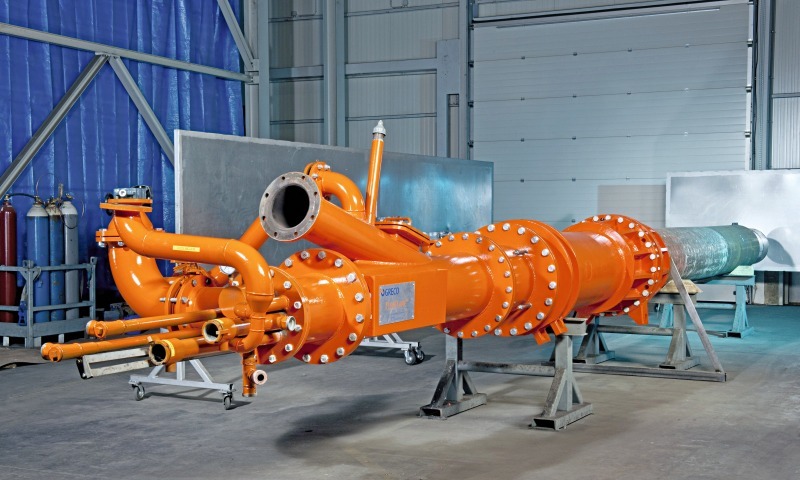
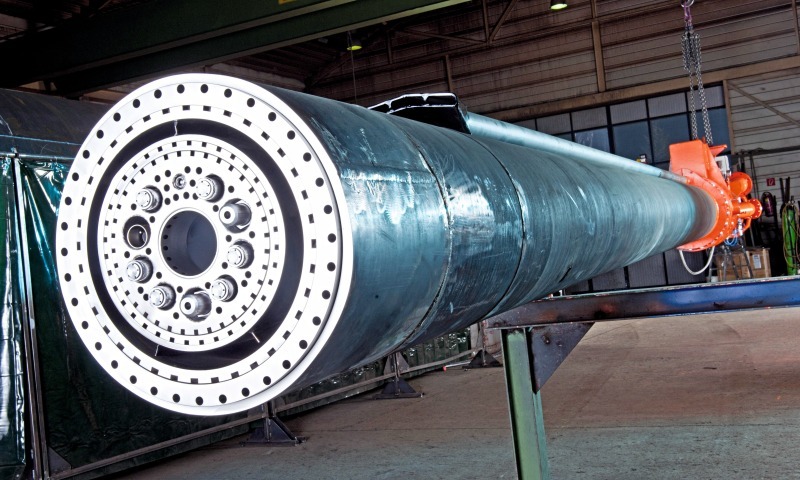
Today’s burner suppliers are offering different technologies for their main burner to produce the final clinker quality in the kiln. Recently some of them changed their designs to lower momentum burners, while A TEC improved its high momentum burner. The experience, comparison and newer installations have shown that burners with a higher flame impulse are more flexible to reach the described process targets of cement production.
1 Historical review
The main technological principles of high momentum kiln burners by A TEC Greco are based on calculations and studies undertaken by Prof. Clemente Greco (1937-2003), who lectured in Brazil at the Institute of Thermodynamics. Thus, practically the entire Brazilian cement industry was converted to petroleum coke firing in the 1990s in order to save on fuel costs. A TEC Greco was one of the leading providers of burners for petcoke, as this initially difficult to handle fuel placed special demands on the burner concept.
Today, this basic concept of rotary kiln firing is still in...
1 Historical review
The main technological principles of high momentum kiln burners by A TEC Greco are based on calculations and studies undertaken by Prof. Clemente Greco (1937-2003), who lectured in Brazil at the Institute of Thermodynamics. Thus, practically the entire Brazilian cement industry was converted to petroleum coke firing in the 1990s in order to save on fuel costs. A TEC Greco was one of the leading providers of burners for petcoke, as this initially difficult to handle fuel placed special demands on the burner concept.
Today, this basic concept of rotary kiln firing is still in use. A TEC Greco burners were developed further and optimized for combined firing with liquid and solid alternative fuels. Current rotary kiln burner design developments aiming at a 100 % thermal substitution rate (TSR) are already well advanced.
With beginning of the 1990s, A TEC Greco constructed rotary kiln burners for the local cement industry and was among the first suppliers to provide the burners needed for changing over the numerous heavy oil and coal firing systems to the cheaper petcoke fuel. From today’s point of view the company’s petcoke burner design was advanced technology. The burner’s axially symmetric design and high momentum enabled the effective use of petcoke, which significantly reduced fuel costs. Up to now, there are more than 300 of such burners in successful use in cement plants all around the world.
Since its start, A TEC Greco has maintained its corporate philosophy of customized burner geometry precisely tailored to the customer’s particular requirements. Today, the company’s main development activities are located in Austria, where A TEC Greco has built up and operated its technical centre since 2010 in co-operation with the pyroprocessing specialist A TEC. The comprehensive R&D division testing facilities support the company’s further developments in burner design.
Whoever writes a new chapter in the future may not even be aware that once again a tribute is being paid to a man, an engineer, and a professor who left the A TEC Greco brand as a technological inheritance of great value – Prof. Clemente Greco.
2 FlexiflameTM design characteristics
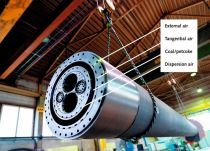
The Fexiflame™ burner operates with an outer, high momentum flow of primary air (external air), whose high momentum and therefore high exit velocity is decisively responsible for the slim, firm shape. That produces a shorter and high radiant flame compared to low momentum burners. The high momentum is equivalent to the mixing zone length of the flame which follows the ability to control the flame from the ignition point to the remaining flame length. A low momentum burner design means a longer mixing zone and a longer flame inside the kiln. Not always good when trying to control the clinker sintering zone length and cooling zone length for crystal grow formation. A shorter flame length and the ability to control the flame are favourable for sulphur cycles at the kiln inlet as well.
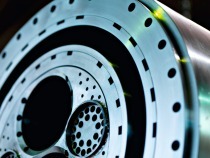
The arrangement of the primary external air flow as individual air jets has a very favourable effect on the combustion, as it assures rapid mixing of the hot secondary air into the flame. The form of the flame is adjusted by means of the primary air momentum. To the outside and inside of the burner’s coal/petcoke channel, there are two inlets for swirling airflows (tangential air & dispersion air) that intensively mix the pulverized coal. This so-called double-swirl effect gives the flame a high stability (providing superior flame control) and results in rapid flame formation (flame ignition point close to the burner). Compared to other burners, the flame geometry in the kiln is easy to control, a fact that is evidenced by the thermal profile of the kiln shell.
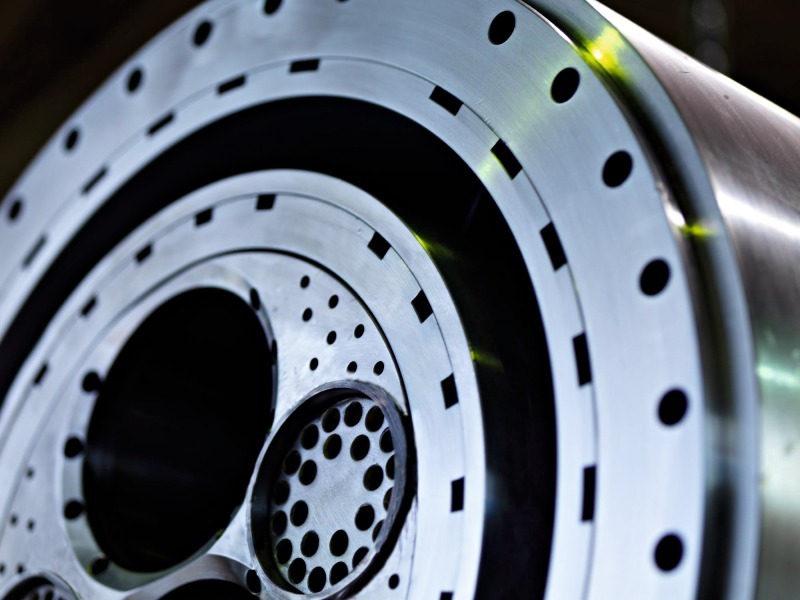
The central elements of the burner, such as the oil lances, solid fuel pipes, igniter, etc. are guided and cooled via a burner tip plate. If the mixture of fuels and the arrangement of the channels permit, an axially symmetric design is used, as this ensures better flame control than an asymmetric design. The very safe construction enables extremely precise setting of the burner. As all burner channels are separately adjustable, their functioning can be clearly followed, without influencing other airflows.
The important mixing momentum of the burner is selected on a customer-specific basis, depending on the kiln application, the system configuration, the fuel composition and the clinker analysis. This customer-specific burner design with a sophisticated nozzle geometry has achieved excellent operating results and thus reduced the fuel costs even in the case of very sensitive kilns, such as a white cement kiln with planetary cooler (low secondary air temperature) operated with a fuel mixture of petcoke and solid alternative fuels (sawdust & fluffy SRF).
A further basic concept of the A TEC Greco burner is to minimize the wear. This is achieved by means of the following design features:
The coal channel has no cone or geometric deflection (it is possible to use supply air for adjusting the coal injection velocity)
The alternative fuel pipe inlets are wear-protected with composite material
Mixing nozzles for alternative fuels (SRF) are located for wear reasons at the outside of the burner tip plate
Components for coal feeding into the burner are flow optimized and protected by ceramic elements
Good burner cooling (longer refractory service life) due to the higher flow velocity in the outer/ external air channel.
3 Powderized fuel
It is well known that petcoke has particular characteristics as regards complete burnout in the flame and transmission of heat to the material to be burnt. It has to be taken into consideration that petcoke has a low content of volatiles and that this results in late ignition of the fuel, which lengthens the black ignition zone of the flame. As soon as the fuel has ignited, carbon combustion commences. This can last longer than it does in the case of normal hard coal and can therefore produce a longer flame.
Particularly in the case of burner designs that work with lower mixing energies (mixing momentum I = m ∙ v), i.e. with low primary air pressures and primary air rate, the lengthening of the flame is measurable and results in a longer sintering zone. This longer sintering zone can cause undesirably excessive growth of the clinker crystals, which in turn results in larger clinker granules. Shortening of the flame by the use of higher swirl air rates, which is often assumed to be an effective countermeasure, actually only partially compensates this process because the insufficient primary air momentum restricts the swirl to the periphery of the flame and prevents from penetrating into the flame core. As a fundamental principle, the burner should not induce a high degree of flame swirl, as this leads to the so-called diabolo effect, i.e. an initial constriction of the flame followed by a trumpet-shaped wide flame expansion with a high rate of flame swirl, which is counterproductive for the burning process.
4 Solid alternative fuels
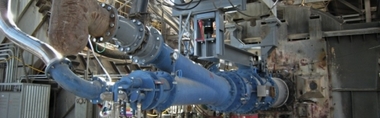
The last optimization measures performed for the Flexiflame™ burner resulted from a study of the injection and combustion of solid alternative fuels through pipes located at the center of the burner. An injection velocity that can be set independently of the conveying air (typically between 35 and 45 m/s, depending on the type of kiln) proved advantageous. It is fundamentally important to mention that the selected design of a burner for solid alternative fuels ensures that oxygen is available close to the injection point in order to promote faster ignition of the alternative fuels. In this zone, there is a local deficiency of oxygen, as this usually has a higher affinity for the carbon combustion. In other words, unless special design measures are taken, the alternative fuel is initially injected into a zone of the flame that has low oxygen content until the carbon combustion has taken place and sufficient oxygen is available -after drying and pyrolisis- to ignite and burn the alternative fuel in the flame.
One often observed problem is that alternative fuel particles prematurely fall out of the flame and land in the bed of clinker. The greater proportion of the alternative fuels burn on in the flame and cause a displacement of the flame in the direction of the kiln inlet. Depending on the quality of pre-processing, the alternative fuel composition and its ignitability, this problem can effect at a TSR of 10 % and occurs sorrowly at higher TSR at the main burner. It is not possible to increase the TSR for solid alternative fuels with today’s conventional technology without causing further problems in kiln operation.
5 Control of emissions
Kiln process studies combined with burner optimization measures have shown that the fundamental combination of lower primary air rate and higher momentum has the beneficial effect of reducing the NOx generation. The setting of the swirl air channel (dispersion air) that is located to the inside of the coal channel has a significant influence on the NOx emission. The burner observably reacts to a reduction of the internal recirculation zone with a decrease in NOx generation. This effect of the burner is certainly of advantage in particular kiln systems and with particular fuels. Alternative fuels with their water content may decrease the flame peak temperature due to the necessary demand of evaporation energy which follows in a decrease in NO2 emission.
6 The future of main burner technology
Due to the market situation in Europe, further development of pyroprocessing technology is being directed at achieving a TSR close to 100 %. The necessary burner geometry will differ decisively from the technology known today. Both 2-dimensional and 3-dimensional alternative fuels will be employed (fluffy SRF containing plastics, textiles, paper etc. from industrial and municipal origin), which will be specially prepared and will allow substitution rates of up to 100 % in the planned new burner series. The solid alternative fuel will be additionally conditioned to permit controlled ignition, flame formation and burnout similar to the characteristics of a coal flame. The known disadvantages of the current main burner technology, such as flame displacement (double flame formation), reduced combustion, high inlet temperatures and loss of clinker quality should be a matter of the past. The costs of classical fuel have a high saving potential that is of great interest to all kiln operators. This new technology, in which A TEC Greco is again pioneering as in past, will soon be presented to the market.

Überschrift Bezahlschranke (EN)
tab ZKG KOMBI EN
This is a trial offer for programming testing only. It does not entitle you to a valid subscription and is intended purely for testing purposes. Please do not follow this process.
This is a trial offer for programming testing only. It does not entitle you to a valid subscription and is intended purely for testing purposes. Please do not follow this process.
tab ZKG KOMBI Study test
This is a trial offer for programming testing only. It does not entitle you to a valid subscription and is intended purely for testing purposes. Please do not follow this process.
This is a trial offer for programming testing only. It does not entitle you to a valid subscription and is intended purely for testing purposes. Please do not follow this process.