A new water-repellent agent for gypsum-based drymix mortars
1 Introduction
Builders appreciate gypsum-based construction materials for more than just economic and environmental reasons – they also value their favorable processing characteristics, as well as the physical and biological properties they exhibit in construction applications. These materials, for instance – especially plasters that use gypsum as a binder – create a comfortable indoor climate, because they regulate interior humidity and always feel pleasantly warm and dry to the touch.
Set gypsum has two weaknesses that limit its potential applications, however: it has relatively poor...
1 Introduction
Builders appreciate gypsum-based construction materials for more than just economic and environmental reasons – they also value their favorable processing characteristics, as well as the physical and biological properties they exhibit in construction applications. These materials, for instance – especially plasters that use gypsum as a binder – create a comfortable indoor climate, because they regulate interior humidity and always feel pleasantly warm and dry to the touch.
Set gypsum has two weaknesses that limit its potential applications, however: it has relatively poor hardness, and is slightly – yet noticeably – soluble in water (the solubility of calcium sulfate dihydrate is roughly 2.6 g/L at 20°C). Gypsum-based construction materials lose their compressive strength when saturated with moisture, and relatively long exposure to water or repeated exposure to fresh water irreversibly damages their structure. While their sensitivity to water is the primary concern, their low hardness also makes gypsum-based construction materials generally unsuitable for exterior applications in most climates.
Indeed their water sensitivity even limits the uses of gypsum-based construction materials in interior applications. Gypsum-based construction materials should only be used in damp rooms, if they have been made effectively hydrophobic, i.e., water repellent. Hydrophobicity is difficult to achieve in gypsum-based drymix mortars, as the powder water repellents that have been available up to now only meet the requirements of gypsum construction material manufacturers in isolated cases.
The Munich-based Wacker Group has now developed a completely new powdered water repellent for gypsum-based materials. Commercially available under the name SILRES® BS Powder S (patent pending), the new product was introduced first in October 2012. The additive has been designed for use in the drymix process and allows manufacturers to produce gypsum-based wall plasters, joint fillers, top coat materials, flooring screeds and adhesives that can be used throughout the interior of a building.
2 Traditional water repellents
Additives for making gypsum construction materials water repellent have been around for some time. Organosilicon water repellents based either on what are known as H-siloxanes (polymethyl hydrogen siloxanes) or on alkali alkyl siliconates have proven highly effective for gypsum building panels, such as gypsum plasterboard, fiberboard or block. Additives in the first group are applied as either oils or as aqueous emulsions; the latter are applied as aqueous solutions. All of these materials, in other words, are liquids and, as such, are not suitable for use as additives when formulating drymix mortars.
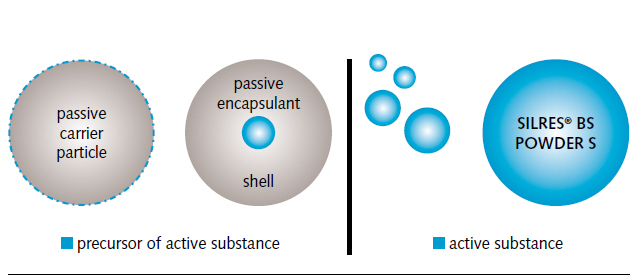
In order to obtain free-flowing, solid additives from available liquid agents, silicone manufacturers and formulators have had to make use of a trick: they take the active agent, which is itself a liquid, and either encapsulate it within a solid material or adsorb it on a solid carrier material, thereby creating a vehicle for introducing and blending the agent into the drymix mortar formulation (Fig. 1, left). In practice, silicone manufacturers do not even actually use the active agent itself (an alkyl silicic acid), but rather a liquid precursor of the active agent, such as an alkyl silicic ester, a polyalkyl silicic ester or mixtures of these (also known as alkylalkoxysilanes and alkylalkoxysiloxanes). They do this because the actual active agent is highly reactive, ruling out the option of isolating it and using it directly.
This also rules out encapsulating the liquid organosilicon water repellents that have been used in large-scale applications up to now, just as it rules out depositing them onto a carrier. H-siloxanes, for instance, react with protogenic compounds by evolving hydrogen – consequently it is risk to process H-siloxanes in spray-drying systems. Siliconates prevent stable encapsulation, because the encapsulation material (usually polyvinyl acetate) would saponify, and the siliconates could react with the surface of the carrier material and be immobilized. The only remaining option that silicone manufacturers had for obtaining a free-flowing, solid gypsum water repellent was to fall back on available liquid precursors and “package” them suitably.
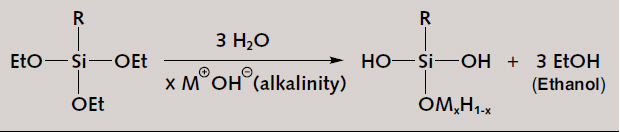
When gypsum drymix mortars that include this kind of carrier-based or encapsulated active agent are mixed with water, the liquid substance leaves its “packaging” and is converted to the actual active agent (an alkyl or polyalkyl silicic acid) via hydrolysis (Fig. 2). There are numerous disadvantages associated with the use of these traditional solid water repellents, however:
First of all, the solid additive contains very little active substance, because the carrier and/or encapsulating material can only accommodate around 30 % of the precursor. Loading these materials with larger amounts of liquid yields a sticky additive that is no longer free flowing. Because the carrier and/or encapsulating material itself has no effect whatsoever, at least 70 % of the bulk of the additive contributes nothing toward making the mortar water repellent. This, in turn, means that large quantities must be used, which is why traditional solid water repellents are so inefficient.
Second, mixing the gypsum drymix mortar with water results in hydrolysis, and, if this reaction is to proceed at a practical rate, the mortar has to be rendered highly alkaline. If the pH of the blended compound is too low, the gypsum will set faster than the precursor can hydrolyze and be converted to the agent itself, thus rendering the additive largely – or entirely – ineffective. Yet, even if the pH is sufficiently high, the chemical reaction does take some time to proceed. Water repellency, in other words, would not take effect in the set gypsum plaster material for some time.
Third, traditional solid water repellents release volatile organic compounds (VOCs) when applied, because the alkoxy groups of the precursor compounds dissociate as alcohols during alkaline hydrolysis. Today, however, VOCs should be avoided for health reasons, especially in interior applications.
Fourth, traditional solid water repellents cause mixing problems. Once gypsum drymix mortars have been packaged, the liquid components of the additives can migrate from carrier materials and/or from the encapsulation material onto the surrounding bulk solid and the calcium sulfate hemihydrate or anhydrite. This can even occur while the materials are still in storage, thus making the binders and fillers water repellent before the mixing water is added. As a result of these unfavourable wetting properties, the mortar takes a long time to mix with water and develops a significant amount of dust, because the mixing water cannot wet the hydrophobic plaster dust. This should also be avoided, not least for health reasons.
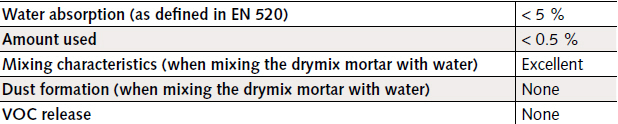
Manufacturers of gypsum construction materials have been looking for a water repellent that would be suitable for use in drymix processes, would be exceptionally efficient, pose no problems when mixed with water, and would not release any VOCs when used (Table 1). Regarding water repellency, a few manufacturers of gypsum construction materials indicated that an ideal additive would reduce water absorption to below 5 percent by weight (after being stored under water for two hours, as described in EN 520). These manufacturers anticipate that absorption below this level would allow them to make universal dry mixes for use in any interior applications.
3 A new solution
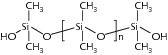
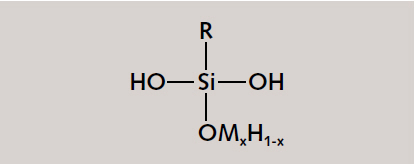
SILRES® BS Powder S circumvents all of the problems that arise with traditional solid gypsum water repellents. This new water repellent consists of the pure active agent itself (Fig. 1, right) and, most importantly, contains no carrier or encapsulation materials, making it highly efficient. The development of this product represents a substantial breakthrough: the active agent is a potassium methyl siliconate (Fig. 3), a colorless, odorless, free-flowing powder produced via a special process that is environmentally friendly and conserves resources. The x variable in the structural formula indicates that the composition of the substance, and therefore its properties, can be adjusted. Potassium methyl siliconates have been used for protecting masonry since the 1950s, serving such purposes as imparting water repellency to the surfaces of heavy clay products or to the materials used in prefabricated gypsum building elements. Up to now, however, alkali alkyl siliconates – as indicated earlier – have only been produced and used in the form of aqueous solutions.
Wacker has now devised a large-scale method for obtaining alkali alkyl siliconates as free-flowing solids. The Munich-based group of companies has developed a variety of drying processes for making powders with different properties. The potassium-silicon ratio has also been adjusted to optimize the balance between stability, reactivity and pH in gypsum-based construction materials.
Because potassium methyl siliconates already contain the silica groups necessary for the inter-action with gypsum, there is no need for a preliminary chemical reaction to generate these groups. The siliconate itself is already in its effective form, which means that, unlike traditional water repellents, the new product eliminates the need for elevating the pH of the material formulation in order to induce alkaline activation. The product also produces no VOCs. The active agent itself is astonishingly hydrophilic and water-soluble, resulting in outstanding mixing behavior. When stirred into water, gypsum drymix mortars modified with this additive mix very quickly without forming any dust.
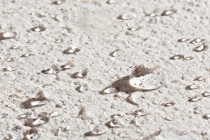
When the calcium sulfate hemihydrate is blended with the mixing water, the water soluble potassium methyl siliconate goes into solution very quickly. While the plaster sets, the siliconate selectively interacts with the growing gypsum crystals, using its hydrophilic silica groups to anchor itself onto the gypsum crystal surfaces. Its hydrophobic methyl groups, however, point away from the crystal surfaces of the calcium sulfate dihydrate being formed. This orientation causes the siliconate to lose its original hydrophilic properties and form a shield that prevents water from penetrating the gypsum crystals in the set material. When applied in this way, the potassium methyl siliconate makes the material hydrophobic throughout, as evidenced by the tendency of water to bead in cracks on plaster objects in which the additive has been used. In other words, the mechanism of action utilizes the balance between the hydrophilic properties of the active agent before it is anchored in place and the hydrophobic properties of the active agent after it has adsorbed to the gypsum crystals.
The interaction between the siliconate and the gypsum is primarily electrostatic in nature, which is an interaction between ions, i.e., charged particles, either with each other or with polar OH- groups. As the gypsum sets, a monomolecular layer of the active agent is formed on the faces of the growing gypsum crystals, making the capillary surfaces within the structure of the construction material hydrophobic, yet without sealing them off. This means that the outstanding permeability of gypsum construction materials to water vapor remains unaffected.
SILRES® BS Powder S is suitable as an additive for an exceptionally wide variety of gypsum-based drymix mortars and can be used at any pH relevant for practical applications. Because this additive is the active agent itself and not a precursor, its properties take effect with no delay, immediately after the plaster material sets – and not after a preliminary reaction time has elapsed.
4 Testing efficacy and efficiency
The efficacy of the new powdered additive was tested as directed in EN 520, using test objects made of many different kinds of gypsum-based drymix mortars. The test objects were prepared as described in EN 196-1, while varying the amount of water repellent used. A formulation with no water repellent (amount used = 0 %) served as a reference for each. The following gypsum drymix mortar formulations were studied: a joint filler (pH 9, water-to-solid factor: 0.50), a hand-applied lime-gypsum plaster (pH 12, water-to-solid factor: 0.67), a machine-applied lime-gypsum plaster (pH 12, water-to-solid factor: 0.60), a machine-applied lime-gypsum plaster with a high content of filler (70 % carbonates, pH 12, water-to-solid factor: 0.35) and a flooring screed (pH 11, water-to-solid factor: 0.17). Traditional solid water repellents were tested for comparison.
The studies began with a comparison between two traditional, commercially available powdered gypsum water repellents. Each of these products was based on a precursor to the active agent – one carrier-based and the other encapsulated. Comparison studies confirmed that high concentrations of the traditional water repellents had to be used and that the additives either worked poorly in many drymix mortar formulations or not at all.
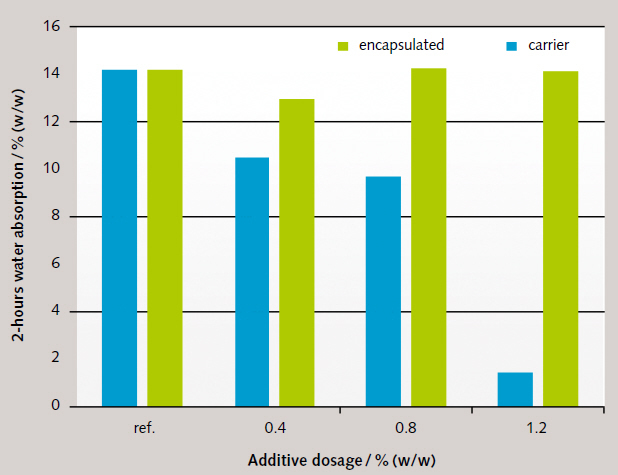
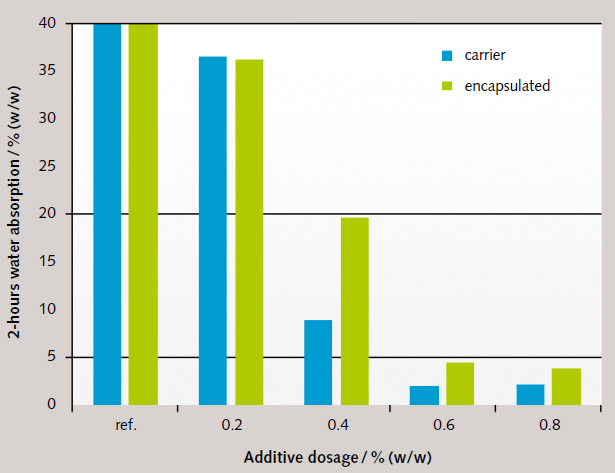
As described earlier and as expected, the pH of the gypsum substrate has a major impact on efficacy. This is because the actual active agent has to be generated in situ via alkaline hydrolysis. As such, the encapsulation system is completely ineffective in a joint filler with a pH of 9 (Fig. 4), as the hydrolysis reaction clearly proceeds too slowly at this pH to release enough silica groups. The poor efficiency of traditional additives is also evidenced in lime-gypsum plasters for manual applications (Fig. 5): despite the high pH of 12, satisfactory results depend on a high concentration of water repellent.
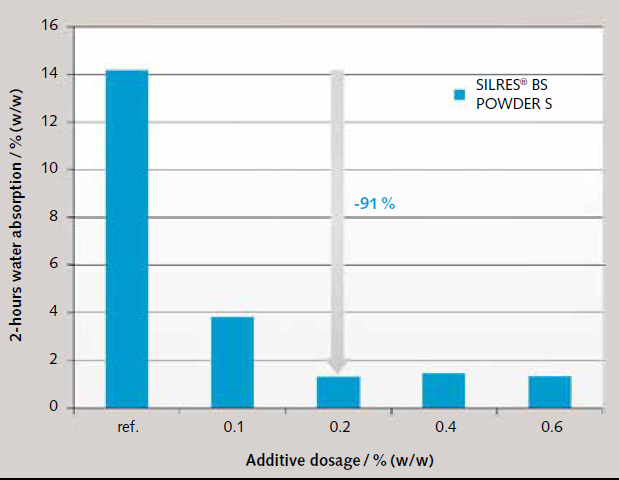
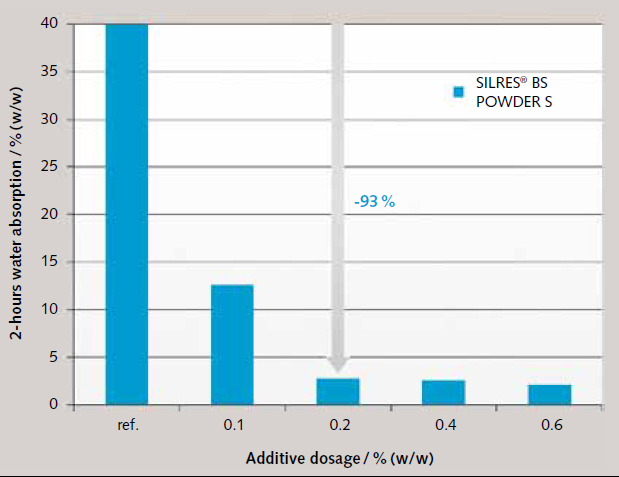
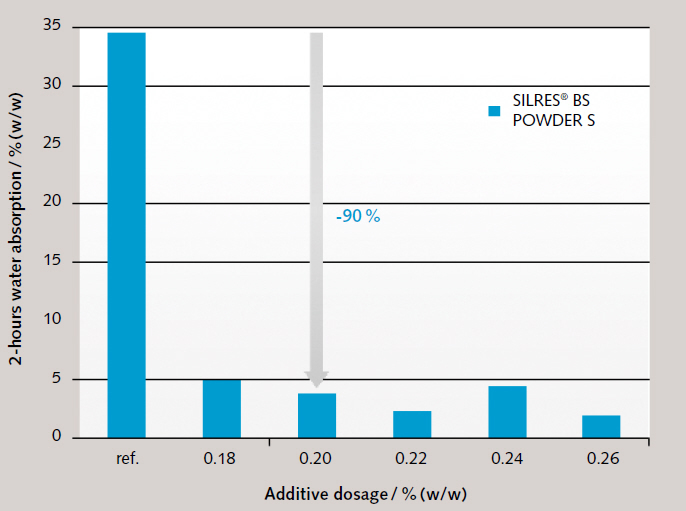
Drymix mortar formulations modified with SILRES® BS Powder S behaved very differently, however (Figs. 6, 7 and 8). The water absorption measured as a function of additive dosage shows that the new water repellent is highly effective and highly efficient – in all gypsum drymix mortar systems and at any pH that typically arises in gypsum-based formulations. Large amounts of filler in the drymix mortar formulation do not increase the values measured for water absorption. As shown in Fig. 6, an additive concentration of just 0.1 % lowers water absorption to below the limit required by the gypsum industry (Tab. 1) for a gypsum joint filler with a pH of 9. When 0.2 % of the new additive is used, the set joint filler absorbs 95 % less water than the reference system after two hours of immersion in water. Increasing the amount used to over 0.2 % does not reduce water absorption any further.
This is also true when organosilicon water repellents are used in other gypsum based construction materials, where a point is likewise reached at which increasing concentration does not further increase the desired hydrophobic effects (Figs. 7 and 8). While this limit depends on the system, it generally lies below 0.3 %. For most gypsum-based drymortar formulations, an additive concentration of around 0.2 % is enough to lower water absorption values to below 5 %. Figures 6 and 8 also show how SILRES® BS Powder S selectively deposits onto the gypsum crystals and not onto the filler granules – otherwise the large surface area of the fillers would, in both cases, require significantly more than 0.2 % to achieve the desired water repellency.
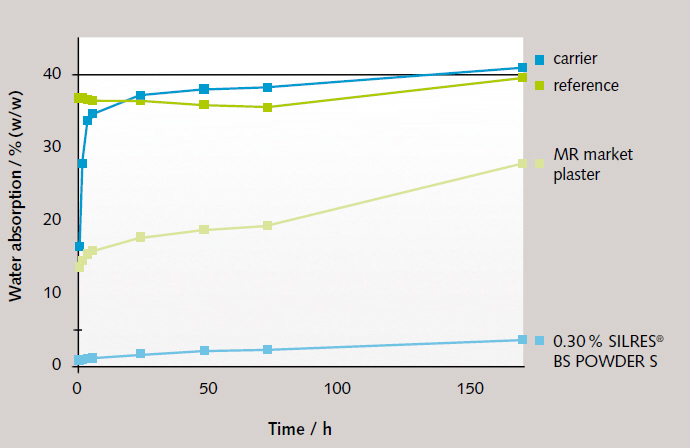
The new water repellent suppresses water penetration so effectively that it can keep water absorption to below 5 % even after seven days of immersion in water – given an appropriate concentration of additive. No other water repellent was able to achieve this, as evidenced by the exemplary study performed on gypsum plaster test objects (Fig. 9). The starting point for this study was a commercially available, untreated lime-gypsum plaster (reference), to which SILRES® BS Powder S had been added at various concentrations. This drymix mortar was also modified using a carrier system. For comparison, the study also included a commercially available water repellent plaster. In other words, unlike traditional solid water repellents, the new additive can be used in gypsum construction materials to keep water absorption very low over long periods of time.
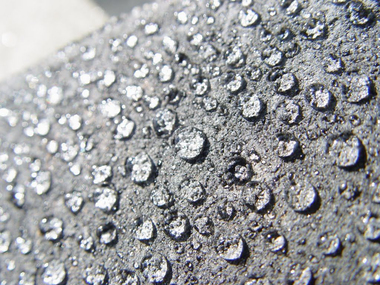
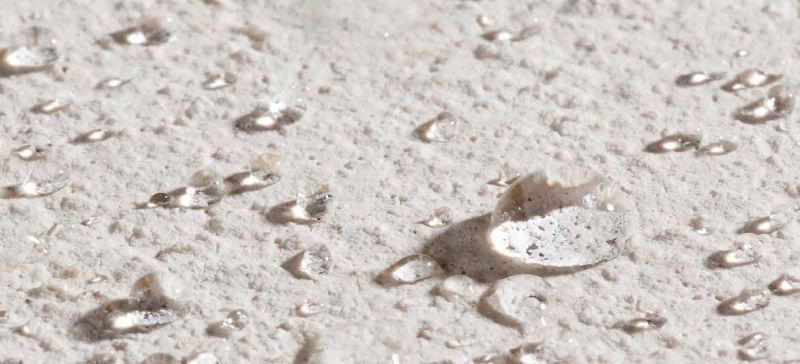
Not only does SILRES® BS Powder S reduce water absorption – it also generally causes significant beading on the surface of the material. When a water droplet is applied, it initially remains on the surface and does not penetrate the gypsum material for several hours. For hand- or machine applied plasters, droplets take roughly 4 hours to soak in when the new additive is used at a concentration of 0.2 % (added in a drymix process).
5 Effects of too much additive
As a highly effective water repellent, SILRES® BS Powder S can produce side effects under certain circumstances. For this reason, tests were performed to establish what properties other than water absorption are affected by the addition of water repellent and to determine the concentrations at which these side-effects occur. The studies revealed that SILRES® BS Powder S can affect the amount of air pores (determined as directed in EN 1015-7) in fresh mortars that have been combined with water. This effect is particularly pronounced in gypsum plasters for machine application, which contain more air entrainers than hand-applied plasters. When the additive is used at a concentration of 0.2 %, for instance, the amount of air pores diminishes slightly, which can be controlled by adjusting the formulation, i.e., by modifying either the concentration or the type of air entrainer.
A sample study showed, however, that if the additive concentration is exceptionally high (0.5 %), the amount of air pores in machine-applied plasters fell by a good 60 % compared to a formulation to which no water repellent had been added. When this happens, the fresh mortar can no longer be processed correctly, as it becomes extremely thick under certain circumstances. In other words, there is therefore no reason to use more of this highly effective water repellent than recommended, and this should also be avoided for processing reasons.
The sample study also showed that the additive affects the mechanical strength of the end products. Tensile, flexural and compressive strength all lie within the same range as the reference value at a relatively low additive concentration of 0.2 %. At higher concentrations, however, the deaeration process described above tends to increase strength in set mortars when compared to set formulations to which no water repellent has been added. While this side effect is positive in and of itself, it can be moderated, if needed, by adjusting the formulation.
When the new additive is used at the correct concentration, and any applicable side effects are offset by adjusting the formulation accordingly, then the fresh mortar can be applied to the substrate and worked as usual – workers do not notice any difference between it and untreated gypsum mortars. This has also been found to be the case for new formulations that manufacturers of gypsum-based construction materials have developed on the basis of SILRES® BS Powder S.
6 Conclusion
Thanks to SILRES® BS Powder S, the gypsum industry now has a highly efficient, powdered water repellent for gypsum-based drymix mortars. Even at very low concentrations, this new water repellent reduces capillary water uptake to such an extent that gypsum construction materials can even be used in damp locations, thereby solving the problem of poor water resistance in gypsum-based plasters, joint fillers, top-coat materials, flooring screeds and adhesives. Hydrophobicity takes effect as soon as the material has set, eliminating the need for alkaline activation. This additive provides the key to developing drymix mortars that are universally suitable for use throughout home interiors. Because there is now no technical reason for limiting the use of gypsum-based mortars to dry locations, manufacturers can now produce all-purpose plasters that can readily be used in home kitchens, bathrooms, stairwells and garages.
Gypsum-based drymix mortars modified with SILRES® BS Powder S could also theoretically be used in damp locations in commercial spaces. The new additive could even conceivably be used for exterior applications in certain regions of the world where the climate is relatively dry and where long periods of driving rain are unlikely – e.g., the Middle East or North Africa – as well regions where gypsum coatings are already used on exteriors.
Gypsum joint fillers and plasters containing SILRES® BS Powder S exhibit the same low water absorption properties over their entire surface areas. This characteristic can also be beneficial in terms of subsequent coats of paint, as it makes it possible to compensate for local differences in paint absorption due, for instance, to differences in the thickness of gypsum layers that arise when joint fillers are used for filling joints. The result is an even coat achieved with less paint. In summary, the new additive offers manufacturers of gypsum-based drymix mortars the opportunity to significantly expand their range of gypsum-based drymix mortars and open up new markets.

Überschrift Bezahlschranke (EN)
tab ZKG KOMBI EN
This is a trial offer for programming testing only. It does not entitle you to a valid subscription and is intended purely for testing purposes. Please do not follow this process.
This is a trial offer for programming testing only. It does not entitle you to a valid subscription and is intended purely for testing purposes. Please do not follow this process.
tab ZKG KOMBI Study test
This is a trial offer for programming testing only. It does not entitle you to a valid subscription and is intended purely for testing purposes. Please do not follow this process.
This is a trial offer for programming testing only. It does not entitle you to a valid subscription and is intended purely for testing purposes. Please do not follow this process.