Quality and innovation
Second International Drymix Mortar Conference idmmc two, Nuremberg/Germany (30.03.2009)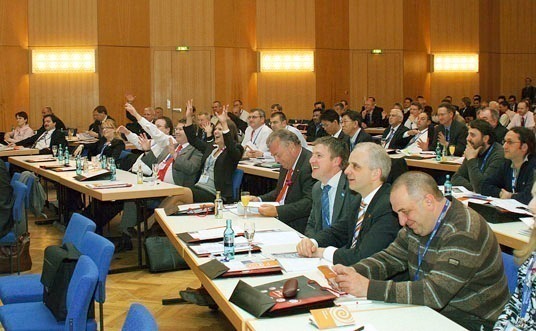
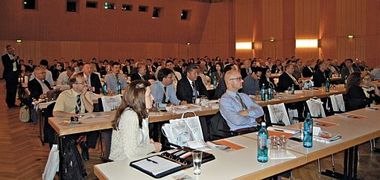
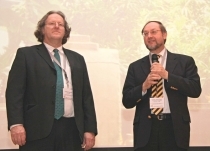
224 participants attended the 2nd International Drymix Mortar Conference idmmc two in the “Kleine Meistersingerhalle” in Nuremberg/Germany (Fig. 1). Ferdinand Leopolder of drymix.info and the Chairman of the Technical Committee Prof. Dr. Johann Plank, TUM, opened the extensive programme of presentations (Figs. 2 and 3).
The first of these was given by Andreas Hecker, DowWolff Cellulosics GmbH, on the subject “CEM III cements in cement-based spray renders”. One of his main points was that CEM III cements possess satisfactory early strengths and a suitable strength development, so that they...
224 participants attended the 2nd International Drymix Mortar Conference idmmc two in the “Kleine Meistersingerhalle” in Nuremberg/Germany (Fig. 1). Ferdinand Leopolder of drymix.info and the Chairman of the Technical Committee Prof. Dr. Johann Plank, TUM, opened the extensive programme of presentations (Figs. 2 and 3).
The first of these was given by Andreas Hecker, DowWolff Cellulosics GmbH, on the subject “CEM III cements in cement-based spray renders”. One of his main points was that CEM III cements possess satisfactory early strengths and a suitable strength development, so that they represent a good alternative to CEM I. Next, Dr. Bogdan Mororaru of BASF presented a paper concerning the “Interaction of polymer dispersions and redispersible powders and inorganic binders in waterproofing membranes”, in which he spoke particularly about the effect of crosslinking during polymerization. Dr. Jacek Michalak of Atlas sp.z.o.o. then covered present trends and developments in the Polish cement industry. He stated that of approximately half a million tonnes of tile adhesive in Poland, 250 000 t fail to conform with quality standards (e. g. C1/C2). The reason for this is that the price is still the decisive criterion. In the case of grouts the situation is different. He also stated that ETICS are an important market in Poland. In the next paper, Dr. Jacob Terpstra of Avebe presented “Innovative starch ethers for use in tile adhesives”. Thanks to optimization measures, products have been developed which have improved anti-slip properties as well as open time, and in addition a new product has been launched.
After a break, the presentation by Dr. Rüdiger Oberste-Padberg
of Ardex discussed the performance of cement-based tile adhesives at low temperatures. He made clear that not all the systems advertised as “rapid” are actually suitable for working at low temperatures. The next speaker, Dr. Claus-Jochen Häcker of SE Tylose GmbH, presented the complex effects of cellulose ethers on the mechanical and rheological characteristics of gypsum-based building materials. A new generation of antifoam agents in powder form was the subject of the next paper by Roger Reinartz of Air Products. These combine the advantages of a rapid-action antifoam agent with long-term deaeration at the molecular level. He also presented a new multifunctional and universally applicable wetting agent. After that, Dr. Roger Zurbriggen of Akzo Nobel Functional Chemicals, Div. Elotex AG and Alexander Wetzel, University of Bern, showcased new methods for the characterization of external damage of tiled surfaces. Model calculations employed in combination with experimentation permit precise diagnosis of the failure pattern of tile adhesives, which permits the development of optimization concepts.
Frank Köning of Evonik Goldschmidt GmbH then presented antifoam agents on the basis of organo-modified siloxanes, in which precisely defined properties can be selected by means of specific functional groups. Dr. Stefano Carrá of Mapei followed with a paper on the use of rheological analyses to characterize the effect of cellulose ethers on the flocculation of cement particles. Dr. Loris Amathieu of Kerneos subsequently spoke about innovative calcium aluminates for use in floor screed systems. Chemical additives can be employed in order to reduce some of the mutual reactions, e.g. the sensitivity of a binding agent system to fluctuations in the Portland cement composition or the inherent stability. The presentation by Dr. Ulrike Peter of Hexion dealt with critical parameters affecting the performance of latex-dominated and cement-based blended materials.
Engin Bagda of the Dr.-Robert-Murjahn-Institut, then spoke about standardization activities on the ETICS sector. He emphasized that ETICS can only develop its maximum performance if all its components are of high quality and optimally harmonized. Klaus Bonin of Wacker Chemie AG covered the interesting subject of the transfer of application data from laboratory and construction site scale. By example of the air pore distribution in mortar, he demonstrated how the machine application of mortar can be simulated under laboratory conditions. Among the applications of vacuum setting of mortars in the laboratory is the simulation of structural developments that can also occur during mechanical working. The penultimate paper was an experience report concerning a project that has now been running for two years and has the objective of reducing the dust formation in chemical products. Dr. Steffen Witzleben of Henkel illustrated how appropriate product development leads to a significantly lower dust emission in the case of granulated mortars or mortars treated with suitable additives. The concluding presentation was given by Ludo van Nes of Caltra and dealt with the application of calcium-sulpho-aluminate cements. Manufacturing of these cements from the raw materials bauxite, lime and gypsum has a considerably lower temperature requirement and thus produces a smaller emission of fuel-related CO2. However, the burning process has to be very precisely controlled. Taking an overall view, in industrial practice these cements are more expensive than corresponding conventional binding agent systems by a factor of approx. 5, not least because of the use of bauxite.
Throughout the conference, enthusiastic use was made of the opportunity to ask questions after every presentation. Many questions were concerned with the extent to which newly-developed binding agent systems or additives are compatible with classical materials. The conference was accompanied by an exhibition (Fig. 4), in which Evonik, Wacker, Elotex, Kerneos, Schleibinger, Grace, MIG and BASF presented their products. ZKG INTERNATIONAL also had a stand there. In their concluding words, F. Leopolder and J. Plank thanked all the participating speakers and companies for their indispensable support of the conference. J. Plank also stated three essential future objectives of the drymix mortar industry. The first is a changeover from the use of purely CEM I-based systems to drymix mortar recipes employing CEM II and CEM III. Furthermore, Plank regards the further development of thermal insulation composite systems as urgently necessary, because a major portion of the input thermal energy still escapes unutilized from buildings. Finally, quality standards should be unified and refined; only if the production and working of drymix mortar products is of high quality can the long-term and sustainable employment of these products be assured.
The conference has meanwhile established itself as a central forum of the drymix mortar industry. Parallel to the conference, the Drymix Mortar Yearbook 2009 containing selected conference topics was published and can be ordered via www.drymix.info. It also provides information about further events concerning drymix mortar. The First Indian Drymix Mortar Conference is to take place in Mumbai on 27.11.2009, followed by the First Latin American Drymix Mortar Conference in Sao Paulo on 11.12.2009. The next idmmc will take place in 2011 and will be announced on www.drymix.info in good time.
www.drymix.info

Überschrift Bezahlschranke (EN)
tab ZKG KOMBI EN
This is a trial offer for programming testing only. It does not entitle you to a valid subscription and is intended purely for testing purposes. Please do not follow this process.
This is a trial offer for programming testing only. It does not entitle you to a valid subscription and is intended purely for testing purposes. Please do not follow this process.
tab ZKG KOMBI Study test
This is a trial offer for programming testing only. It does not entitle you to a valid subscription and is intended purely for testing purposes. Please do not follow this process.
This is a trial offer for programming testing only. It does not entitle you to a valid subscription and is intended purely for testing purposes. Please do not follow this process.