Grinding technology – not just for the Russian market
Summary: The attractiveness of the cement business, gaps in the market, high cement prices and the overall tremendous industrial growth that has taken place within Russia are all factors which have, over recent years, led several investors to express a desire to build new cement plants. At the beginning of 2009, Loesche GmbH had already supplied and commissioned more than 450 raw meal mills, including some in the CIS states. Loesche mills can be used to grind almost every cement raw material with a moisture content of up to 25 %. The rated power levels of a cement raw material mill can reach up to 1000 t/h, a rate which ensures a constant supply of raw meal for modern kiln lines with only one mill.
1 Introduction
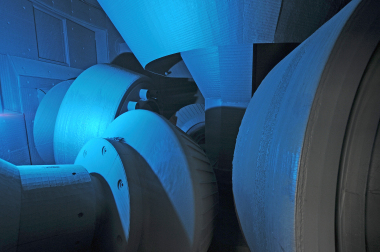
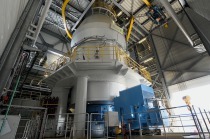
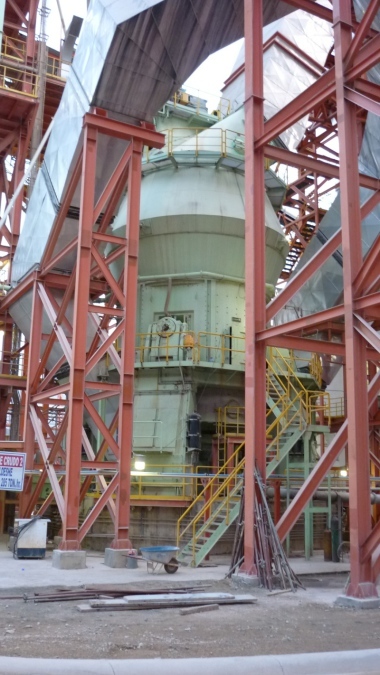
For more than 100 years, the Loesche GmbH has been developing and manufacturing vertical roller mills for grinding cement raw material, coal, clinker, granulated blast furnace slag and other materials (Figs. 1–3). Thanks to its patented expertise gathered over the course of several years in the fields of process technology and mechanical engineering, the Loesche GmbH has had great success in carving out its position at the top of the world’s rankings for mill technology suppliers. The company’s core strengths lie in the planning and project engineering stages of grinding plants,...
1 Introduction
For more than 100 years, the Loesche GmbH has been developing and manufacturing vertical roller mills for grinding cement raw material, coal, clinker, granulated blast furnace slag and other materials (Figs. 1–3). Thanks to its patented expertise gathered over the course of several years in the fields of process technology and mechanical engineering, the Loesche GmbH has had great success in carving out its position at the top of the world’s rankings for mill technology suppliers. The company’s core strengths lie in the planning and project engineering stages of grinding plants, as well as their assembly and commissioning, with its work demonstrating a commitment to strictly observing the production-related requirements of the customer. During recent years, the company has become active both on the Russian market and in other countries within the Commonwealth of Independent States. It was around five years ago that the first Loesche mills were established in the countries of the former USSR, where they have been used with favourable results right up to the present day. Smaller mills with lower throughput rates, which were primarily used for producing
dry construction material mixtures, paved the way for large
raw material, cement and coal mills used in companies in the CIS states.
2 Progress through technology
Loesche mills represent technologically sophisticated products. The output material is ground in the mill between the rotating horizontal grinding table and the conical rollers, which are fixed in place (Fig. 4). The axes of the conical rollers are positioned at a 15 ° angle to the surface of the grinding table, causing the grinding process to be performed as a result of not only the compressive force exerted by the rollers on the layer of material, but also the shearing force. The centrifugal force produced by the rotation of the grinding table transports the ground material outwards. Hot gas, which conveys the ground material upwards towards the classifier, is fed through a louvre ring located between the grinding table and the wall of the mill housing. It is while the ground material is being transported towards the classifier that the final drying and mixing processes take place. Coarse material which has not been ground down to the required product size is separated by the classifier, before being sent back through the grit cone onto the grinding table for regrinding. The finished product is conveyed past the classifier and exits the mill with the process gas flow.
3 Special features and advantages of Loesche mills
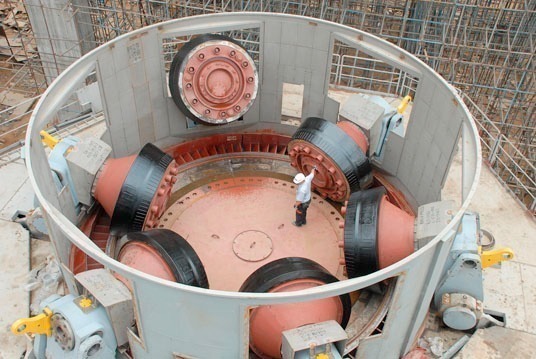
Modularity represents one of the chief structural features offered by Loesche’s mills, and is something which other vertical mills available on the market cannot lay claim to. Because the company’s vertical roller grinding mills are designed in a modular structure, specific mill components that have already been field-proven for years can be used in a variety of applications with various throughput rates. A module consists of a grinding roller, roller rocker arm, pedestal and spring system (Fig. 5). This design allows individual guided grinding rollers without introducing any forces into the mill housing.
Loesche’s introduction of its modular system led to expansion in terms of the range of mill sizes the company could offer, which in turn allowed more flexibility for planning grinding plants whilst maintaining strict adherence to the requirements and conditions set by the customer. This modular construction principle was patented in the 1970’s and is used in both coal mills and mills for the cement industry, facilitating the design of mills with two, three, four or even six grinding rollers, as well as mills with a 2+2 or 3+3 system for grinding clinker or granulated blast furnace slag.
3.1 Cement raw material mills of the Loesche GmbH
At the beginning of 2009, Loesche GmbH had already supplied and commissioned more than 450 raw meal mills, including some in the CIS states. Loesche mills can be used to grind almost every cement raw material with a moisture content of up to 25 %. The rated power levels of a cement raw material mill can reach up to 1000 t/h, a rate which ensures a constant supply of raw meal for modern kiln lines with only one
mill.
In the process of producing cement, the ability of the kiln line to operate without problems hinges on the supply of raw meal. The technique harnessed by Loesche in order to prevent a shutdown of the kiln involves swinging any roller that is faulty or undergoing maintenance work out of the mill’s working area, together with the roller situated opposite it. The openings are closed again, thus enabling the mill to continue operation. The operation of the kiln can be maintained however with a reduced throughput rate. Coupled with several other technical solutions, this method has helped Loesche assert its leading position in the market.
In the meantime, vertical roller mills have demonstrated real success in grinding cement raw material. Grinding the finished cement product in vertical roller mills is another matter entirely, and it may still be some time before a definitive solution is found for this issue – in particular, on the Russian market, where „traditional“ grinding methods using ball mills prevailed for several decades. However, during previous years Loesche has managed to make some achievements in this area too. Up to now, Loesche has supplied more than 140 plants for grinding cement and granulated blast furnace slag, using patented Loesche technology, to locations all over the world. Last year alone, the Loesche GmbH concluded contracts for the supply of six cement mills featuring high throughput rates to different companies in the CIS states, enabling the company to assume a leading role in the market for cement grinding with vertical roller mills.
3.2 Grinding cement and granulated blast furnace slag
A defining feature in the process of grinding cement clinker and granulated blast furnace slag is that the required product size for these materials is significantly higher than that of cement raw material or coal, in combination with a higher hardness of the materials. A considerable drawback of vertical mills which processed clinker or granulated blast furnace slag lay in the increase in vibrations resulting from the varying height of the grinding bed. This was also the reason why it was not possible to optimize the mill and achieve a final product whose quality was comparable with that of ball mill products. Research work primarily set out to develop a method of operating the mill with as little vibration as possible, with the aim of achieving an increased specific pressure for the grinding roller compared with the pressure exerted for the purpose of grinding cement raw material. A high level of specific pressure – which is required for the purpose of grinding clinker and granulated blast furnace slag – can only be used if care is taken to monitor the grinding bed height. To this end, a suggestion was put forward to replace two of the grinding rollers used in Loesche’s original four-roller raw material mill with two support rollers with a smaller diameter – a technique known as the “2+2 system”. Modernizing the six-roller mill by replacing 3 master rollers with support rollers (the “3+3 system”) was the next logical step. The throughput rate of a mill of this kind reaches up to 350 t/h during cement grinding, and up to 250 t/h during granulated blast furnace slag grinding.
Each pair of rollers consists of a smaller support roller (S-roller) and a large master roller (M-roller). The support roller is located on the grinding route, in front of the master roller, and has the task of preparing the grinding bed before it proceeds to the grinding stage. The support roller is constructed in such a way that it carries out rolling motions only, and has absolutely no displacing effect on the sides of the grinding material. Instead, it ensures that the strength of the grinding bed remains constant, thus helping to achieve optimum conditions for the stage at which the grinding material is ground under the master roller. The grinding material is ground directly by the master roller at a high level of pressure. It is possible to vary the height of the support roller above the surface of the grinding route using a hydraulic system.
4 Perspectives
The attractiveness of the cement business, gaps in the market, high cement prices and the overall tremendous industrial growth that has taken place within Russia are all factors which have, over recent years, led several investors to express a desire to build new cement plants. Various sources have put the number of planning projects that have been submitted at 45, although in times of economic crisis, the possibility that a large number of new projects will be aborted cannot be excluded. At the same time, investment circles are seeing the concept of erecting individual cement-grinding terminals which deal with deliveries of clinker and use additives, rather than full cement factories, crop up with increasing frequency. Granulated blast furnace slag is often held to be the additive of highest importance in this area. As a general rule, the construction of grinding terminals for the production of blended cements with added granulated blast furnace slag is set in motion by companies which count work involving iron and steel (in other words, the sources of the granulated blast furnace slag quantities required for grinding) among their activities.
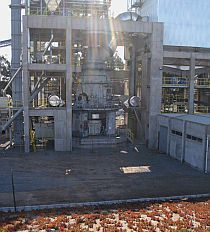
One of the most recent projects to be undertaken by Loesche GmbH in Russia is the construction of a grinding terminal on the site of the Mechel iron works in Chelyabinsk. The terminal consists of two independently operating grinding plants (Fig. 6),
each of which has a Loesche cement mill type LM 53.3+3
as its key component, and is designed for manufacturing
various types of cement, from OPC produced at 190 t/h with 3300 Blaine, right up to CEM III with 65 % added granulated blast furnace slag, produced at 110 t/h with 4800 Blaine for each mill. Loesche’s scope of supply includes the processrelated engineering services and the relevant machines, from the feeding point of the raw material through to the finished product coming off the production line. At the present time, the configuration of this grinding terminal is already fully completed.
The activities of the Loesche GmbH in Russia and other CIS states continue to develop. With the aim of making collaborative work with Loesche easier for our Russian-speaking customers, they employ Russian-speaking employees in all of their key departments, which considerably simplify and accelerate the process of responding all of their customers’ up-to-the-minute queries. At the end of 2008, Loesche GmbH opened the doors of its Russian representative in Moscow/Russia. Already the ninth of the company’s subsidiaries worldwide, this move has enabled Loesche to come one step closer to its customers and partners based in the CIS states.

Überschrift Bezahlschranke (EN)
tab ZKG KOMBI EN
This is a trial offer for programming testing only. It does not entitle you to a valid subscription and is intended purely for testing purposes. Please do not follow this process.
This is a trial offer for programming testing only. It does not entitle you to a valid subscription and is intended purely for testing purposes. Please do not follow this process.
tab ZKG KOMBI Study test
This is a trial offer for programming testing only. It does not entitle you to a valid subscription and is intended purely for testing purposes. Please do not follow this process.
This is a trial offer for programming testing only. It does not entitle you to a valid subscription and is intended purely for testing purposes. Please do not follow this process.