Building materials research in China
In October 2008 the editorial office of ZKG INTERNATIONAL had the opportunity to gather first-hand experience of research and the use of building materials in China. The occasion for this was an invitation from Prof. Hongyi Jiang and Dr. Qinglin Zhao (Fig. 1) of the Wuhan University of Technology to attend a lecture on the subject “Conception and Implementation of Technical Publications”. The invited editor of ZKG INTERNATIONAL was Dr. Thomas Weiß, who – in addition to his experience on the building materials sector within the framework of his activities as a ZKG editorial staff member – can...
In October 2008 the editorial office of ZKG INTERNATIONAL had the opportunity to gather first-hand experience of research and the use of building materials in China. The occasion for this was an invitation from Prof. Hongyi Jiang and Dr. Qinglin Zhao (Fig. 1) of the Wuhan University of Technology to attend a lecture on the subject “Conception and Implementation of Technical Publications”. The invited editor of ZKG INTERNATIONAL was Dr. Thomas Weiß, who – in addition to his experience on the building materials sector within the framework of his activities as a ZKG editorial staff member – can look back on a long background in the field of materials science. As the primary author of scientific publications, book publisher and reviewer for scientific journals he is familiar with many facets of the dissemination of scientific information.
1 Scientific contributions
to international media
The procedure would actually seem quite simple: identify the scientifically or technically interesting aspects and carefully research them, write them up and then make them available to the appropriate journal. However, at Chinese universities there is still a great drive to achieve even better distribution of their own knowledge to an international environment. There is a lack of knowledge, particularly among students and doctoral candidates, regarding how to submit a contribution and what criteria have to be fulfilled in order to achieve a successful publication.
Firstly, the fundamentals were presented. For every publication, no matter whether in ZKG INTERNATIONAL or in one of the other scientific journals, a researchable subject first has to be identified. For publication of the data, the sequence: Introduction, Material and Methods, Results, Discussion and Conclusions has become firmly established. The value of the Acknowledgement paragraph should also not be underestimated, because it presents the opportunity to give credit for the cooperation and assistance without which a modern research project would be impossible.
When the contribution has been written it is submitted for publication to an appropriate journal. Essentially, one differentiates between journals with a review system, in which one or more experts furnish an opinion to the editor, and journals without a review system. In the case of the latter, the editors decide, if necessary aided by an informal assessment from an expert member of an advisory panel (as in the case of ZKG INTERNATIONAL), on the possibility of publication. Unfortunately, the language barrier is still a major hurdle standing between Chinese scientists and a publication. Although ZKG, for instance, revises and adapts contributions together with language experts, many contributions to purely scientific journals come up against a stone wall for this reason alone. Naturally, the reviewers and editors also have to decide on the merits of the contents. Questions which thereby often arise are, for example, whether the contribution contains new information, whether the latest technological status has been suitably taken into account and which fields are affected by the innovations included.
Naturally, the lecture also contained a section in which the possibilities of publication in ZKG were described: from the news, with short bulletins concerning staff changes, company and product information right up to the announcement of events. In the sections “Companies” & “Products”, companies can present their products or announce new information concerning the company. The section “Events” is concerned with reports about recent events and notification of coming events. However, the essential feature of ZKG is the technical contributions. These are divided into articles on the subjects “Process Know-how”, “Materials Science” and “Knowledge” and are well-founded technological and scientific papers relating to a range of topics. This can include anything from new developments in plant technology to new studies of cement chemistry. The programme is rounded off by accurately researched market reports and product reports. Whether a Chinese scientist remains in the research sector or joins a cement manufacturer, there is something for every type of reader.
2 Tour of current projects in the metropolitan area of Wuhan
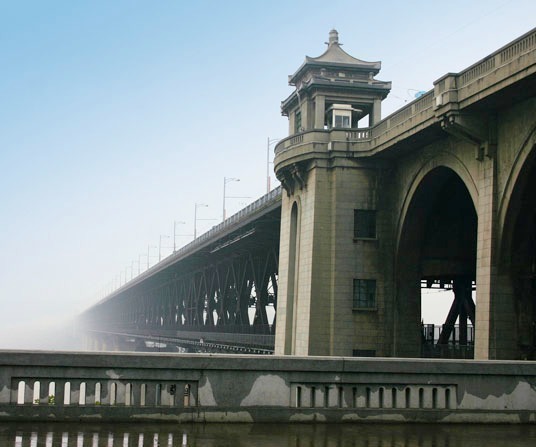
Various projects involving the Wuhan University of Technology are currently nearing completion. For some of these projects, the Wuhan University of Technology created special binding agents tailored to the respective application. Two examples of this - bridges under construction over the Yangtze - were visited: the Edong Changjiang Expressway Bridge (Fig. 2) and the TianxingzhouYangtze River Bridge (Fig. 3). For the first of these the Wuhan University of Technology had developed the formulation for the high-performance concrete not only for the bridge girders but also for the transition between the steel girders and the concrete girders. The bridge has a length of 6203 m and the distance over the Yangtze between two foundations at the main bridge truss is 926 m. Costing over 2.94 billion RMB (around 340 million €) and with a construction period lasting from October 2006 until December 2010, this bridge is a monumental structure. During the bridge construction some of the particular considerations were the prevention of cracking, durability aspects and the application techniques of high-performance concrete for the construction of width prestressed concrete bridge girders. For the transition between the steel girders and the concrete girders it was also essential to prevent cracking in the self-compacting low-shrinkage steel fibre concrete.
For the second bridge, the Wuhan University of Technology had developed the formulation for the high-performance concrete for a part of the bridge girder (Fig. 4) and was also responsible for the quality control of various raw materials and the quantity determination to take account of the temperature change of the bulk concrete. This bridge is classified as a primary national project in the tenth five-year plan and was allocated finances amounting to approx. 11.06 billion RMB. The bridge is 4657 m long. In the construction section in Nancha the bridge carries an expressway in the upper part of the structure and a railway in the lower part. In another section in Beihan the expressway and the railway run parallel. In the construction of this second bridge, particular value was placed not only on the high-performance concrete for the bridge girders, but also on the flow characteristics, heat development and setting retardation of the bulk concrete. The loading is calculated at 2 t. For both bridges, comprehensive strength classes C40/50 were applied for the bridge girders and C25/30 for the foundation. The concrete used reflects the fact that fly ash and ground blast furnace slag are becoming more and more popular raw materials for concrete. For example, the C25/30 concrete has a fly ash content of 20–30 %.
3 Insight into China’s building materials industry
Within the framework the excellent organization by Dr. Zhao of the Wuhan University of Technology, it was also possible to visit a cement factory, the “Huaxin Cement Co. Ltd. Huangshi Branch” in Huangshi (Fig. 5), and a dry mortar producer, the “Wuhan Aojie New & High Technology Co. Ltd.” in Wuhan. The Deputy General Director of the Huangshi department, Mr. Yuanzhao Yang (Fig. 6), was kind enough to act as guide in the cement factory. The factory employs equipment from Chinese providers for all sections, e.g. the raw meal grinding system (Fig. 7) and the kiln system (Fig. 8). Its main products are different types of cement, e. g. ordinary cement including ordinary cement with special properties and special cements with very low heat of hydration, such as “low heat expansive cement”. About 50 % of the products leave the factory in bags and around 50 % as bulk deliveries by railway or lorry. In former times the cement was produced in three wet-process lines at the other end of the lake. The dry process of the Huangshi factory was employed in 1994.
The dry mortar factory was toured in the company of Mr. Zhengqi Zhao (Fig. 9, a member of the Dry Mortar Association and senior engineer of the Building Quality Supervision and Testing Centre of Hubei and also of the Research and Design Institute for the Building Industry of Hubei). The factory made a modern impression. The main product is 120 000 t of special mortar per year for thermal insulation composite systems, tile adhesives and interfacing treating mortar (Fig. 10). However, at present the factory is only running at a capacity utilization of 20 % and thus has considerable capacity reserves, which can be rapidly utilized to cover market needs when demand increases. In a personal conversation with the factory manager, Mr. Minjian Bai it became clear however, that higher sales of factory-produced dry mortars is still impossible because of their somewhat higher prices. With regard to the technical and economic advantages of factory-mixed dry mortars there is a need for market education, i. e. the potential customers have to be made more aware of the long-term benefits. Regarding the potential market for factory-mixed dry mortars in China Mr. Zhengqi Zhao of the Dry Mortar Association stated that “In the whole of China there is a demand for over 10 million t, but the demand varies from region to region. The acceptance of factory-mixed dry mortars could be essentially influenced by better information about its advantages and a favourable price development. The technology employed in Chinese dry mortar factories is mainly based on Chinese know-how. As soon as demand and sales increase, European plant providers with efficient systems allowing the manufacturing of high-quality product would naturally also have a chance.”
4 Research opportunities at the Wuhan University of Technology
The university is perfectly equipped. There are apparatuses
for all modern methodical approaches to building materials analysis. For almost all the apparatuses the university has experts who are perfectly acquainted with the method and the equipment. This enables the scientists to concentrate directly on their research projects and results. For this reason the Wuhan University of Technology welcomes collaboration with German universities, institutes or companies, either within the framework of research projects or for the purpose of product development, material testing and project consultation. The joint organization of conferences also offers a good field for cooperation.ZKG INTERNATIONAL interviewed Dr. Zhao (Fig. 11) on the subject of ZKG INTERNATIONAL’s visit in China
ZKG: Dr. Zhao, what is your assessment of the visit made by Dr. Weiß to your university?
Dr. Zhao: The visit by Dr. Weiß to my university was a great success and highly interesting, particularly his lecture. At the Wuhan University of Technology there are about 3000 professors, over 35 900 students, 13 500 diploma and doctorate candidates and 293 foreign students. For this reason, the Wuhan University of Technology also supports the exchange of scientists and students.
Many of them do not yet know how to write a good international scientific article. Thanks to the lecture by Dr. Weiß they have gained an important insight into this subject. But the lecture provided a new window onto the opportunities of international publications not only for students but also for some of our staffs. One indication of this was the large number of questions asked after the lecture. One of the central topics was that a non-native speaker has great difficulty in drafting a text in the English language. For this reason, many questions were concerned with how one can compensate for language deficits. Naturally, Dr. Weiß cannot do anything about the fact that, in addition to the professional preparation of the texts, the author’s language skills are a fundamental prerequisite for successful placing of a contribution. But his lecture provided a very clear and useful picture of the procedure to be followed when submitting publications and of the criteria that have to be fulfilled. In my opinion, the lecture motivated many people to devote themselves to acquiring or improving foreign language skills alongside their professional work.
ZKG: What development potential do you see for China’s building materials industry?
Dr. Zhao: There is a very positive development potential for the building materials industry in China. Everyone knows that China is currently going through a quite rapid development phase. As is typical for a developing nation in the development phase, many sectors have to be expanded and improved, such as the railway system, highway network, river dams and also housing etc. And when building is taking place, it is very good for the building materials industry. The development of the construction market can be divided into two time phases, the development period and the consolidation period. Some of the construction markets in China, such as the cement market, are currently just changing from the development phase to the consolidation phase. Other building materials, such as dry mortar, are still in the development phase. However, the development potential for such building materials industries are already visible. At present, for instance, Ms. Yan Yao, a professor level senior engineer and General Director of
China Building Materials Academy, is a Visiting Professor at our university and is concerned with such subjects.
ZKG: What trends are currently taking place in the building materials sector?
Dr. Zhao: The economic crisis is currently also affecting China’s economy. This also applies to the building materials sector. To illustrate this, I can give you figures for the dry mortar factories and companies in Wuhan. In 2007 there were over 130 registered dry mortar factories and companies. At the beginning of 2009 this had declined to the present figure of only 62. Some dry mortar factories are nominally in operation but are only manufacturing the product in response to actual demand. But this situation also provides a chance for the future. Those companies who maintain a capability will be able to improve their previous position when demand rises again. Moreover, the Chinese government announced some very good news for the building materials sector in November 2008: The state intends to invest RMB 4000 billion in energy, transportation, social services and infrastructure. The building materials industry regulates itself. Regulations for commercial structures, product types and places of delivery provide good boundary conditions for the building materials industry, enabling it to quickly define a direction of development. This will facilitate the further development of the Chinese building materials sector in a fast, stable and sound manner.
ZKG: Thank you for the interview.

Überschrift Bezahlschranke (EN)
tab ZKG KOMBI EN
This is a trial offer for programming testing only. It does not entitle you to a valid subscription and is intended purely for testing purposes. Please do not follow this process.
This is a trial offer for programming testing only. It does not entitle you to a valid subscription and is intended purely for testing purposes. Please do not follow this process.
tab ZKG KOMBI Study test
This is a trial offer for programming testing only. It does not entitle you to a valid subscription and is intended purely for testing purposes. Please do not follow this process.
This is a trial offer for programming testing only. It does not entitle you to a valid subscription and is intended purely for testing purposes. Please do not follow this process.