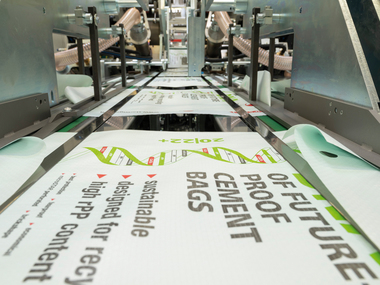
The next generation of cement packing
With increasing global cement production and new players in the market, a ­better packaging solution is required. Block bottom heat-sealed woven PP bags offer a number of advantages over conventional sewn woven PP bags.

India is the second largest cement producer in the world behind China with an estimated forecast of around 315 million metric tones of cement production by the year 2015. Since the time of the cement industry’s inception in 1914, the market has moved from days of scarcity, deterrent statutory controls, and imports. The cement industry of today has come a long way from a seller’s market to a buyer’s market. Packaging and marketing is a challenge which will intensify with upcoming cement capacities and new players. A better packaging solution is the order of the day. We would like to discuss...
India is the second largest cement producer in the world behind China with an estimated forecast of around 315 million metric tones of cement production by the year 2015. Since the time of the cement industry’s inception in 1914, the market has moved from days of scarcity, deterrent statutory controls, and imports. The cement industry of today has come a long way from a seller’s market to a buyer’s market. Packaging and marketing is a challenge which will intensify with upcoming cement capacities and new players. A better packaging solution is the order of the day. We would like to discuss various generations of cement packaging and the forthcoming trends below.


1 Jute bags for cement

From a net production of 85 000 tons in 1918, Indian ­cement production has almost reached a production ­capacity of 300 million tons. Jute bags were one of the first solutions for the packing of cement. The jute production was good enough to sustain the initial demands in the cement sector and the bags also had a good after-use value (Tab. 1).


Uncoated plastic woven stitched bags
The rising demand in the cement industry for a packaging material led to thoughts about plastic as an alternate source. One of the requirements was that the packaging system should offer a weave like jute bags which would allow the air coming in during the filling of cement to pass through and which would also offer the strength and robustness of a jute bag. Looking at the increasing competition in the cement industry in India and worldwide, the bag also had to be cost effective.

Uncoated HDPE bags were first used to pack cement but they could not sustain the temperatures of the cement during packing. Such bags made from PP tapes however offered a very good solution to the cement packaging needs in India. The PP tapes are manufactured on tapelines and then woven into tubular fabric. The tubular fabric produced on circular looms is then separated into individual cutoffs by means of a heated knife or wire, printed and stitched manually to produce the present day woven bags which are seen all around the country.

The PP woven bags offered various advantages like favourable economics, good availability, lower seepage, good moisture barrier, good branding due to a possibility of good graphics and print results, lower packaging weight and lower transportation costs etc.


Heat-sealed cross bottom PP woven bags:
AD proTex bags
Within the last three years Bangladesh has moved to block bottom heat sealed woven PP bags for cement packaging and a similar trend has been observed in several countries in Asia, Africa and South America. The bags offer various advantages compared to the conventional sewn PP woven bags being used in India. This paper will discuss the advantages and manufacturing process for the bags.

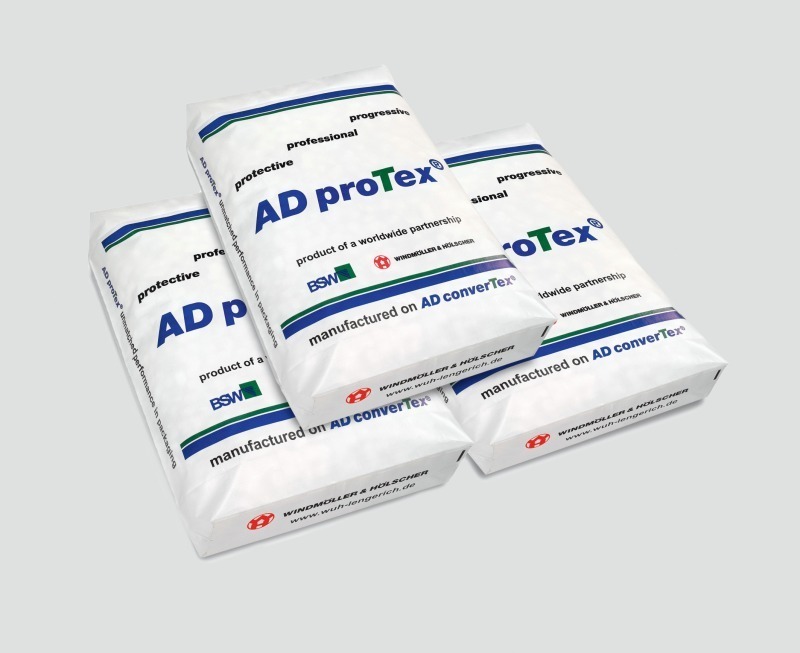
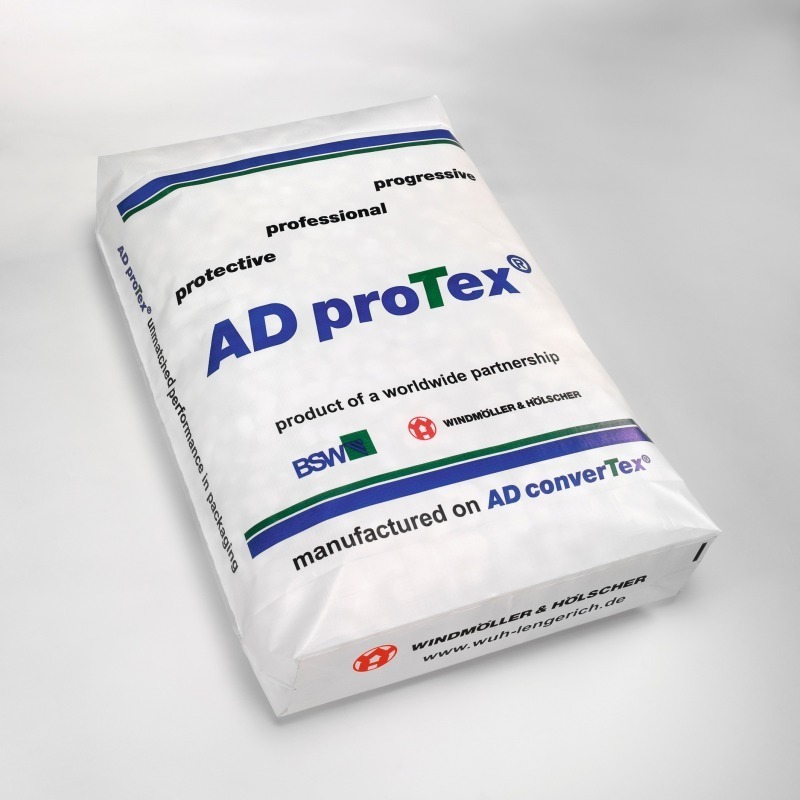
Increasing competition in the cement market, ­attractive export possibilities and increasing demand for automatic filling and palletizing systems support a better and technical superior packaging solution for ­cement in India. The german machine manufacturer Windmöller & Hölscher has introduced the brand name AD proTex for bags produced by this technology. They offer various advantages like better aesthetics, less cement dust development, low loss, low breakage rate, easier transportation etc. which in addition to the above also helps making the cement packer to end user cycle cost effective (Fig. 1).


2 Manufacturing of AD proTex bags

The base material for manufacturing AD proTex bags is the same as that of conventional WPP bags (Tab. 2). However, it is now converted into a material with enhanced qualities by extrusion coating. An extrusion coating line applies molten polymer to the surface of the fabric using a flat die. The circular fabric produced on the looms can be coated on this line on both sides at the same time, using a turner bar system. Flat fabric can be coated on the same line. Both coated tubular and flat fabric is printed on a roll to roll Flexographic printing machine. After this processing step the printed, coated tubular fabric roll is ready for conversion into AD proTex bags on the bottomer. Additionally, the bottomer requires rolls of coated flat woven fabric which are processed on slitter rewinders.


Shape of the sack
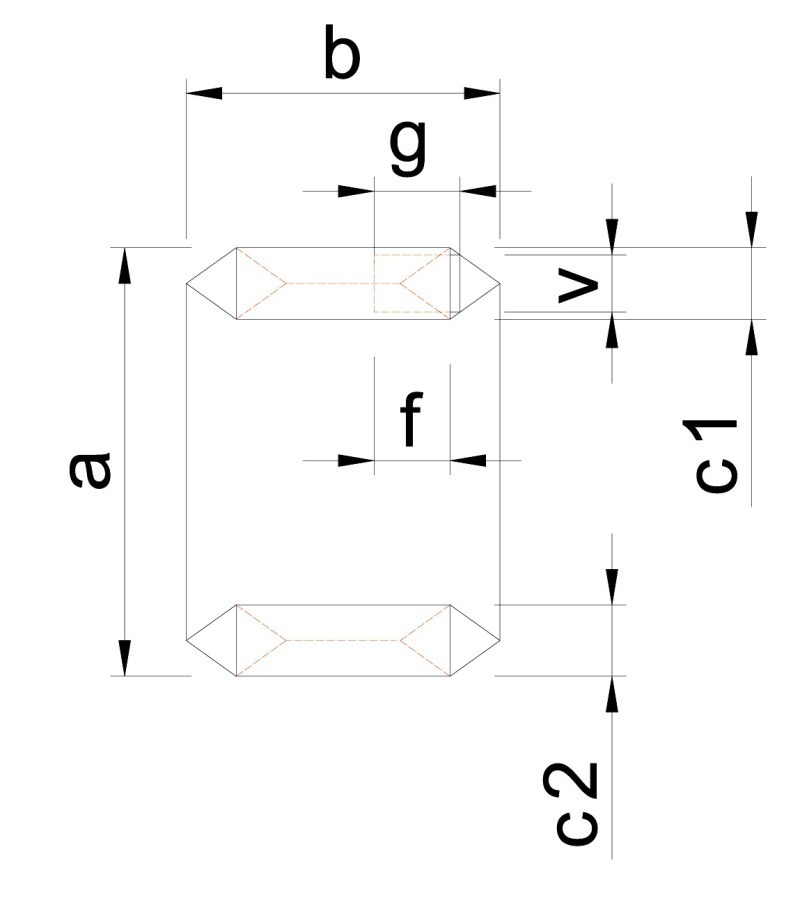
A sack used for cement packaging has to be a flat valve sack with hexagonal shaped ends as shown in Figure 2, the measuring methods are listed in the Box. After filling the sack will feature a box shape.


3 Equipment and various processes

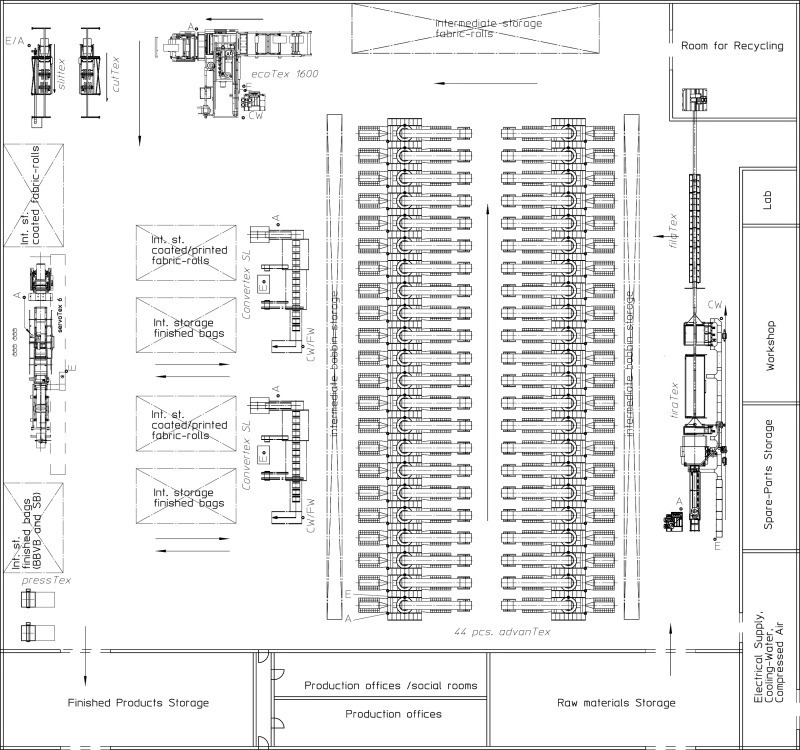
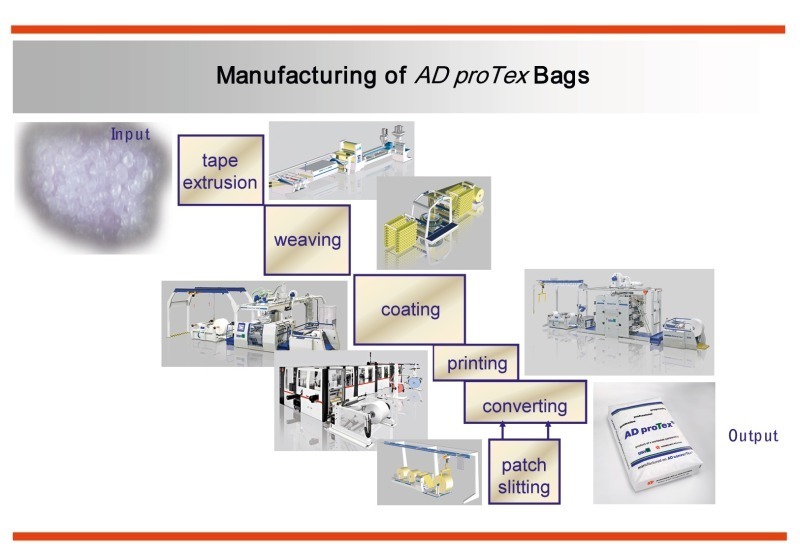
Figure 3 shows various processes involved in the manufacturing of AD proTex bags. A plant to produce AD proTex bags has various stand alone machines which are discussed below.


Tape stretching line
A tape stretching line produces tapes made out of polyolefins (in our case PP) using an extrusion process and a downstream orientation of the macromelecular polymer chains. The objectives of the extrusion system are threefold:

to provide a homogeneous melt at uniform tempera­tures. The melt temperature must be sufficiently high to melt the resin completely without excessively degrading the polymers (degradation describes the break-up of the polymer chains by excessive heat).

to shape the extrudate to the desired form and dimension ( in our case to a film which is eventually slit to produce tapes)

to incorporate other materials like additives, pigments etc.

The extruder of the line is continuously fed with polyolefin resin which it processes into a high quality homogenous melt. This melt passes through a flat die directly into a water quenching bath, which is maintained at a temperature of something between 20–50°C and solidifies to the so-called primary film. After drying the film passes a knife block which slits it into a large number of narrow tapes.

Before stretching, the polymer chains in the tapes are arranged randomly, in no specific order. The subsequent stretching process with a draw ratio of about 1:5.5 elongates the tapes, making them thinner and narrower, and, more importantly, orientates the polymer chains in the longitudinal direction. This orientation is the reason for the high tenacity of the tapes. In order to facilitate the orientation the tapes are heated to softening temperature (precisely: crystalline melting temperature) while passing a hot air oven.

Shortly after leaving the oven, the stretched tapes are reheated by means of heated rollers. This annealing process relieves the internal stress developed during orientation and serves to avoid shrinkage of the tapes resp. the fabric when exposed to elevated temperatures at a later date, for instance during extrusion lamination. After cooling down the tapes by means of chill rollers, the tapes are eventually wound on aluminum winding cores on the tape winders.


Circular weaving loom
The circular loom converts the tapes into tubular fabric (also flat fabric using online cutters on the looms). In general fabric (or cloth) is the result of interlacing two distinct sets of threads at right angles. The longitudinal threads are called the warp, the lateral threads are the weft. In a circular loom, the warp threads are arranged in a circular fashion and the shuttle inserts the weft in a continuous manner while travelling in a reed ring.


Extrusion coating line
The PP fabric for AD proTex bags is extrusion-coated with a PP-based blend of polymers – composed in a way that it melts at a lower temperature than the PP of the fabric. This enables the coating to soften at a lower temperature than the base fabric during the subsequent sack sealing process, thereby excluding any thermal damage to the load-absorbing structure of the bag. The main attention during extrusion coating is paid to achieving a very good bonding strength, as the strength of the joints of the bags depends on it.

The coating process starts with feeding the line with tubular (also flat) fabric rolls produced on the looms.

The melt from the extruder is laid on the PP fabric using a flat die. Using a turner bar system on the machine allows a single flat die to coat the fabric on both sides. The coated fabric is cooled by a chill roll. Using either polished oder tarnished rollers results in shiny or matte finished fabrics.


Flexographic printing machine
The printing of graphics and text on the surface of coated fabric for the production of AD proTex bags is done using the flexographic printing process. Other pro­cesses can be chosen but flexography scores over other processes in terms of flexibility and cost savings. The flexographic printing process utilizes flexible printing plates to transfer printing inks on the printing substrate (coated woven fabric in our case). The anilox rolls pick up the ink from the ink containers and transfer it to the plate cylinders on which the flexographic plates are mounted using adhesive tapes. The plates then transfer the ink to the substrate.


Bag conversion line (bottomer) AD CONVERTEX
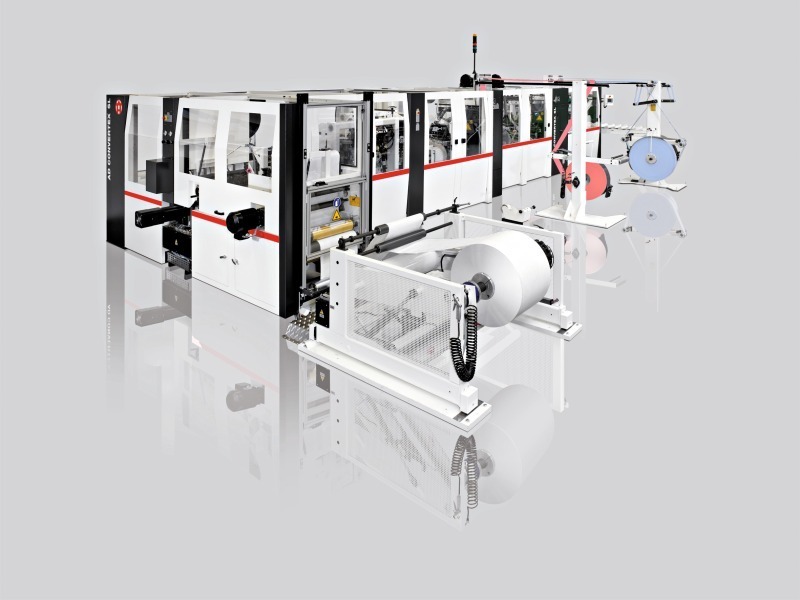
The bag conversion line (Fig. 4) represents the technological centerpiece of the whole plant for producing block bottom heat-sealed woven bags. It is fed with tubular coated and printed woven fabric in roll form. Additionally, narrow rolls of coated fabric for valve and bottom patches are used on the machine as well.

The bottomer uses only air at high temperatures and pressure to create the joints on the bag. The air is directed by nozzles on to the valve-and bottom patches and on to the fabric of the sack body, softening the coating on the surfaces. Immediately afterwards, pressing the sack fabric and patches together creates the joints.

It is of course very important that the AD proTex bags are produced with correct geometry and accurate dimensions. To a large degree, this depends on the quality of the input fabric. The specification of fabric required for the AD proTex bags is shown in Table 3.


4 Advantages of AD proTex bags

The bag offers various advantages to the cement manufacturers and end users, some of which are as mentioned below:

The bag is produced by a hot air sealing process and thus ­requires no stitching or glue for production. Being adhesive free this method is environmentally friendly and makes production simpler and cost effective.

The AD proTex bags are produced with minimum length and width variations, permitting a consistently high filling degree. Lower size tolerances also make the bags more suitable for automatic filling systems and help in easier palletizing.

The bag is designed in such a way that it increases the productivity of the packing machine and minimizes cement dust development during filling. The AD proTex bags feature micro-perforated holes which deaerate the bag during filling while at the same time preventing cement escaping from the bag. The size and the pattern of micro-perforation holes can be easily controlled to optimize the filling rates to control the dust development. Efficient ­micro-perforation also helps in reducing breakage of filled bags during handling

The heat-sealed joints of the bags feature a supreme strength. Once opened to empty the content however, the bags ­cannot be closed again thus making it tamper proof.

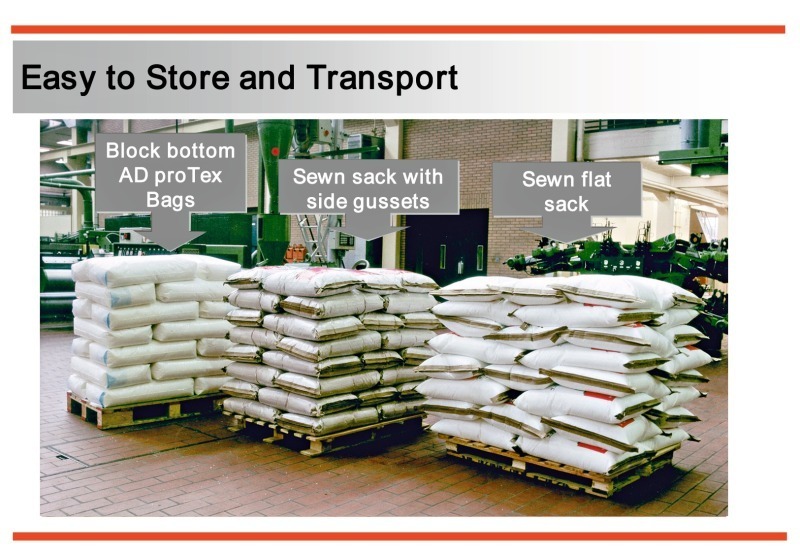
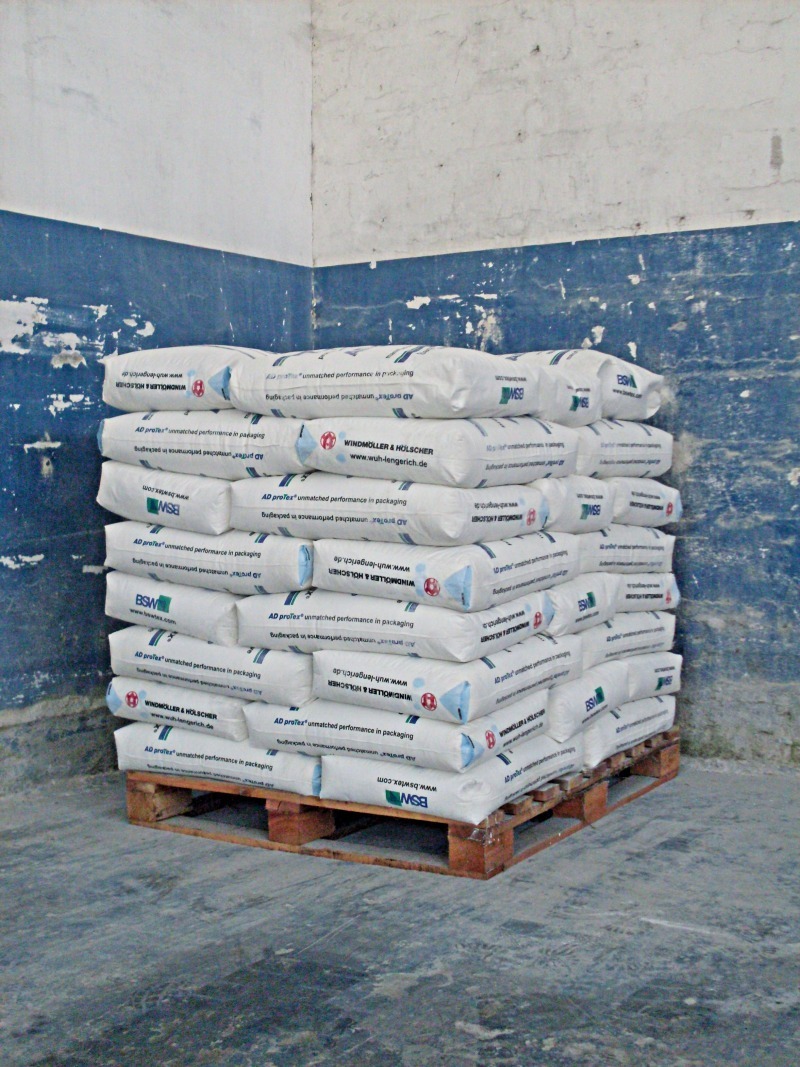
On filling, the bag takes on a box type shape thus ­allowing easy stacking (Fig. 5, 6) and offers more printing surfaces than other bag types. The logo of the manufacturer and other information can be read from the sides when the bags are stacked. This increases visibility for the customers and improves promotional effectiveness.

Coated fabric offers a much flatter surface compared to uncoated material resulting in better print quality. Thus the AD proTex bags allow for superior graphics to be printed with very good quality.

AD proTex bags can be seen as a long term strategic solution for the cement industry. The bag is already being used in the Indian market and is well accepted by the end users. Similar trends have been observed in many other countries around the world and some of India´s neighbouring countries have already almost entirely substituted AD proTex bags for other bags.


5 Project for the production of AD proTex bags

A standard factory project for the production of AD proTex bags is dimensioned for more than 50 million units per year (based on 7200 working hours). There are larger projects, but for practical reasons, such a project will be discussed here.

The required production area is approximately 4500 square meters. Add to this offices, staff rooms, the laboratory and the warehouse, and the total area is approximately 6000 square meters. The design is based on an energy requirement of approximately 1 MW for the entire project, including all supply systems. The compressed air requirement would be 300 m3/h.

Table 4 summarizes the estimated demand for labor to operate a plant with a capacity of 50 million plus bags per year. The number depends on the performance and other variables.

www.wuh-group.com

Überschrift Bezahlschranke (EN)

tab ZKG KOMBI EN

4,99 € / Woche* (Test EN)

This is a trial offer for programming testing only. It does not entitle you to a valid subscription and is intended purely for testing purposes. Please do not follow this process.

This is a trial offer for programming testing only. It does not entitle you to a valid subscription and is intended purely for testing purposes. Please do not follow this process.

Bestellbutton in Angebotsbox (EN)

tab ZKG KOMBI Study test

2,49 € / Woche* (Test EN)

This is a trial offer for programming testing only. It does not entitle you to a valid subscription and is intended purely for testing purposes. Please do not follow this process.

This is a trial offer for programming testing only. It does not entitle you to a valid subscription and is intended purely for testing purposes. Please do not follow this process.

Bestellbutton in Angebotsbox (EN)

Related articles:

Issue 12/2010

Woven*FFS – a symbiosis of raw material, ­packaging material and filling machine

A combination of two successful concepts: the FFS filling concept for bulk commodities and woven tape fabric as a packaging material.On the other, there is woven tape fabric as a packaging material....

more
Issue 7/2022 STARLINGER & CO. GES.M.B.H.

Starlinger unveils the cement bag of the future

Block bottom valve bags made of woven plastic are not only a tear and moisture-resistant packaging for dry bulk goods – they are also becoming an increasingly sustainable packaging alternative in...

more
Issue 06/2025 STARLINGER

K 2025: The power of Circular Packaging

Plastic packaging for a sustainable future: Starlinger presents technical solutions for closed-loop systems in woven plastic packaging. “Plastic packaging is the packaging of the future,” stated...

more
Issue 07/2025 STARLINGER

Closing the loop on woven plastic packaging

Increase sustainability, reduce plastic waste: Companies in almost every industry worldwide face the need to put these two goals into practice. In the area of woven plastic packaging for dry bulk...

more
Issue 11/2019 STARLINGER & CO. GESELLSCHAFT M.B.H.

New sack collection for woven plastic fabric

The new Starlinger sack collection

As a market leader in machinery for woven plastic fabrics, Starlinger has been setting trends for decades with innovative packaging solutions for dry bulk goods. Now customers can choose from an even...

more