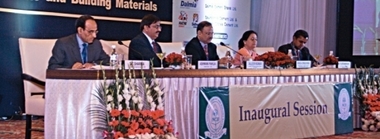
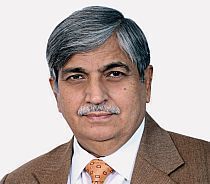
On the occasion of the 12th NCB International Seminar on Cement and Building Materials, successfully held at the end of 2011, Dr. Thomas Weiss, Editor-in-Chief of ZKG INTERNATIONAL, talked with Mr. Ashwani Pahuja, the Director General of the National Council for Cement and Building materials (NCB), India about the needs and development of the Indian cement industry.
ZKG: Mr. Pahuja, what are the current hot topics in the Indian cement industry that were discussed at the NCB meeting?
Ashwani Pahuja: Some of the important topics discussed at the 12th NCB International Seminar were alternative fuels and raw materials (AFR) and appropriate combustion systems, limestone beneficiation technologies, advances in plant and machinery, process optimization, energy management, total quality management (TQM), cements based on alkaline activation of alumo-silicates, Portland limestone cements, utilization of different types of waste materials in cement and concrete, performance, durability and sustainability of concrete systems etc.
ZKG: What is your view about the present situation and future development of the cement industry in India?
Ashwani Pahuja: With an installed capacity of 323.2 million t and production of 228.3 million t during year 2010-11, India is the 2nd largest cement producer in the world after China. The installed capacity has increased at a compound annual growth rate (CAGR) of 8.8 % during 2001–2011 and matched the growth in production which averaged 8.2 %. The turnover of the cement industry was estimated at US$ 25 billion in 2010–11. With a continuous increase in demand and an adequate supply, the industry has a bright future. Keeping in view the demand and installed capacity growth projects, the installed capacity by 2020 would be approximately 600 million t.
On the technological front the Indian cement industry has made tremendous strides in technological upgradation and assimilation of the latest technologies. Presently, about 97 % of the total capacity in the industry is based on modern and environment-friendly dry process technology. Partial decontrol (1982–88) and then total decontrol (1989) have contributed to the growth of the cement sector and adoption of the state-of-the-art technologies. All new capacity to be added in the future is likely to be based on the dry process and even some of the existing units may also change the process to become more competitive.
The Indian cement industry today is by and large comparable to the best in the world in respect of quality standards, fuel and power consumption, environmental norms for new plants, use of the latest technology and capacity.
ZKG: Which measures are taken for sustainability development of the industry?
Ashwani Pahuja: The key elements of sustainable development are “conserve, recycle and renew” i.e., minimum use of natural resources, recycling of wastes and by-product materials and tapping the sources of renewable energy. The efforts of the cement industry in using waste materials like fly ash have been commendable. The initiatives taken by the Indian cement industry towards alternative raw materials were evident from the fact that production of blended cements in the country in the year 2010–11 was as high as 75 % as against only 36 % in 2000–01. There is substantial scope for increasing the utilization of wastes, particularly hazardous and combustible wastes and we are confident that the industry will soon acquire international best practices of waste utilization for sustainable development. The Indian cement industry is also in the process of installing cogeneration plants based on waste heat and about 100 MW of cogeneration capacity has been recently installed. About 90 MW of wind power has also been installed at cement plants in coastal areas.
ZKG: Which new binder systems, alternative fuels and raw materials are currently beeing investigated and developed in India?
Ashwani Pahuja: New binder systems are being investigated to obtain cements which are more sustainable and have an equal or better performance compared to OPC. Binders based on geopolymers, composite cements and cements incorporating nanoparticles are under investigation. The use of hitherto unused materials such as non-metallurgical slags, coal bottom ash, bagasse ash etc in cement and concrete is also being investigated. The results have indicated that with suitable processing these wastes may also become useful materials.
The new binder systems currently under investigation in India are:
Composite cements consisting of OPC clinker and limestone/slag/fly ash and gypsum
Portland-limestone/dolomite cements
Cements consisting of nanoparticles
Geopolymers based on alkali activation of BF slag/fly ash/metakaolin as a source of aluminosilicates
Utilization of industrial wastes such as slag from Pb-Zn & Cu industries, sludges, red mud, SPL wastes from aluminum industries, E-cat from refineries, phosphochalk from fertilizer industries in the manufacture of OPC for reducing the temperature of clinker formation and improving the properties of cement
The Indian cement industry has taken the initiative in utilizing alternative fuels including waste derived fuels along with main fuel coal in cement kilns in the past few years. These include tyre-derived fuel, ETP sludge, paint sludge, scraped plastic, spent wash from the alcohol industry, municipal solid waste depending on availability in the economic region and other logistics. Presently these alternative fuels are being used by the cement industry in small proportions up to 5 % depending on the characteristics and availability. The industry has a long way to go in the substitution of alternative fuels up to 25 to 30 % or more.
ZKG: Are there any commitments or initiatives concerning mitigation of greenhouse gas emissions?
Ashwani Pahuja: The Indian cement industry has been working on various issues of its GHG emissions and has reduced the CO2 emission level from 1.12 t of CO2/t of cement in 1996 to 0.82 t of CO2/t of cement at present. Some of the mitigation measures adopted for reduction of GHG emissions by Indian cement industry are:
Optimization of pyro-processing
Production of blended cements by substitution of clinker by fly ash and blast furnace slag
Use of alternative fuels and raw materials
Improving energy efficiency
Waste heat recovery
Use of renewable energy sources such as wind energy
Carbon sequestration
ZKG: Where do you see the most important and urgent needs for improvement in the future?
Ashwani Pahuja: The cement industry needs to take a number of initiatives for a sustainable development in the future. New innovative technologies, such as low NOx calciners, multi-channel burners, energy efficient coolers, have to be installed for improved environmental and energy efficiency. Highly energy inefficient mills for grinding raw material, coal, cement grinding in some of the older generation plants have to be replaced by energy efficient grinding systems such as the vertical roller mill, roller press and horizontal roller mill. The co-generation of power by utilizing waste hot gases from the pre-heater and cooler must also be a target. Furthermore, the increased utilization of alternative fuels through organized methods of collection, pre-treatment and incentive linked schemes is desirable. Also the processing of fly ash for increased use in cement/concrete is on the agenda, as well as the development and finalization of standards for composite cements. Studies for exploration/identification of new limestone reserves for greenfield cement plants and upgradation of low grade limestone and mines rejects for cement manufacture have to be intensified. Last but not least the increased use of renewable energy sources should be a target for the future.
ZKG: Thank you for the interview.