Laser-based online analysis of minerals
![3 Singled limestone particles on a belt conveyor [RWTH-AMR]](https://www.zkg-online.info/imgs/101526650_602e962d4a.jpg)

Summary: At the Fraunhofer Institute for Laser Technology, a laser method for determination of the composition of minerals was developed that can be used for the fast online analysis of a wide range of raw materials. At a limestone quarry, this method was applied to demonstrate the generation of a deposit model based on online analysis already during drilling. The non-contact multi-element analysis with which a direct sorting criterion can be determined, also facilitates automatic and economic single-particle sorting of rocks and ores. On a demonstration rig, an efficient reduction of the MgO content of limestone production samples could be realized.
To ensure efficient exploitation of natural raw material deposits and their high-quality processing, many deposits, in particular those which are inhomogeneous with a complex structure require both precise mapping of the deposit as well as sorting of the extracted raw materials.The sorting processes used in the processing of minerals separate the material to be sorted based on a sorting criterion, which only indirectly correlates with the chemical composition of the material. For example, ores are separated according to their density or their surface wettability. For sorting that...
To ensure efficient exploitation of natural raw material deposits and their high-quality processing, many deposits, in particular those which are inhomogeneous with a complex structure require both precise mapping of the deposit as well as sorting of the extracted raw materials.The sorting processes used in the processing of minerals separate the material to be sorted based on a sorting criterion, which only indirectly correlates with the chemical composition of the material. For example, ores are separated according to their density or their surface wettability. For sorting that actually separates the material directly according to the required criterion, e.g. value material or impurity content, a characterization of the material, however, is necessary, for which suitable measuring technologies must be available [1]. For the generation of deposit models, generally the chemical composition of samples from exploratory or blast hole drillings is analysed in the laboratory. On account of the considerable time required for these tests and the financial cost, compromises must be accepted with regard to the accuracy of the deposit model. Dynamic adjustment of the drilling pattern for extraction is not possible.
Laser light is predestined for the online measurement of physical and chemical properties, such as, for example, the geometry of objects or their material composition. Laser measurement methods work fast and over distances of several centimetres to metres. The measured object can be analysed directly in a production line, without the need to remove it or otherwise influence the process flow. The capability of online analysis opens up new possibilities for optimized process control, which cannot be realized with conventional methods.
In cooperative projects with industry partners and funding from Germany’s Federal Ministry of Economics and Technology [2], the Fraunhofer-Institute of Laser Technology and the RWTH Aachen University have developed processes that enable laser-based online analysis of minerals. In one project, these methods were applied to plot a deposit model based on the analysis of the drillings. In another project, the technology of laser-based analysis was combined with the technology for single-particle sorting of products. The two process approaches were applied in the first instance for the extraction and processing of limestone and can also be used in many other applications.
For fast element analysis of many materials, laser direct analysis based on emission spectrometry of laser-induced plasmas is suitable [3]. If the beam of a pulsed laser is focussed on a measured object, power densities in the range of GW/cm² are reached locally for short time. These are sufficient to vaporize any material, to dissolve the chemical bonds and heat the material to temperatures above 10 000 °C. In this state, the material emits light in its specific spectral lines, which is analysed with a spectrometer. Such laser-induced plasmas on limestone are shown in Figure 1. The spectrally resolved detection of the emitted line radiation allows the qualitative and quantitative determination of the composition of the object. The purely optical excitation and simultaneous analysis of the spectral lines enable the analysis of metallic and non-conductive material within just a few microseconds. It also enables the analysis of fast-moving objects. Laser-induced breakdown spectroscopy (LIBS) is a method for elemental analysis, which is also described as laser plasma spectroscopy or laser-OES. In contrast to other optical measurement processes such as laser-induced fluorescence (LIF) and infrared spectroscopy (IR/NIR), the element content can be determined independent of the chemical compounds or crystalline structures present. With this method, simultaneous measurement of all elements is possible more than 1000 times per second.
The Fraunhofer ILT has already introduced the LIBS method to different industrial applications, especially for process control. The method has also proved effective for fully automatic measurements [4]. It has, for example, already been used for the analysis of metallic raw materials for material recycling [5] and is available thanks to further development for use in mineral processing. To obtain quantitative analysis results, it is necessary to calibrate the process. For this purpose, rock samples were used from which one part was separated and ground. This part was investigated with the established standard method of X-ray fluorescence analysis (XRF). The values for the rock samples measured with the laser were compared with these values and a calibration function was calculated for the element concentrations to be measured.
The first step in the production of high-quality and constant product grades is the use of starting materials of a high, certified quality. Online analysis during blasting hole drilling allows real-time generation of a deposit model with an impracticable degree of detail so far. This can be used to dynamically adjust the drilling pattern to the needs of the downstream processing steps. Extraction, transport and dumping of accessory rock can be reduced with considerable improvements in efficiency. With precise knowledge of the composition of the blasted material, the material quality required for processing can be adjusted.
At the drilling machine, the cuttings are separated into a coarse and a fine fraction in a cyclone. The dust-like fines with a grain size smaller than 60 µm are fed through a hose into a filter in the machine where the dust is removed on filters.
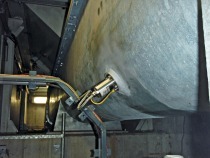
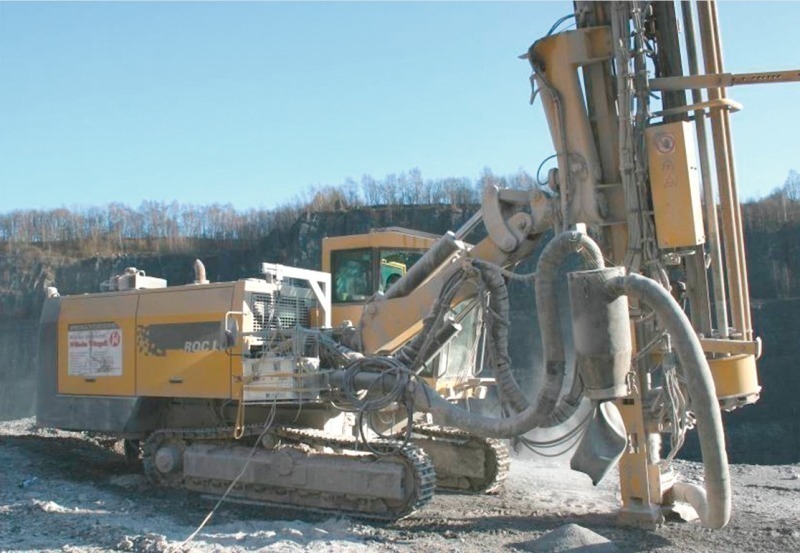
The compact, autonomously operating laser analysis module contains all components to conduct laser analysis and is adapted to the environmental conditions at the quarry. This module is attached directly to the dust hose. The laser beam is focussed through a hole with a diameter of 2 cm in the wall of the hose directly into the stream of dust. A patent-pending device ensures that the optical elements are kept permanently free of dust. A prototype of the module for on-site tests at the quarry is shown ready for measurement at a drilling machine in Figure 2. The analysis results can be combined with data from the drilling machine, for example the drilling depth and position, to generate a deposit model.
Sorting is often necessary to obtain saleable products or to produce higher grade products from the minerals extracted from a deposit. The aim of this sorting is, for example, to concentrate the value content in the product, to reduce the mass flow for downstream processes or to comply with a limit for a product impurity.
A consistent product within the given specifications is to be produced, while the loss in value material minimized. To meet these requirements as effectively as possible, the concept of single particle sorting with full laser analysis of all single particles was pursued.
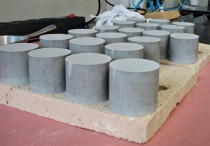
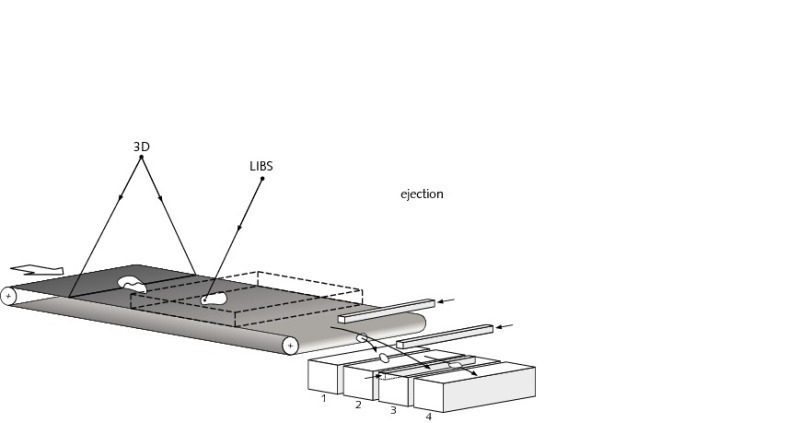
The material to be sorted with a particle size of 50 –150 mm (Fig. 3) is first separated into single particles and then fed onto a belt conveyor with a belt speed of 3 m/s. As shown in Figure 4, the single particles on the belt are identified optically and their position and geometry are determined. Then the laser beam is specifically directed at the single particles for analysis. The results of the analysis are evaluated in fractions of a second and a sorting decision is made for every single particle. Based on the analysis and position information, the compressed air jets in the discharge unit are actuated and controlled in such a way that the individual particles can be separated and discharged in two or more fractions. Thanks to the fast direct analysis, the different stages in the sorting process can be arranged practically seamlessly downstream of each other. The conveying distance from 3D identification to the end of the belt is less than 2 m. To ensure that the individual particles still remain on the belt, a sufficient stabilization zone must also be provided upstream of the sorting unit.
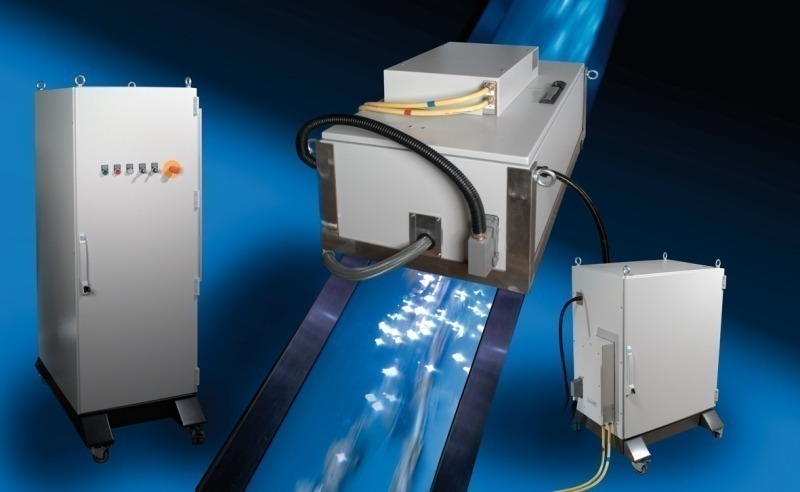
Figure 5 shows the laser analysis unit for single-particle sorting. The laser module is installed above the belt conveyor. Laser, spectrometer and control module are rugged, designed to be suitable for use in industry and for use under surface mine/quarry conditions. With a measurement rate of 15 Hz, for the particle size range from 50 –150 mm, throughput rates of up to 100 t/h can be achieved. Further developments of the components used are intended to permit 100 individual measurements per second so that even with a smaller particle size or irregular loading, economic throughput rates can be achieved.
To demonstrate the feasibility of online analysis of drillings directly at the drilling machine, an on-site test was conducted over several days in a limestone quarry. A total of 18 boreholes, each with a depth of 24 m, were drilled with simultaneous dust analysis. With the analysis, the Mg, Al, Si and Fe contents were determined.
For this on-site test, the analysis module was attached to a drilling machine, which was equipped with a device for representative sampling. After each 2 m of drilling depth, a sample was taken. Each sample was divided with a sample splitter to conduct XRF analyses in two different laboratories and thus validate the results of the laser analysis.
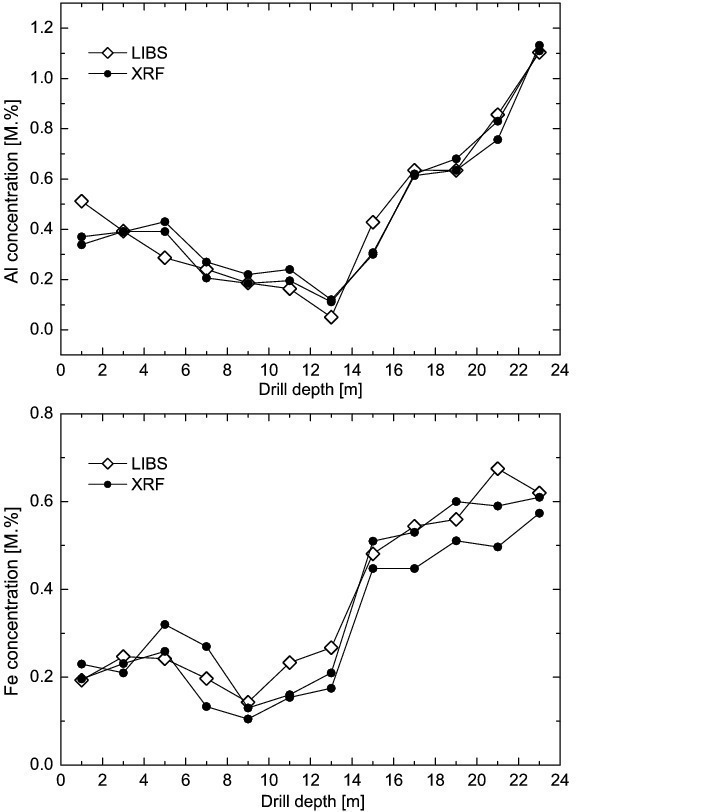
Figure 6 shows by way of example the comparison between the laser analysis results and the results of the two XRF laboratories for the elements aluminium and iron for a single drillhole. The concentrations determined with the laser lie close to the values returned from the two XRF laboratories. This shows that the laser analysis is not inferior to XRF analysis in accuracy and correctness.
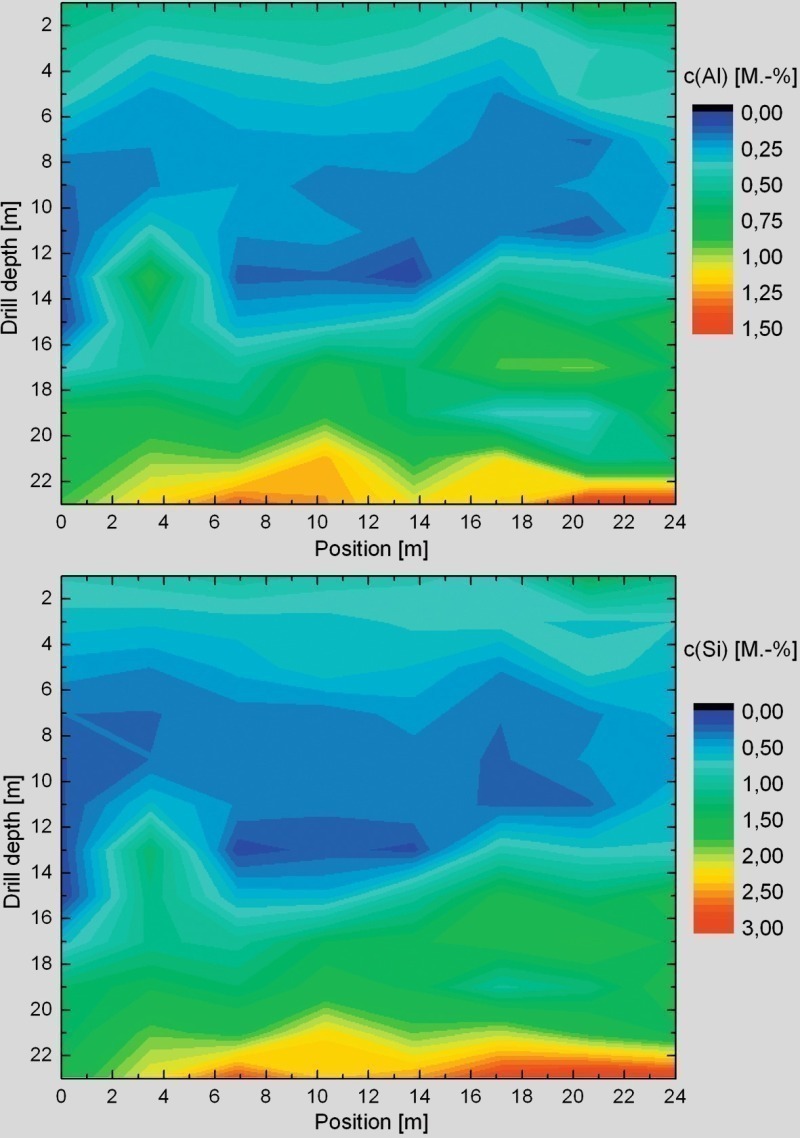
The possibility of fast generation of a detailed deposit model with the help of laser analysis was shown by drilling 12 holes in a 2-m borehole grid. Figure 7 shows as an example the results for Al and Si. The spatial resolution of the model is 2 m. Apart from the cover layer, three layers can be identified. In the depth range 6 –13 m there is a layer with lower content (< 0.2 %) of Al and Si. From 16 m to 20 m depth, the Al content is around 0.75 %, the Si content 1.5 %. Below this, the contents increased substantially up to 1.5 % for Al and 3 % for Si. So laser analysis can be used for the online development of a precise model during blast-hole boring.
The use of laser direct analysis for sorting minerals was initially tested for an application in limestone processing. Of importance here is the magnesium content, so as to differentiate pure limestone from dolomitic rock. In the analysis of production samples, a MgO content in the range from 0 to over 20 % was covered.
A value of 5 % MgO can be taken as a typical maximum value for the usability of the aggregate for cement and steel production. The work presented here is therefore limited to the magnesium content. As in the above examples, in addition other clay minerals and extraneous rocks can also be determined.
For fundamental studies, production samples from several limestone quarries in three different countries were available. A measurement and evaluation method could be developed that can determine the MgO content irrespective of the deposit and differences in the surface properties.
Laser direct analysis provides a local analysis of the sample surface. As in all measurement methods with a low penetration depth into the material (e. g., XRF, LIF, NIR, LIBS), dust sticking to the particle surface can interfere with the analysis. The high-energy laser beam used in this case results in local material removal. This can be used to selectively clean the sample surface prior to analysis. An approach was developed that allows such local cleaning even of moving objects at a belt speed of 3 m/s. With this patented approach, the precision of the laser direct analysis could be improved so that no noticeable disturbances caused by surface dust remained.
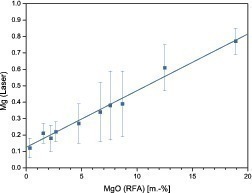
The measurement process was calibrated as described above with production samples whose MgO content had been determined with X-ray fluorescence analysis. Figure 8 shows a calibration curve obtained from static samples. Measurements were taken at 10 measurement points distributed over the surface of the samples, from which the sample for XRF was also taken. The LIBS measurements can be linearly calibrated to the XRF with a correlation coefficient R² of 0.99, which corresponds to a process standard deviation of 0.74 % MgO. The high standard deviation of the individual measurements (error bars in Fig. 8) can be attributed to the inhomogeneity of the samples. For measurements on moving specimens, the process standard deviation rises to around 1.3 % MgO, since here measurements are taken at other automatically selected points of the specimens, which do not represent the same spatial averaging as the XRF analyses. The scattering of the individual measured values is not critical for the characterization of the composition of a material stream, where based on temporal averaging, a conclusion can be made with regard to the mean content. How far localized laser direct analysis is sufficiently representative for effective single particle sorting can only be established in sorting tests under realistic conditions.
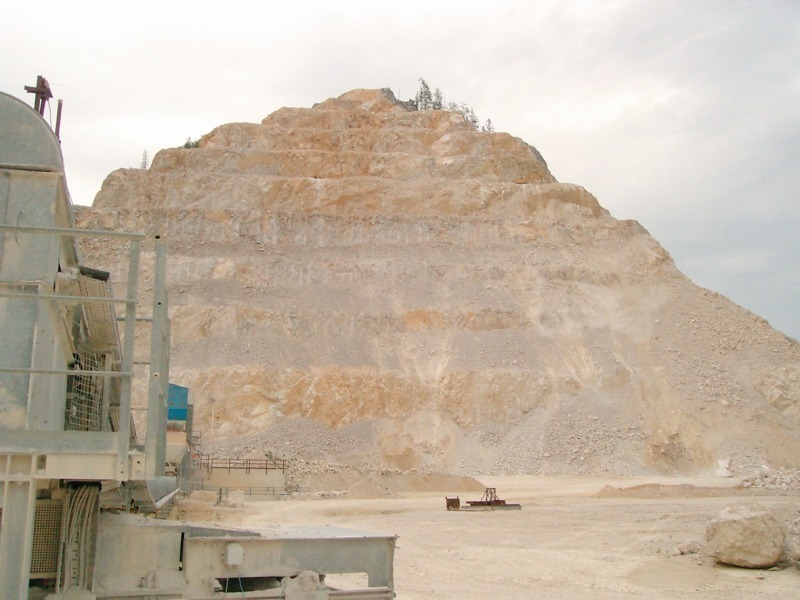
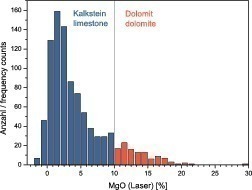
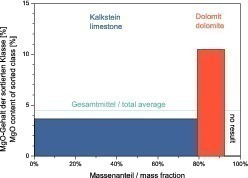
For this purpose, a demonstration rig was set up according to the concept described above, which enables the sorting of production batches in the testing centre. Without further pretreatment, a batch of 435 kg of unknown composition from an Austrian limestone quarry (Fig. 9) was separated into two fractions on the basis of their MgO content; these can be classified as limestone and dolomite. As a threshold value for the classification, in the following example, a MgO content of 10 % was chosen. The sorted fractions were then comminuted as a whole and homogenized so that based on a representative specimen the average composition of the fraction could be determined with XRF. Figure 10 shows the frequency of the measured MgO content of the single particles based on a single LIBS measurement. Most rocks have around 2 % MgO. The distribution soon drops to higher contents, extending to around 20 % MgO. Classification according to the defined limit leads to a classification of 79 % (weight) as limestone and 13 % as dolomite (Fig. 11). A content of 8 % could not be classified, mainly because the stabilization zone was too short, so that the particles did not lie still on the belt conveyor. The XRF measurements resulted in a MgO content of 3.6 % for the limestone and 10.5 % for dolomite compared to 4.5 % for the entire batch. If the unclassified content is included in the limestone fraction instead of the return flow, the MgO content does not change significantly. The averaged analysis results of a test of 1000 single particles show that the laser measurements deviate by less than 0.3 % from the XRF analysis.
Summing up, it can be said that with production-oriented conditions (3 m/s belt speed, untreated production samples), effective single particle sorting based on laser direct analysis was achieved. With a discharge of only a good eighth of the material, the MgO content of the useful rock could be lowered significantly by one fifth from 4.5 % to 3.6 %.
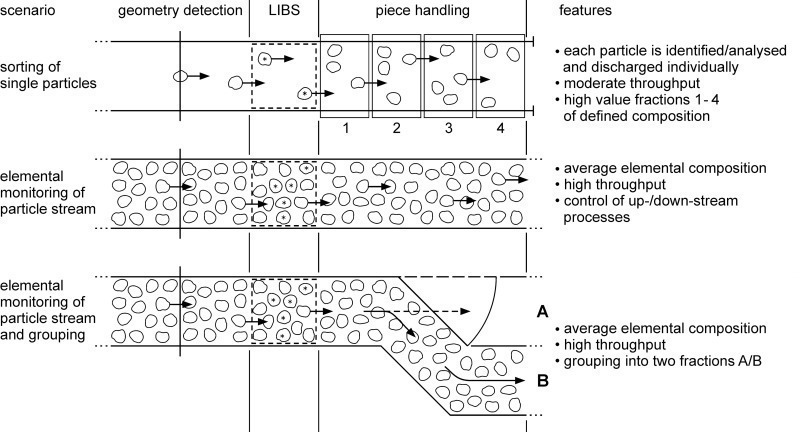
With laser direct analysis, the material composition of the extracted raw material is determined online in real time. This facilitates a large number of applications in raw materials extraction and processing, of which two applications for the limestone industry are presented as examples. For processing, in combination with processes for singling, detection and discharge of particles, an efficiently operating sorting system was realized, In raw materials processing, online analysis, however, can be used in different configurations. Figure 12 shows the different approaches. Besides the previously described single particle sorting, both straight characterization of the material stream, where based well as grouping of the stream on the basis of temporally averaged analysis results are possible.
In single particle sorting, laser analysis can also be used, in addition to a sorting decision for individual particles, for monitoring the average composition of the fractions obtained. Thanks to a continuous automatic determination of the decisions criteria for the sorting, a raw material stream with a constant composition and high yield can be obtained. Thanks to the production of particularly high-grade products and a low loss of value material, a significant value increase in mineral processing and therefore economic use of the system is possible after only a short time of use. As the measurement method does not entail any intervention in the process flow and does not use any ionizing radiation, it can be easily integrated in existing plants.
With the help of the new sorting method, problems can be resolved for which there has so far been no efficiently functioning process. As a result, previously unexploited deposits, but also previously unworkable parts of deposits already being mined or quarried can be considered for exploitation.
By an adaption of the spectroscopic measurement method, laser direct analysis can be adapted to meet different requirements. Thanks to this flexibility of the process, it is not only suitable for limestone processing, but also for processing a wide range of other ores and industrial minerals. As this process is a dry processing method, it is also suitable for use in areas in which water is not or is insufficiently available as a process medium. Accordingly, sorting applications can be realized in (semi-)arid regions as well as regions with permafrost soil [6].
Besides mineral processing, the direct material extraction process represents a wide range of application for the analysis method on account of its extreme versatility. Not only its use with blast hole boring machines in limestone described here is one potential application, models for the integration of LIBS systems in disk shearers in coal mining have already been more closely investigated. Here analysis can contribute to the differentiation between coal and accessory rock.
The range of application of the system will in future be extended to other segments with similarly rough environmental conditions. The integration of the measurement system in mining equipment such as the Surface Miner permits real-time analysis of the useful mineral content during extraction and facilitates the combination of high product quality and optimized deposit utilization. Laboratory tests for determination of other mineral raw materials, including copper ore, iron ore, bauxite and potassium salts, have already been successfully carried out. The multi-element analysis of the laser process ensures that the analysis module can be adapted to other minerals by changing the evaluation algorithms.

Überschrift Bezahlschranke (EN)
tab ZKG KOMBI EN
This is a trial offer for programming testing only. It does not entitle you to a valid subscription and is intended purely for testing purposes. Please do not follow this process.
This is a trial offer for programming testing only. It does not entitle you to a valid subscription and is intended purely for testing purposes. Please do not follow this process.
tab ZKG KOMBI Study test
This is a trial offer for programming testing only. It does not entitle you to a valid subscription and is intended purely for testing purposes. Please do not follow this process.
This is a trial offer for programming testing only. It does not entitle you to a valid subscription and is intended purely for testing purposes. Please do not follow this process.