XAR® in crushers and mills
Crushers and mills are used to comminute materials like rocks, deposits, and minerals, but also coal, waste or scrap. During comminution they are subject to wear and abrasion (from Latin abrasio “scraping down”). The material used to build the crushers or mills therefore has an important influence on the durability and operating reliability of the machines.
With their high hardness, XAR® (eXtra Abrasion Resistant) steels from ThyssenKrupp Steel Europe, one of the worldwide leading flat steel manufacturers, provide outstanding protection against the forces and wear conditions generated during...
Crushers and mills are used to comminute materials like rocks, deposits, and minerals, but also coal, waste or scrap. During comminution they are subject to wear and abrasion (from Latin abrasio “scraping down”). The material used to build the crushers or mills therefore has an important influence on the durability and operating reliability of the machines.
With their high hardness, XAR® (eXtra Abrasion Resistant) steels from ThyssenKrupp Steel Europe, one of the worldwide leading flat steel manufacturers, provide outstanding protection against the forces and wear conditions generated during the comminution process in crushers and mills. The wear-resistant XAR® special structural steels are produced at the Business Unit Heavy Plate in Duisburg-Hüttenheim, which is part of Thyssen-Krupp’s Business Area Steel Europe. Thanks to the continuous further development of the steels, today the product portfolio comprises plate thicknesses between 3 and 100 mm and Brinell hardnesses from 300 to 600 HB, which they get from their special chemical composition and the quenching and tempering process. Besides crushers and mills, typical applications for XAR® steels include screens, earth-moving machinery, cement plants and agricultural machinery.
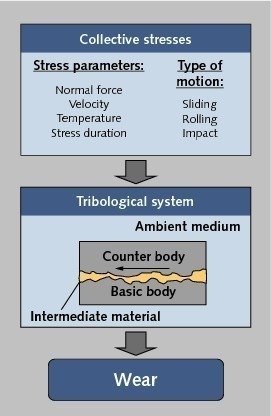
To select the optimum material for a specific wear application, various factors must be taken into account. In a first step, the structure of the tribological system (tribology = Greek tribos “rubbing”), which consists of the four components basic body, counter body, ambient medium and intermediate material (Fig. 1). In crushers and mills the counter body is the material to be comminuted, the ambient medium is, for example, air and the intermediate material can, for example, contain oils and dust. The basic body is the crusher or mill itself. As it is either not possible or difficult to change the counter body, ambient medium and intermediate material in an application, the basic body must therefore be designed so that it can withstand the collective stresses imposed by the other three components as effectively as possible.
These collective stresses consist of the generated forces, velocities, temperatures and stress duration as well as the type of motion between the bodies (e. g. rolling/sliding or impact). The high hardness of a material has a positive effect on its wear resistance when exposed to sliding or rolling contact, while impact stresses necessitate high toughness. In practice the properties of hardness and toughness often run counter to one another, for instance ceramics are very hard and therefore very wear-resistant when exposed to gliding and sliding motion, but its low toughness makes it very brittle, so it tends to break even when subjected to the lowest impact stress. On the other hand, the toughness of rubber or manganese steel provides effective protection against impact, but these materials are worn down very quickly when exposed to a relative sliding motion as they are not hard enough.
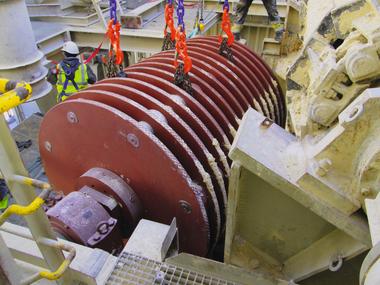
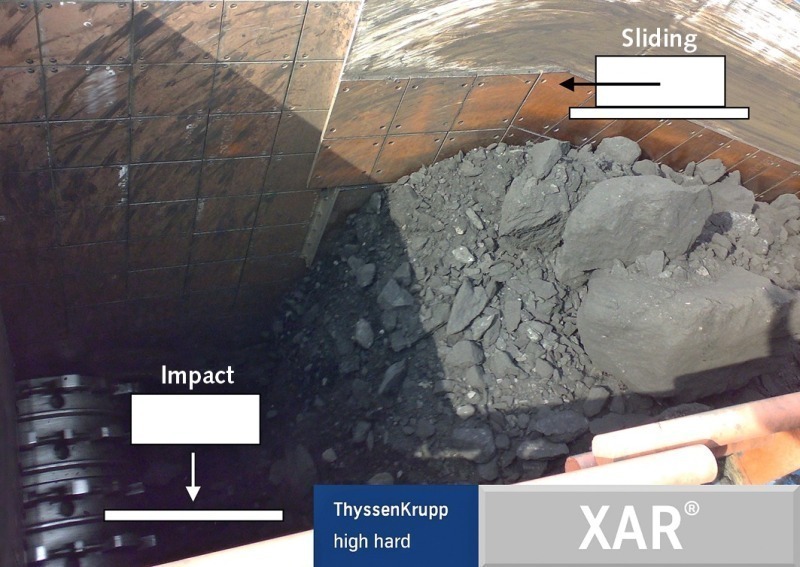
In an analysis of the type of motion between the basic and counter body in crushers and mills (Fig. 2), both rolling/gliding motion as a result of sliding and impact motion on account of particles falling onto the base body are observed. In the selection of the basic body material, it is necessary to ensure that the selected material exhibits effective resistance to forces from impact as well as from sliding motion.
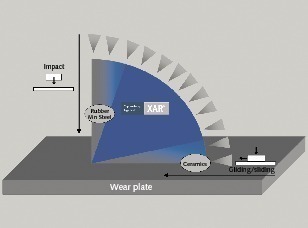
Fig. 3 shows the application spectra of ceramics, rubber, manganese steel and XAR® steels. It is clear that with their outstanding hardness and toughness XAR® steels have a very wide spectrum of applications as they exhibit effective wear resistance to sliding and impact wear. Especially when the two types of wear are combined in their effect, as is the case in almost every application, XAR® wear steels provide optimal protection and considerable advantages compared to alternative materials.
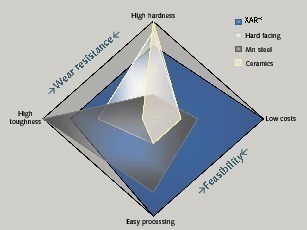
Besides the wear resistance, it is necessary to assess the feasibility of an application in the field. Factors important here are specifically the low costs and easy processing. Figure 4 shows schematically that XAR® steels demonstrate the high hardness and toughness necessary (Fig. 5). In addition, XAR® is much lower in cost and easier to process than alternative materials.
Available for applications with only low or moderate wear stresses is the XAR® 300 grade, which is produced by normalizing rolling without subsequent heat treatment. It therefore offers a very good price-performance ratio combined with an excellent surface quality.
The standard grade for wear applications is XAR® 400 with a hardness of 400 Brinell, with which, compared to conventional structural steel, five times the usual component lifetime can be achieved. XAR® 400 combines high hardness and wearresistance with excellent processing properties. XAR® 400 is superb for cutting, welding, cold forming and machining. The heat-resistant variant XAR® 400 W is also suitable for use at higher temperatures to 400 °C. XAR® 450 exhibits higher wear resistance on the one hand, but its processing properties almost match those of the standard grade XAR® 400. It is expected that XAR® 450 will supersede XAR® 400 as the standard grade in the future.
For particularly severe wear stresses the steel grade XAR® 500 is available. This steel is suitable for forming and welding. For extreme wear stresses, the steel XAR® 600 has been recently developed. On account of its exceptional hardness, cold forming of this steel is not advisable.
Optimized processing and application of the XAR® steels requires close cooperation between supplier and user. For this reason, a comprehensive technical customer service has been set up to provide support on all aspects of processing, design and wear.
ThyssenKrupp Steel Europe backs this up with the free-of-charge application software ProWeld and ProWear (for welding and wear calculations) and an extensive range of brochures.
Operating Group Unit Heavy Plate/
Kontakt Geschäftsfeld Grobblech:
Dipl. Wirt.-Ing. Tobias Gödde;
Tel.: +49 (0)203-5275673; Fax : + 49 (0)203-5275190;
Email: tobias.goedde@thyssenkrupp.com

Überschrift Bezahlschranke (EN)
tab ZKG KOMBI EN
This is a trial offer for programming testing only. It does not entitle you to a valid subscription and is intended purely for testing purposes. Please do not follow this process.
This is a trial offer for programming testing only. It does not entitle you to a valid subscription and is intended purely for testing purposes. Please do not follow this process.
tab ZKG KOMBI Study test
This is a trial offer for programming testing only. It does not entitle you to a valid subscription and is intended purely for testing purposes. Please do not follow this process.
This is a trial offer for programming testing only. It does not entitle you to a valid subscription and is intended purely for testing purposes. Please do not follow this process.